Introduction: Surface modification of metallic implants through a coating method using bioactive and degradable compositions is very useful to improve the osteogenic properties of implants. Furthermore, drug deliverable coating can induce more effective tissue regeneration. Electrophoretic deposition (EPD) is one of the most effective coating methods available, due to its simplicity, uniformity, the short process time and low-temperature process to use in biomedical applications[1]. This study was aimed to produce graphene oxide (GO)-bone morphogenic protein2 (BMP2) complex coatings on Ti for osteogenic surface with sustained drug release. GO has been reported it has high capacity as a delivery carrier for biomolecules as well as supportive material for osteogenic improvement of stem cells[2]. The BMP2 incorporation is considered to enhance the osteo-conductivity. Therefore, it is expected that the GO-BMP2 coating is contributed to improve tissue-compatibility of metallic implants.
Materials and Methods: The GO-BMP2 were deposited on Ti substrate (10 mm ´ 10 mm) through the EPD process. In order to prepare deposit materials, the BMP2 (100 ㎍/ml) was combined with GO (50 ㎍/ml) 10 % ethanol. The coating layers were observed by scanning electron microscopy (SEM, Hitachi S-3000H). The cellular behavior of the composite coating was investigated using mesenchymal stem cells (MSCs), and the result was compared with bare Ti as a control. The BMP2 release was monitored up to 20 days.
Results and Discussion: Figs. 1 show the picture of GO-BMP2 coated Ti plates and the morphology of the composite coating surface generated through the EPD process, respectively.
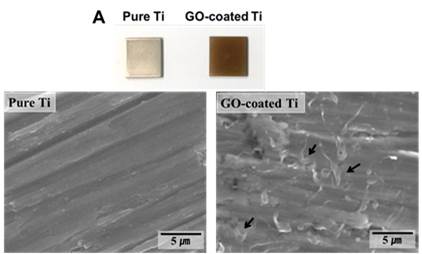
Fig. 1. Picture (A) and SEM images of the surface morphology of the EPD composite coating layer. The GO-BMP2 complex was strongly deposited on the Ti surface. We could obtaine uniform coating [ Fig 1(A)]. However, in detailed view through the SEM, the deposition of GO-BMP2 complex (black arrows) induced the surface morphology change slightly, compared to bare Ti surface.

Fig. 2. Cumulative BMP2 released in PBS.
BMP2 release profiles for 20 days are presented in fig 2. The composite coatings revealed continuous and long-term release patterns of BMP2, and the amount of BMP2 released from the coatings were approximately 65%.

Fig 3. Differentiation levels of MSCs on samples after culturing for 10 days.
The ALP activity was assessed to evaluate the effect of composite coating on the osteogenic properties of metallic implants. The ALP activity of the GO-BMP2 composite coating was improved compared with the bare Ti.
Conclusion: The GO-BMP2 composite coatings were successfully produced via electrophoretic deposition (EPD) technique. The composite coatings showed a thin and uniform surface morphology. The composite coatings continuously released BMP2 for 20 days. The biological property of coatings, particularly ALP activity, was improved compared with that of the bare Ti.
References:
[1] Chen F et al. Mater Sci Eng 2007;27:325-332
[2] Tapas R et al. ACS Nano 2011;5(6):4670-4678