 Benyamin Lichtenstein
- Entrepreneurship Faculty, and Director of the Entrepreneurship Program, University of Massachusetts, Boston, MA, United States
Although this Special Issue calls for a theory of emergence, the present paper argues that the breadth of the phenomenon\a requires a science, within which various theories can be explored and tested. To identify a structure for such a science of emergence, I pursued an in-depth cross-disciplinary analysis of emergence and its emergents. The result was identifying 9 emergence Prototypes, each of which reflects a unique aspect or context of emergence. Further, within some Prototypes, decades of scientific research has led to one or more Principles that its scholars ascribe to. Finally, the potential of an emergence science is explored by introducing applications of emergence to Leadership, Entrepreneurship, and Sustainability.
1 Introduction
This Special Issue aims to clarify “the theory of emergence,” across it’s many forms and definitions. This is no small task, for emergence--as a construct and a phenomenon--has long been examined and explained across all of the sciences: in physics (Prigogine et al., 1972; Haken, 1985; Nicolis, 1989), chemistry (Luisi, 2002; Sieroka et al., 2024), biology (Margulis, 1967; Csanyi and Kampis, 1985; Reid, 2007), evolutionary theory (Bergson, 1911; Morgan, 1923; Wicken, 1979; Weber et al., 1989), philosophy (Pepper, 1926; Klee, 1984; Humphreys, 1997; Sawyer, 2004; Gillett, 2016; Humphreys, 2016; Wilson, 2021), as well as psychology (Ashby, 1947; Weick, 1979), sociology (Durkheim 1898, Berger and Luckmann, 1967; Walker et al., 2006; French et al., 2022), organization science (Katz and Gartner, 1988; Anderson et al., 1999; Levinthal and Warglien, 1999; Chiles et al., 2004; Garud et al., 2006; Fulmer and Ostroff, 2015), and entrepreneurship (Fuller and Moran, 2001; Lichtenstein, 2002; McKelvey, 2004; Gartner and Brush, 2007; Roundy et al., 2018). Scholars in additional fields not listed also have much to contribute.
The challenge is that each of those disciplines examines emergence through it’s own nomological net (Kuhn, 1970), i.e., through models and parameters that are developed by that particular science. For example, thermodynamics models emergence in terms of energy flows, with the emergent outcome being a tangible “dissipative structure” within the closed system. A very different frame comes from the science of aerodynamics, which explains the emergence of the V-shape formation of geese flying. Specifically, that formation dramatically increases the aerodynamic capacity of the entire flock, allowing each bird to fly faster, thus enabling the flock to go much farther each day (Hainsworth, 1986; Cutts and Speakman, 1994). Both are exemplars of emergence, but the nomological differences make them seem to be totally different.
Separately, any given discipline may have more than one theory of emergence. For example, in physics, Dissipative Structures theory has long been explored through thermodynamics (Prigogine, 1955; Prigogine and Glansdorff, 1971; Nicolis, 1989). At the same time, the physics of light were explored by (Haken, 1985; Haken, 2008), who was able to extrapolate and pursue the “self-organization” of light, i.e., laser light. Although both scholars use the term “self-organization” their meanings are substantively different.
More theories of emergence can be found in other natural science disciplines, especially biology (Csanyi and Kampis, 1985; Reid, 2007). Likewise, exploring emergence in social systems has generated new theories of emergence in leadership (Uhl-Bien et al., 2007; Lichtenstein and Plowman, 2009; Lanaj and Hollenbeck, 2015), teams (Katz, 1993; Sawyer, 2001; Arrow and Burns, 2004; Kozlowski and Chao, 2012), innovations (Cheng and Van de Ven, 1996; Garud et al., 2006; Dougherty and Dunne, 2011; Garud et al., 2015; Inigo and Albareda, 2016), and new enterprises (Brush and Vanderwerf, 1992; Lichtenstein et al., 2006; Lichtenstein et al., 2007; Goldstein et al., 2010a; Nair et al., 2019); to name a few. The result is a plethora of emergence theories, leading to the presenting problem expressed in the Special Issues’ Call for Papers: “It will clarify the differences and commonalities of the many diverse and often conflicting conceptualizations of the theory of emergence…”
The present paper provides an alternative approach, reflecting a pluralistic view of emergence (Onnis, 2023), as initially suggested by Humphreys and Bedau (2008). Specifically, consider emergence as a science, rather than a (singular) theory. As a science, emergence can employ many different disciplines, each of which provides a unique context for understanding. Likewise there are often many theories within a science, as there are about emergence. Further, an active science is inherently self-correcting, as new findings and explanations resolve earlier conflicts. Over time, patterns and regularities of emergence have been found within disciplines. By framing this work as a science of emergence, we gain numerous “footholds” for exploring emergence in all of it’s forms.
The paper starts with definitions for emergence, highlighting the complementarity of emergence process and outcomes. Next I propose a series of Prototypes of emergence, as a structure for an emergence science. By focusing on one of these--Generative Emergence--I show the potential of patterns or “laws” within that Prototype. Finally I show how emergence can be applied to several social and human sciences.
2 What is emergence? Defining characteristics
The classic definition of emergence: a “whole that is greater than the sum of it's parts,” is perhaps more accurate than we give it credit. By “whole” the implication is that something new has been formed; “greater than the sum of it’s parts” suggests most of the Characteristics of emergence described below. Still, several emergence scholars have formalized definitions of emergence that more helpful.
For the social sciences, Fulmer and Ostroff (2015) define emergence as: “…a higher-level “whole” that is formed from the individual “parts” in the system. …A new pattern or form emerge[s] as a collective, higher-level phenomenon.” They use the classic language of a whole from it's parts, but describe the emergent whole as a “collective, higher-level phenomenon,” thus acknowledging the influence the emergent has in the system.
A broader definition is from De Wolf and Holvoet (2004), pg. 3): “A system exhibits emergence when there are coherent emergents at the macro-level that dynamically arise from the interactions between the parts at the micro-level. Such emergents are novel with regard to the individual parts of the system.” This definition identifies tangible emergents, which arise through an emerging process of interactions between the parts of the system; he combination of process and outcome is essential. Likewise they characterize emergents as being novel, which reflects numerous Characteristics such as semi-autonomous, unpredictable, and the potential to be agentic.
Consider Goldstein’s (1999) definition, which also incorporates process and outcomes: “[Emergence is] the arising of novel and coherent structures, patterns and properties during the process of self-organization in complex systems.” Goldstein identifies tangible examples of emergent outcomes, as “coherent structures, patterns and properties; ” equally his definition emphasizes both process and outcomes of emergence. Later Goldstein formulated this definition into a unique: emergence is “self-transcending construction.” Thus emergence is a process whereby new structures are ‘constructed’ by the entity’s parts, with outcomes that transcends the parts that make it (Goldstein, 2002; Goldstein, 2003). Overall, Goldstein’s definition is complete and descriptive, yet rather technical. All three definitions are acceptable, due to the vast range of “emergence” and “emergents.”
Another way to define emergence is to focus on it’s Characteristics, i.e., what it is defined by, including unpredictability, non-linearity, and coherence (see Table 1). As one would expect, emergence scholars have identified a small set of defining Characteristics for the phenomena of emergence. For example, De Wolf and Holvoet’s (2004) exhaustive literature review found the six most common characteristics of emergence; (Sawyer, 2004); identified seven structures of emergence, Goldstein (Goldstein, 1999; Goldstein, 2011), presented seven qualities of emergence, while Harper and Endres (2012) discerned six core features of an emergent social system. As shown in Table 1, these combined characteristics are quite correlated, with the most common terms being grouped onto the first column. Note the correlation of terms across scholars in Table 1.
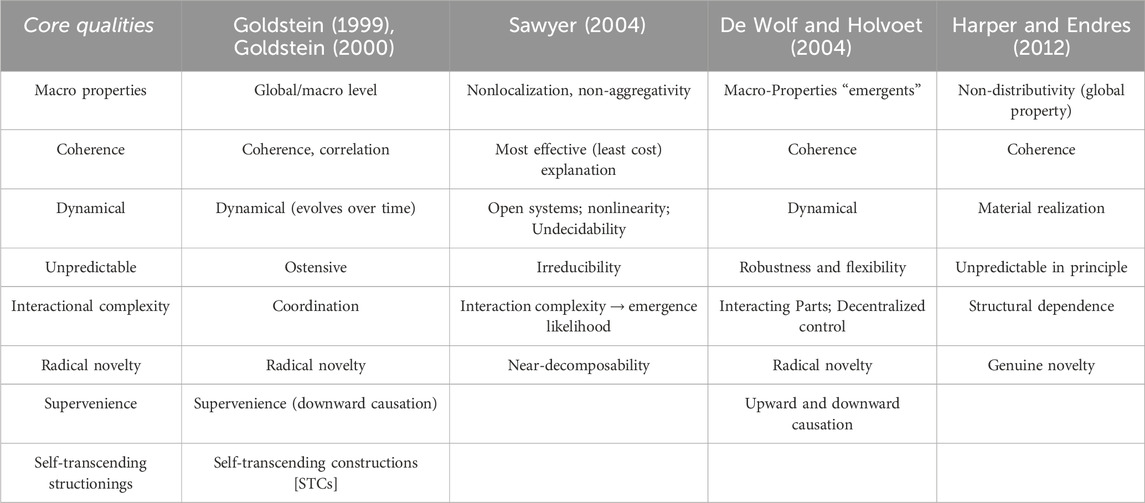
Table 1. Core qualities of emergence.
The first six of these are commonly cited as being minimally necessary for emergence. Specifically: Macro properties are new global structures or qualities that are not found in the system’s micro-level components. Coherence reflects a high degree of order in the emergent system. Dynamical means the ordering may change over time without diminishing it’s function. Unpredictable in principle means irreducible to it’s components. Interaction complexity refers to the fact that emergence is often enacted through the interactions between system agents. Radical Novelty refers to a new level-of-analysis that emerges in the system.
In contrast to the first six Characteristics, the last two are not shared. Supervenience claims that the system’s macro-properties exhibit downward causation on it’s micro-level elements; a common example is how a group’s norms constrain the behaviors of it’s members. However some scientists dismiss supervenience, as it seems to suggest a “mysterious force” with the properties of downward causation, which is not permitted in natural science (Kim, 1984; Kim, 1992; Humphreys, 1997).
The last distinction is Goldstein’s term, Self-transcending construction (Goldstein, 2002). As mentioned above, construction references a tangible emergent with material outcomes in social systems. Goldstein explained Self-transcending, “Emergent order arises out of, yet transcends, lower level and antecedent conditions” (Goldstein, 2007, pg. 73). Further, the outcomes transcend the known capabilities of their components. Likewise, emergence assumes the co-creation of a new “level-of-analysis,” thus emphasizing the importance and influence of the new whole on it’s parts (Goldstein, 2001).
These qualities provide a sound basis for defining emergence, although as before it seems challenging to find a definitive definition. Perhaps the definition depends on how emergence is being expressed, i.e., on the type of emergence we are attending to. Following that logic, the proposed Science of Emergence is structured around Prototypes, i.e., core expressions of emergence, which operate across the natural and social world.
3 Prototypes of Emergence
Consider the ontological phenomena of emergence, i.e., the specific ways that emergence gets expressed in the world. For example, on your way home from a family outing you suddenly get stuck in a traffic jam. But one of your kids suddenly sees a V-shaped flock of geese gliding across the sky. “Look!” says another, pointing to a rainbow overhead, emergent for a glorious moment. Each of these are emergents, but they operate in very different ways. Thus the idea of Prototypes for emergence (Goldstein, 2011). A prototype is a context for understanding a particular type of emergence; each one is developed through the combined studies of emergence scientists in that context. [See Table below]
As an example, the prototype of Biological emergence includes several ontological (tangible) examples, each of which is associated with a theory of emergence. One is symbiogenesis (Margulis, 1967; Margulis, 1971) whereby a group of macromolecules ingests neighboring macromolecules in the cell; these emerge as a mitochondria, which produces 2000% more energy for the cell compared to the original macro-molecules on their own. Another theory of emergence is called autopoiesis, meaning self-producing systems (Maturana and Varela, 1980; Csanyi and Kampis, 1985); it presents the minimum resources and conditions necessary for a self-producing system to emerge. Separately (Reid, 2007, pg. 323) identifies 12 theories of evolutionary emergence through intrinsic factors, as part of a grand theory of evolutionary self-organization developed by Jantsch (1980), Wicken (1980), Wicken (1986), and Laszlo (1987).
Other prototypes are better known, for example, Computational emergence, which includes all the models showing how order can unexpectedly emerge in computational systems. Among these are artificial life (Langton, 1986), complex adaptive systems (Holland, 1992; Holland, 1995; Holland, 2006), cellular automata (Neumann, 1966; Bedau, 1997; Watts and Strogats, 1998), genetic algorithms (Holland, 1992), NK landscapes (Kauffman and Levin, 1987; Bak and Chen, 1991; Axelrod and Bennett, 1993). Virtually all of these are affiliated with the Sante Fe Complexity Institute; to some these are the complexity science.
Organizing the science of emergence into Prototypes allows us to pursue each one in greater depth, thus gaining knowledge about the processes and outcomes of emergence across levels of analysis. Below are Prototypes of Emergence that I propose for a Science of Emergence. Additions, corrections and discussions are welcome.1
To begin, note the sheer range of emergents in the list, from molecular fusion, to the creation of a living cell, the evolution of biological creatures, the generation of organizations, the emergence of an economy (Foster and Metcalfe, 2012; Harper and Endres, 2012), as well as the self-organization of our global economic network (Li and Tesfatsion, 2012; Grodal et al., 2015; Mazzoni et al., 2021). The prototypes (See Table 2) provide a scaffolding for this wide range of emergence phenomena, a structure for organizing our knowledge about emergence. In a science of emergence, each prototype may contain several theories that explain emergence, from their viewpoint. As such there are likely to be many theories of emergence, each of which explains one aspect or facet of emergence. Instead of trying to reduce this to “a” theory, a science invites the full range of emergence to be identified and explored over time.
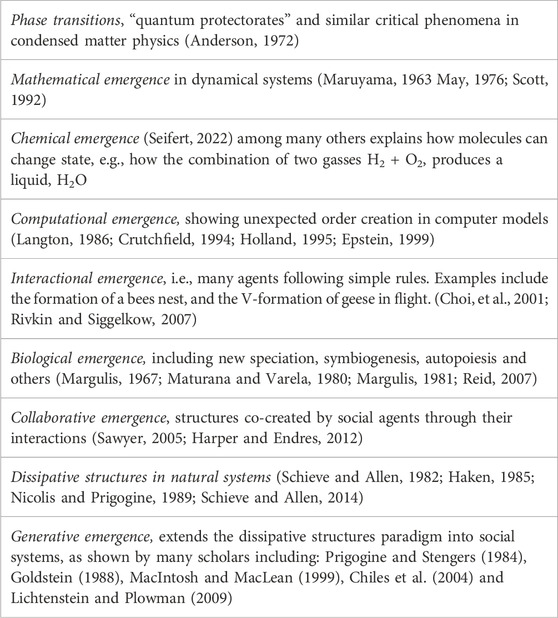
Table 2. Prototypes of emergence.
This suggests an important task for an emergence science is to identify and categorize any patterns within their prototype, such that each prototype is more deeply understood. Then, to use a metaphor, each of these become facets, which allow us to see a specific aspect of emergence. Further like a jewel, emergence can only be seen through (one of) it’s facets. Each facet provides a unique view into emergence; together they expand our insights and overall understanding (Onnis, 2023).
4 Are there laws of emergence?
For some, a science is defined by it’s laws, as Physics was through Newton’s Laws of Motion. If so, what are the “Laws of Emergence?” This point is well taken, and it emphasizes the need for an Emergence Science, so researchers can pool knowledge about Emergence and find broad regularities. The diversity of emergence phenomena may preclude finding specific laws that cover all expressions of emergence, yet the query is valid, and worthy of an active science.
Within particular Prototypes we do have evidence of certain Laws. In Computational Emergence each model describes law-like outcomes from it’s unique algorithm. As an example consider the “Law of Interdependence” for NK Landscapes: As the interdependence (K) between elements of a system increases, the system’s performance landscape becomes more “rugged.” This lawful pattern has sparked an entire literature pursuing this and all of Kauffman’s original work (Kauffman and Levin, 1987; Kauffman, 1993; Levinthal, 1997; McKelvey et al., 2013).
Separately, the Dissipative Structures prototype was the basis for the Law of Maximum Entropy Production described by Swenson (1988), following work by Prigogine. “Given an open system far-from-equilibrium, the system will chose from the entire ensemble of possible pathways, that path that maximizes local entropy production. Empirically this [occurs]… when a dissipative structure emerges, such that order-creation is always the preferred path” (Swenson, 1988; Swenson, 1997; Reid, 2007). This idea has sparked a number of responses, including McKelvey’s (2004) “Oth Law of Thermodynamics,” explaining order creation through Swenson’s concept.
Equally, social applications of Dissipative Structures theory (Gemmill and Smith, 1985; Artigiani, 1987; Adams, 1988; Schieve and Allen, 2014) have revealed a specific sequence of dynamics that lead to an emergence event (Lichtenstein, 2014); these are the dynamics within Generative Emergence. Within that context here are four principles (not yet laws), which are well-documented and empirically confirmed empirically across several levels of analysis. These are proposed as Principles of Generative Emergence.
Principle 1. Generative Emergence is in disequilibrium.
Within this prototype, an emergence process will commence only when the system is in dis-equilibrium (Nicolis and Prigogine, 1989). In the social world, this state occurs when the system goes “outside the norm” -- in pursuit of an opportunity or to deal with an urgent crisis. In the science of thermodynamics, disequilibrium is a pre-requisite for self-organization (Prigogine, 1955; Nicolis, 1989). In Generative Emergence as well, disequilibrium creates the conditions within which emergence can occur (Goldstein, 1994; Kiel and Elliott, 1996; Meyer et al., 2005; Lichtenstein, 2014; Leong, 2021).
Being in disequilibrium changes the interdependencies between the agents in the system, across the scope of their daily interactions. Research has found that interdependencies between agents is likely to increase as the system is pushed farther away from equilibrium, in some cases becoming the catalyst for an emergence (Kauffman, 1993; Sorenson, 1997; Deacon, 2003). In practical terms this principle means that for emergence to occur, the system must leave it’s status quo and put resources into exploring new possibilities with unknown potential (McKelvey, 1999; McKelvey, 2004; Lichtenstein, 2009). Entrepreneurs are especially adept at taking action in disequilibrium situations, as has been well expressed by many including Smilor and Feeser (1991), Biggiero (2001), Fuller and Warren (2006), Dew et al. (2011), and Leong (2021).
Principle 2. Generative Emergence Increases Capacity.
One of the most important outcomes of emergence in thermodynamic systems is the dramatic increase in the capacity of the system, first shown by Prigogine et al. (1972). A re-analysis with more advanced tools showed that the emergence of dissipative structures increased the system’s capacity “by orders of magnitude” (Swenson, 1989). An exemplar in the biological world is a bees nest, which can host up to 60,000 bees for many generations. That emergent structure increases the capacity of it’s agents through higher productivity and longer lifespans, as well as to the beehive itself, which would perish without a central home. Furthermore they can pollinate a very large planted area, increasing the capacity of the entire ecosystem to grow and flourish.
A similar principle is at the heart of modern capitalism, as revealed by Smith (1776) and his pin factory. Whereas one individual can make only a few pins a day, by organizing workers and materials into a factory, a hundredfold times more pins can be made than if all of it’s employees were working separately, being 10,000% more effective.
In social emergence, many researchers have shown how new order can transform teams and organizations through the systemic increase in capacity (Schieve and Allen, 1982; Adams, 1988; Goldstein, 1988; Leifer, 1989; Corning and Kline, 1998; McKelvey, 2004). In sum, Generative Emergence increases the capacity of the system and it’s agents.
Principle 3. Successful Generative Emergence requires strong containers.
The study of dissipative structures requires a specific experimental set-up, which allows for a system that is materially closed but energetically open, i.e., a flow of heat travels from the bottom to the top of the container (Bénard, 1901; Prigogine, 1955). It turns out that the emergence of dissipative structures is dependent on the specific shape, size, and heat-absorbing characteristics of the container itself (Nicolis and Prigogine, 1989; Major, 2024).
More formally, the material and energetic containers that constrain a system’s behavior are highly correlated with the emergence of a new emergent (Swenson, 1991; Swenson, 1997; Goldstein, 2003). Likewise, Goldstein (2011) identified the constraints required for many forms of emergence including mathematical emergence, the emergence of attractors, the self-organization of laser light, the hexagonal shape of dissipative structures, and more. Note that according to Goldstein one of the problems with the term “self-organization” it’s lack of attention to the constraints that are necessary to emergence, thus implying a kind of “order for free” (Kauffman, 1993). As such, the importance of constraints for emergence is expressed through this Principle.
Principle 4. Emergence of emergents: Complementarity of process and outcome
Generative Emergence scholars hold two contrasting but complementary views as to what emergence entails. In one, emergence results in an outcome: emergence yields something tangible. For example, in Fulmer and Ostroff’s (2015) definition: “…A new pattern or form emerge[s], …a higher-level phenomenon.” Examples of this emergent form include a termite nest, the invention of a new tool, or the launch of a new enterprise. One benefit of this approach is the ability to measure specific outcomes of emergence in social systems (Crutchfield, 1994; Goldstein, 2000; Sawyer, 2004; Goldstein, 2018).
An equally valid view explores the process of Generative Emergence: How does new order come-into-being in a social system? This query has been pursued through careful empirical research by dozens of scholars including Goldstein (1988), Katz (1993), Holland (1995), Goldstein (2003), Sawyer (2004), and Kozlowski et al. (2013). Further, many complexity scholars exploring social emergence usually rely on process-based approaches, e.g., (Gartner, 1993; McKelvey, 1999; Van de Ven et al., 1999; Meyer et al., 2005; Garud et al., 2010; Kozlowski et al., 2013).
Together, the process view and the outcome view offer a more complete understanding of emergence. Essentially this principle highlights the complementarity of emergence process and emergent outcomes, arguing that both are necessary for a complete description, as earlier noted by Bateson (1980), Corning (1995), Corning (2002), Deacon (2003), Goldstein (2003), and Sulis (2004). An informative example is based on a small forest outside of a town. The forest is an emergent: It is a tangible place, locatable on a map, hopefully with trails for walking. At the same time the forest is emerging, as a thriving local ecosystem growing and renewing itself every day and throughout the yearly cycles. In the wonderful phrase of Gregory Bateson (1980), the forest is “forest-ing” itself. Forest-ing reveals the continuous unfolding of the forest in it’s every leaf and tree and all it’s creatures. Without this constant unfolding, there would be no physical forest to visit. Likewise without it’s formal boundaries and many acts of conservation, the ecosystem itself might not exist. This principle shows that any given emergent is not fixed, but continuously emerges.
In summary, these four Principles describe patterns and outcomes specific to the Generative Emergence prototype; each is backed by empirical and theoretical studies. Though, the emergence question remains: Are there correspondences and/or connection of these principles across prototypes? As an emergence scientist, I am most interested in this query; one of many in a science of emergence.
5 Implications and conclusion
5.1 What can a science of emergence accomplish?
In the process of writing this paper I came across dozens of academic papers, each espousing their own theory of emergence. When combined with the various theories mentioned here, the prospect of finding one comprehensive emergence theory seems low. Instead, this paper has proposed developing a Science of Emergence, within which all emergence theories can be identified and organized, perhaps leading to a set of integrated insights, principles and perhaps laws.
If so, the first implication of an emergence science is gaining a wider view of what emergence can be, incorporating all the known phenomenon’s of emergence. As a science, one would expect and support the ongoing project of pursuing the Prototypes to ensure they are as complete as possible, and then to pursue each one, finding patterns and insights unique to each. Over time these may lead to more general laws of emergence. Overall a Science of Emergence would be pluralistic (Onnis, 2023), constructive and integrative in the long term.
A more immediate implication is in applying the science of emergence to social phenomena, like Leadership. Numerous scholars have been making this application (Guastello, 1998; Uhl-Bien et al., 2007; Lichtenstein and Plowman, 2009; Goldstein et al., 2010a), in pursuit of a complexity leadership theory. Additional coherence can be gained by applying each of the emergence Prototypes to Leadership. For example, Interactional emergence would show how leadership occurs in every interaction, emphasizing the value of each unique communication. Separately Collaborative emergence would identify all the collaborations and partnerships currently in place, and explore how these can be strengthened. Equally, how should relational leadership be used most effectively (Gittell et al., 2010; Uhl-Bein, 2011). Generative emergence is increasingly central to explorations of an emergence leadership (Guastello, 1998; Lichtenstein and Plowman, 2009; Mike, 2018).
In addition to the Prototypes, the Principles of Generative Emergence could be applied to Leadership. For example, Principle 1: Generative Emergence is in disequilibrium. For a leader who wants to make progress on an issue, this implies operating outside the norm, being willing to “push the boundaries” of the system, to resolve the problems. Likewise an active entrepreneur aims to “get ahead of the curve,” to be at the leading edge of innovation in their sector.
Separately, leaders could learn from Principle 3, Generative Emergence requires strong containers. This could include an emphasis on clear agreements and accountability with everyone on the team. Further the leader could share responsibility with team members, thus empowering the team and themselves (Gittell, 2006; Uhl-Bein et al., 2007; Uhl-Bien, 2011). This notion of strong containers makes sense, but few researchers nor practitioners pay much attention to the containers that literally inform their research (Goldstein, 2003; Goldstein, 2011).
Another category of implications is the application of emergence science to Entrepreneurship. In the social sciences, entrepreneurship refers to the creation of a new enterprise, i.e., an organization emerges, through the activities of it’s agents. For example, now there are products/services which are sold by the enterprise; the organization employes workers; it pays taxes; and it may have it’s own Brand. To be clear, when I am paid by an organization I am not paid by Margaret, the accountant who oversaw payment; nor am I paid by Mark, the Executive who hired me for a specific task. Nor am I paid by the “finance department,” and so on. As an outcome, the organization has become a social entity with agency.
The process of this emergence is well captured by the logic of Generative Emergence, as shown by Katz (1993), Bygrave (1989), Stevenson and Harmeling (1990); this is one reason entrepreneurship scholars were among the first to apply Complexity Science to organizing (e.g. McKelvey, 2004). The currency of the connection is still strong, as suggested by these recent publications, (Leong, 2021; Mazzoni et al., 2021; Bouncken and Kraus, 2022; Lu and Dimov, 2023).
As a theoretical guide, a science of emergence would incorporate as many levels of analysis as possible in explaining an emergent phenomenon. This is also true of Entrepreneurship scholars, who have explored emergence at multiple levels, from opportunity emergence (Nair et al., 2019), to new venture emergence (Gartner, 1993; Lichtenstein et al., 2006; Gartner and Brush, 2007), to the emergence of a new sector (Chiles et al., 2004; Dew et al., 2011; Grodal et al., 2015), and the emergence of entrepreneurial ecosystems (Swanack et al., 2008; Roundy et al., 2018).
In addition, consider the entrepreneurial implication of Principle 4, The Emergence of Emergents: Successful entrepreneurs are attentive to both the outcomes and the process of entrepreneuring. Since the processes do not end, especially after the launch, an entrepreneuring approach complements traditional studies that mainly focus on entrepreneurial outcomes (Gartner et al., 1992; Meyer et al., 2005; Gartner and Brush, 2007; Dew et al., 2011).
One high-potential implication comes by applying the Generative Emergence prototype to nascent entrepreneurs, i.e., individuals seeking to launch a new enterprise (Davidsson, 2006; Major, 2024). By seeing the sequence of dynamics as a guide, the entrepreneur would start by producing disequilibrium in some way, to push the boundaries of the whole system. This tension builds to a breaking point: At that moment is an emergence: either new order as a re-emerged enterprise OR into disorder and dissolution, as often occurs in entrepreneurship. An expert reviewer noted that this might be a conditioned emergence, with the claim: The more an entrepreneur produces the four key dynamics of Generative Emergence, the more likely their efforts will lead to a positive emergence event and the successful launch of their enterprise (Lichtenstein, 2014; Lichtenstein, 2020). If true, this Hypothesis could serve every potential entrepreneur.
Currently, the Generative Emergence theory has gained confirmation in studies by Lichtenstein (2000), Lichtenstein and Plowman (2009), Kearney and Lichtenstein (2022), and others including Mike (2018) and Schonour (2019). To be clear, the theory has not undergone a controlled test, which could examine if and how these dynamics actually unfold, although the groundwork has been laid for pursuing this approach more fully (Major, 2024). If confirmed, it could have a significant impact in entrepreneurship.
5.2 Future applications and aspirations
Leadership and Entrepreneurship are two of many disciplines that have been influenced by Emergence, as described earlier. Looking forward, one field that could gain by applying emergence, is Sustainability. Many scholars have explored this connection, starting with Buckminster Fuller’s (1969), Operating Manual for Planet Earth. Recently connections between sustainability and emergence have been made by Buenstorf (2000), Varga et al. (2009), Goldstein et al. (2010), Espinosa and Walker (2011), Wells (2013) and Inigo and Albareda (2016) among many others.
Consider how a science of emergence might contribute to Sustainability. A touchstone of emergence science is the metaphor of Facets: each of which holds one clear view of an emergent; together they express the full scope of the phenomena. Apply this to Sustainability, which is currently being enacted through dozens and even hundreds of specific initiatives around the world. As a way to leverage impact, consider how Sustainability could be categorized into 20 or so areas (prototypes), each being a necessary facet of the whole.
One result would be connecting many people and networks, all interested in the same general issue. Secondly, by focusing attention onto those approaches (only), we are much more likely to gain visible progress in each area, which builds momentum for further success. This claim is based on two major studies on resolving the Climate Crisis: Hawken (2021) and Dixson-Decleve et al. (2022). The claim provides theoretical leverage and a bit of hope toward starting to resolve the Global Polycrisis (Lawrence et al., 2024; Klyver and McMullen, 2025).
In sum, a Science of Emergence provides new lenses and concepts that may improve our understanding of, and positive action in, our communities and around the world. As a start, my proposed applications of emergence to Leadership, Entrepreneurship, and Sustainability provide plenty of avenues for expanding the value of emergence as a science.
Finally, there are many limitations to all of these claims, in particular my bias toward positive emergences, with one building on the next. However as I’ve said the outcomes of emergence are never predictable, and an emergence can dissolve an organization as much as it can create one. Although this does not invalidate my claims, it speaks to the need to more formally examine Generative Emergence, and test the veracity and viability of it's claims (Major, 2024).
To conclude, Emergence may be seen as a science, rather than as a specific theory. As proposed, an Emergence Science would be structured through a set of Prototypes; together these would encompass all tangible expressions of emergence. Each prototype provides access to emergence and it’s emergents, and is a container for combined knowledge. The paper provided numerous ways that emergence can bring insight into Leadership, Entrepreneurship, and Sustainability. With this may the Science of Emergence continue to emerge.
Data availability statement
The original contributions presented in the study are included in the article/supplementary material, further inquiries can be directed to the corresponding author.
Ethics statement
The studies involving humans were approved by UMass Boston Ethics Review Board. The studies were conducted in accordance with the local legislation and institutional requirements. Written informed consent for participation was not required from the participants or the participants’ legal guardians/next of kin in accordance with the national legislation and institutional requirements.
Author contributions
BL: Formal Analysis, Writing – original draft, Methodology, Data curation, Resources, Conceptualization, Visualization, Investigation, Validation, Writing – review and editing, Project administration.
Funding
The authors declare that no financial support was received for the research and/or publication of this article.
Conflict of interest
The author declares that the research was conducted in the absence of any commercial or financial relationships that could be construed as a potential conflict of interest.
Generative AI statement
The authors declare that no Generative AI was used in the creation of this manuscript.
Any alternative text (alt text) provided alongside figures in this article has been generated by Frontiers with the support of artificial intelligence and reasonable efforts have been made to ensure accuracy, including review by the authors wherever possible. If you identify any issues, please contact us.
Publisher’s note
All claims expressed in this article are solely those of the authors and do not necessarily represent those of their affiliated organizations, or those of the publisher, the editors and the reviewers. Any product that may be evaluated in this article, or claim that may be made by its manufacturer, is not guaranteed or endorsed by the publisher.
References
Adams, R. N. (1988). The eighth day: social evolution as the self-organization of energy. Austin, TX: University of Texas.
Anderson, P. (1972). More is different: broken symmetry and the hierarchical structure of science. Science 177 (4047), 393–396. doi:10.1126/science.177.4047.393
Anderson, P., Meyer, A., Eisenhardt, K., Carley, K., and Pettigrew, A. (1999). Introduction to the special issue: applications of complexity theory to organization science. Organ. Sci. 10 (3), 233–236. doi:10.1287/orsc.10.3.233
Arrow, H., and Burns, K. L. (2004). “Self-organizing culture: how norms emerge in small groups,”The psychological foundations of culture. Editors M. Schaller, and C. Crandall (Mahwah, NJ: Lawrence Erlbaum Associates), 171–199.
Artigiani, R. (1987). Revolution and evolution: applying Prigogine's dissipative structures model. J. Soc. Biol. Syst. 10, 249–264. doi:10.1016/0140-1750(87)90020-0
Ashby, R. (1947). Principles of the self-organizing dynamic system. J. General Psychol. 37, 125–128. doi:10.1080/00221309.1947.9918144
Axelrod, R., and Bennett, D. S. (1993). A landscape theory of aggregation. Br. J. Political Sci. 23, 211–233. doi:10.1017/s000712340000973x
Bak, P., and Chen, K. (1991). Self-organized criticality. Sci. Am. January 264, 46–53. doi:10.1038/scientificamerican0191-46
Bénard, H. (1901). Les tourbillons cellulaires dans une nappe liquide transportant de la chaleur par convection en régime permanent. Ann. de Chimie de Physique 23, 62–114. doi:10.1051/jphystap:0190100100025400
Berger, P. L., and Luckmann, T. (1967). The social construction of reality. Garden City, NY: Anchor Books.
Bergson, H. (1911). Creative evolution (originally L'evolution creatrice, 1907). New York: Henry Holt.
Biggiero, L. (2001). Self-organizing processes in building entrepreneurial networks: a theoretical and empirical investigation. Hum. Syst. Manag. 20, 209–222. doi:10.3233/hsm-2001-20304
Bouncken, R. B., and Kraus, S. (2022). Entrepreneurial ecosystems in an interconnected world: emergence, governance and digitalization. Rev. Manag. Sci. 16 (1), 1–14. doi:10.1007/s11846-021-00444-1
Brush, C., and Vanderwerf, P. (1992). A comparison of methods and sources for obtaining estimates of new venture performance. J. Bus. Ventur. 7 (2), 157–170. doi:10.1016/0883-9026(92)90010-o
Buenstorf, G. (2000). Self-organization and sustainability: energetics of evolution and implications for ecological economics. Ecol. Econ. 33, 119–134. doi:10.1016/s0921-8009(99)00133-0
Bygrave, W. (1989). The entrepreneurship paradigm (II): chaos and catastrophes among quantum jumps. Entrepreneursh. Theory Pract. 14 (2), 7–30. doi:10.1177/104225879001400203
Cheng, Y., and Van de Ven, A. (1996). The innovation journey: order out of chaos? Organ. Sci. 6, 593–614. doi:10.1287/orsc.7.6.593
Chiles, T., Meyer, A., and Hench, T. (2004). Organizational emergence: the origin and transformation of branson, Missouri’s musical Theaters. Organ. Sci. 15 (5), 499–519. doi:10.1287/orsc.1040.0095
Choi, T., Dooley, K., and Rungtusanatham, M. (2001). Supply networks and complex adaptive systems: control versus emergence. J. Operations Manag. 19, 351–366. doi:10.1016/s0272-6963(00)00068-1
Corning, P. (1995). Synergy and self-organization in the evolution of complex systems. Syst. Res. 12 (2), 89–121. doi:10.1002/sres.3850120204
Corning, P. (2002). The re-emergence of “emergence”: a venerable concept in search of a theory. Complexity 7 (6), 18–30. doi:10.1002/cplx.10043
Corning, P., and Kline, S. J. (1998). Thermodynamics, Information and life revisited, part I: 'to be or entropy. Syst. Res. Behav. Sci. 15, 273–295. doi:10.1002/(sici)1099-1743(199807/08)15:4<273::aid-sres200>3.3.co;2-2
Crutchfield, J. (1994). “The calculi of emergence: computation, dynamics and induction,” in Physica D(SFI 94-03-016. Special issue on the proceedings of: complex systems - from complex dynamics to artificial reality).
Csanyi, V., and Kampis, G. (1985). Autogenesis: the evolution of replicative systems. J. Theor. Biol. 114, 303–321. doi:10.1016/s0022-5193(85)80108-9
Cutts, C., and Speakman, J. (1994). Energy savings in formation flight of pink-footed geese. J. Exp. Biol. 189, 251–261. doi:10.1242/jeb.189.1.251
Davidsson, P. (2005). Nascent entrepreneurship: empirical studies and developments. Found. Trends® Entrepreneursh. 2 (1), 1–76. doi:10.1561/0300000005
De Wolf, T., and Holvoet, T. (2004). “Emergence versus self-organization: different concepts but promising when combined,” in Engineering self-organizing systems. Editors S. A. Brueckner, D. Serugendo, A. Karageorgos, and R. Nagpal (Berlin, Heidelberg: Springer).
Deacon, T. (2003). The hierarchic logic of emergence: untangling the interdependence of evolution and self-organization. Evolution and learning: the baldwin effect reconsidered. Editors B. Weber, and D. Depew (MIT Press), 273–308. doi:10.1017/sus.2025.10013
Dew, N., Read, S., Sarasvathy, S., and Wiltbank, R. (2011). On the entrepreneurial genesis of new markets: effectual transformations versus causal search and selection. J. Evol. Econ. 21, 231–253. doi:10.1007/s00191-010-0185-1
Dixson-Decleve, S., Gaffney, O., Ghosh, J., Randers, J., Rockstrom, J., and Stoknes, P. E. (2022). Earth4All: a survival guide for humanity. Club Rome.
Dougherty, D., and Dunne, D. (2011). Organizing ecologies of complex innovation. Organ. Sci. 22 (5), 1214–1223. doi:10.1287/orsc.1100.0605
Durkheim, E. (1898). “Individual and collective representation,” in Sociology and philosophy. Editors D. F. Pocock, and G. Peristiany (Glencoe, IL: The Free Press), 1–34.
Epstein, J. M. (1999). Agent-based computational models and generative social science. Complexity 4, 41–60. doi:10.1002/(sici)1099-0526(199905/06)4:5<41::aid-cplx9>3.0.co;2-f
Espinosa, A., and Walker, J. (2011). A complexity approach to sustainability: theory and application. World Scientific Press.
Foster, J., and Metcalfe, J. S. (2012). Economic emergence: an evolutionary economic perspective. J. Econ. Behav. and Organ. 82, 420–432. doi:10.1016/j.jebo.2011.09.008
French, M., McGowan, K., Rhodes, M. L., and Zivkovic, S. (2022). Complexity as a model for social innovation and social entrepreneurship: is there order in the chaos? Soc. Enterp. J. 18 (2), 237–251. doi:10.1108/sej-05-2022-140
Fuller, T., and Moran, P. (2001). Small enterprises as complex adaptive systems: a methdological question? Entrepreneursh. and Regional Dev. 13, 47–63. doi:10.1080/089856201750046801
Fuller, T., and Warren, L. (2006). Entrepreneurship as foresight: a complex social network perspective on organisational foresight. Futures 38, 956–971. doi:10.1016/j.futures.2005.12.016
Fulmer, C. A., and Ostroff, C. (2015). Convergence and emergence in organizations: an integrative framework and review. J. Organ. Behav. 37. doi:10.1002/job.1987
Gartner, W. (1993). Words lead to deeds: towards an organizational emergence vocabulary. J. Bus. Ventur. 8, 231–239. doi:10.1016/0883-9026(93)90029-5
Gartner, W., and Brush, C. (2007). “Entrepreneurship as organizing: emergence, newness and transformation. Praeger perspectives on entrepreneurship,”, 3. Westport, CT, Prager Publishers, 1–20.
Gartner, W., Bird, B., and Starr, J. (1992). Acting as if: differentiating entrepreneurial from organizational behavior. Entrepreneursh. Theory Pract. 16 (3), 13–32. doi:10.1177/104225879201600302
Garud, R., Kumaraswamy, A., and Sambamurthy, V. (2006). Emergent by design: performance and transformation at infosys technologies. Organ. Sci. 17, 277–286. doi:10.1287/orsc.1050.0179
Garud, R., Kumaraswamy, A., and Karnøe, P. (2010). Path dependence or path creation? J. Manag. Stud. 47 (4), 760–774. doi:10.1111/j.1467-6486.2009.00914.x
R. Garud, B. Simpson, A. Langley, and H. Tsoukas (2015). “The emergence of novelty in organizations,” Perspectives on process organization studies (Oxford, UK: Oxford University Press).
Gemmill, G., and Smith, C. (1985). A dissipative structure model of organization transformation. Hum. Relat. 38 (8), 751–766. doi:10.1177/001872678503800804
Gillett, C. (2016). Reduction and emergence in science and philosophy. Cambridge, United Kingdom: Cambridge Univ. Press.
Gittell, J. (2006). “Relational coordination: coordinating work through relationships of shared goals, shared knowledge and mutual respect,” in Relational perspectives in organizational studies: a research companion. Editors O. Kyriakidou, and M. Ozbilgin (London: Edward Elgar).
Gittell, J. H., Seidner, R., and Wimbush, J. (2010). A relational model of how high-performance work systems work. Organ. Sci. 21 (2), 490–506. doi:10.1287/orsc.1090.0446
Goldstein, J. (1988). A far-from-equilibrium systems approach to resistance to change. Organ. Dyn. 15 (1), 5–20. doi:10.1016/0090-2616(88)90016-2
Goldstein, J. (1999). Emergence as a construct: history and issues. Emergence 1 (1), 49–72. doi:10.1207/s15327000em0101_4
Goldstein, J. (2000). Emergence: a construct amid a thicket of conceptual snares. Emergence 2 (1), 5–22. doi:10.1207/s15327000em0201_02
Goldstein, J. (2001). “Emergence, radical novelty, and the philosophy of mathematics,” in Nonlinear dynamics in the life and social sciences. Editors W. Sulis, and I. Trofimova (Amsterdam: IOS Press - NATO Science Series), 320, 133–152.
Goldstein, J. (2002). The singular nature of emergent levels: suggestions for a theory of emergence. Nonlinear Dyn. Psychol. Life Sci. 6, 293–309. doi:10.1023/a:1019706410499
Goldstein, J. (2003). The construction of emergent order, Or, how to resist the temptation of hylozoism. Nonlinear Dyn. Psychol. Life Sci. 7 (4), 295–314. doi:10.1023/a:1025907716601
Goldstein, J. (2007). “A new model for emergence and it’s leadership implications,” in Complex systems leadership theory. Editors J. Hazy, J. Goldstein, and B. Lichtenstein (Mansfield, MA: ISCE Publishing), 61–92.
Goldstein, J. (2011). Probing the nature of complex systems: parameters, modeling, interventions - part 1. Emergence Complex. Organ. 13 (3), 94–121.
Goldstein, J. (2018). “Emergence and radical novelty: from theory to methods,” in Handbook of research in complexity science (Edward Elgar Publishing), 507–524.
Goldstein, J., Hazy, J., and Silberstang, J. (2010). A complexity science model of social innovation in social enterprise. J. Soc. Entrepreneursh. 1 (1), 101–125. doi:10.1080/19420671003629763
Goldstein, J., Hazy, J., and Lichtenstein, B. (2010a). Complexity and the nexus of leadership: leveraging nonlinear science to create ecologies of innovation. New York, NY: Palgrave Macmillan.
Grodal, S., Gotsopoulos, A., and Suarez, F. F. (2015). The coevolution of technologies and categories during industry emergence. Acad. Manag. Rev. 40 (3), 423–445. doi:10.5465/amr.2013.0359
Guastello, S. (1998). Self-organization and leadership emergence. nonlinear dynamics. Psychol. Life Sci. 2, 301–315. doi:10.1023/A:1022987021965
Hainsworth, F. R. (1987). Precision and dynamics of positioning by Canada geese flying in formation. J. Exp. Biol. 128, 445–462. doi:10.1242/jeb.128.1.445
Harper, D., and Endres, A. (2012). The anatomy of emergence, with a focus upon capital formation. J. Econ. Behav. and Organ. 82, 352–367. doi:10.1016/j.jebo.2011.03.013
Hawken, P. (2021). Regeneration: ending the climate crisis in one generation. New York: Penguin Random House.
Holland, J. (1992). Genetic algorithms. Sci. Am. 267 (1), 66–72. doi:10.1038/scientificamerican0792-66
Holland, J. (2006). Studying complex adaptive systems. J. Syst. Sci. Complex. 19, 1–8. doi:10.1007/s11424-006-0001-z
Humphreys, P. (1997). Emergence, not supervenience. Philosophy Sci. 64 (Suppl. ment), S337–S345. doi:10.1086/392612
Humphreys, P., and Bedau, M. (2008). “Introduction,” in Emergence: contemporary reading in philosophy and science. Editors M. Bedau, and P. Humphreys (MIT Press).
Inigo, E., and Albareda, L. (2016). Understanding sustainable innovation as a complex adaptive system: a systemic approach to the firm. J. Clean. Prod. 126, 1–20. doi:10.1016/j.jclepro.2016.03.036
Katz, J. (1993). The dynamics of organizational s emergence: a contemporary group formation perspective. Entrepreneursh. Theory Pract. 17 (2 - Winter), 97–101. doi:10.1177/104225879301700210
Katz, J., and Gartner, W. (1988). Properties of emerging organizations. Acad. Manag. Rev. 13, 429–441. doi:10.2307/258090
Kauffman, S., and Levin, S. (1987). Towards a general theory of adaptive walks on rugged landscapes. J. Theor. Biol. 128, 11–45. doi:10.1016/s0022-5193(87)80029-2
Kearney, C., and Lichtenstein, B. (2022). Generative emergence: exploring the dynamics of innovation and change in high-potential start-up ventures. Br. J. Manag. 34 (2), 898–914. doi:10.1111/1467-8551.12604
D. Kiel, and E. Elliott (1996). Chaos theory in the social sciences: foundations and applications (Ann Arbor, MI: Universtiy of Michigan Press).
Kim, J. (1984). Concepts of supervenience. Philosophy Phenomenological Res. 45 (2), 153–176. doi:10.2307/2107423
Kim, J. (1992). “Downward causation in emergentism and nonreductive physicalism,” in Emergence or reduction? Essays on the prospects of nonreductive physicalism. Editors A. Beckermann, H. Flohr, and J. Kim (Berlin: Walter de Gruyter), 119–138.
Klee, R. (1984). Micro-determinism and concepts of emergence. Philosophy Sci. 51, 44–63. doi:10.1086/289163
Klyver, K., and McMullen, J. (2025). Rethinking entrepreneuership in causally entangled crises: a poly-crisis perspective. J. Bus. Ventur. 40 (1). doi:10.1016/j.jbusvent.2024.106459
Kozlowski, S. W. J., and Chao, G. T. (2012). The dynamics of emergence: cognition and cohesion in work teams. Manag. Decis. Econ. 33 (5-6), 335–354. doi:10.1002/mde.2552
Kozlowski, S. W. J., Chao, G. T., Grand, J. A., Braun, M. T., and Kuljanin, G. (2013). Advancing multilevel research design: capturing the dynamics of emergence. Organ. Res. Methods 16 (4), 581–615. doi:10.1177/1094428113493119
Kuhn, T. S. (1970). The structure of scientific revolutions. Chicago, IL: The University of Chicago Press.
Lanaj, K., and Hollenbeck, J. (2015). Leadership over-emergence in self-managing teams: the role of gender and countervailing biases. Acad. Manag. J. 58 (5), 1476–1494. doi:10.5465/amj.2013.0303
Langton, C. (1986). Studying artificial life with cellular automata. Phys. D. Nonlinear Phenom. 22 (1), 120–149. doi:10.1016/0167-2789(86)90237-x
Lawrence, M., Homer-Dixon, T., Janzwood, S., Rockstrom, J., Renn, O., and Donges, J. F. (2024). Global polycrisis: the causal mechanisms of crisis entanglement. Glob. Sustain. 7, e6. doi:10.1017/sus.2024.1
Leifer, R. (1989). Understanding organizational transformation using a dissipative structure model. Hum. Relat. 42, 899–916. doi:10.1177/001872678904201003
Leong, D. (2021). Entrepreneurial energy in a far-from-equilibrium opportunity driving entrepreneurial actions. J. Entrepreneursh. Bus. Econ. 9 (1), 1–31. doi:10.31124/advance.13363421.v1
Levinthal, D. (1997). Adaptation on rugged landscapes. Manag. Sci. 43, 934–950. doi:10.1287/mnsc.43.7.934
Levinthal, D., and Warglien, M. (1999). Landscape design: designing for local action in complex worlds. Organ. Sci. 10 (3), 342–357. doi:10.1287/orsc.10.3.342
Li, H., and Tesfatsion, L. (2012). Co-learning patterns as emergent market phenomena: an electricity market illustration. J. Econ. Behav. and Organ. 82 (2), 395–419. doi:10.1016/j.jebo.2011.08.003
Lichtenstein, B. (2000). Self-organized transitions: A pattern amid the ‘chaos’ of transformative change. Academy of Management Executive 14 (4), 128–141.
Lichtenstein, B. (2002). “Entrepreneurship as emergence: insights and methods from philosophy and complexity science,”. Arlie, VA.Lally-Darden Entrepreneursh. Theory Retreat
Lichtenstein, B. (2009). Moving far from far-from-equilibrium: opportunity tension as the catalyst of emergence. Emergence Complex. Organ. 11 (4), 15–25. Available online at: https://scholarworks.umb.edu/management_wp/13.
Lichtenstein, B. (2014). Generative emergence: a new discipline of organizational, entrepreneurial, and social innovation. New York City: Oxford University Press.
Lichtenstein, B. (2020). Generative emergence: research and praxis for social innovation. Oxford Research Encyclopedia Psychology.
Lichtenstein, B., and Plowman, D. A. (2009). The leadership of emergence: a complex systems leadership theory of emergence at successive organizational levels. Leadersh. Q. 20, 617–630. doi:10.1016/j.leaqua.2009.04.006
Lichtenstein, B., Dooley, K., and Lumpkin, T. (2006). Measuring emergence in the dynamics of new venture creation. J. Bus. Ventur. 21, 153–175. doi:10.1016/j.jbusvent.2005.04.002
Lichtenstein, B., Carter, N., Dooley, K., and Gartner, W. (2007). Complexity dynamics of nascent entrepreneurship. J. Bus. Ventur. 22, 236–261. doi:10.1016/j.jbusvent.2006.06.001
Lu, J., and Dimov, D. (2023). A system dynamics modelling of entrepreneurship and growth within firms. J. Bus. Ventur. 38 (3), 106285. doi:10.1016/j.jbusvent.2022.106285
Luisi, P. L. (2002). Emergence in chemistry: chemistry as the embodiment of emergence. Found. Chem. 4, 183–200. doi:10.1023/a:1020672005348
MacIntosh, R., and MacLean, D. (1999). Conditioned emergence: a dissipative structures approach to transformation. Strategic Manag. J. 20, 297–316. doi:10.1002/(sici)1097-0266(199904)20:4<297::aid-smj25>3.0.co;2-q
Major, S. (2024). A rigorous and viable operationalization of Lichtenstein’s hypothesis for the enactment of generative emergence — a curriculum for nascent entrepreneurs. Ph.D., Fredrick, MD: Hood College.
Margulis, L. (1967). On the origin of mitosing cells. J. Theor. Biol. 14, 225–274. doi:10.1016/0022-5193(67)90079-3
Margulis, L. (1971). Symbiosis and evolution. Sci. Am. 225 (2), 48–57. doi:10.1038/scientificamerican0871-48
Margulis, L. (1981). Symbiosis in cell evolution: life and it’s environment on the early Earth. New York: Freeman.
Maturana, H. R., and Varela, F. (1980). Autopoiesis and cognition. Dordrecht, Holland: D. Reidel Publishing.
May, R. (1976). Simple mathematical models with very complicated dynamics. Nature 26, 455–467. doi:10.1038/261459a0
Mazzoni, L., Lazzeretti, L., and Innocenti, N. (2021). Entrepreneurship, complexity, and the emergent order in the techno-economic scenario of the 21st centure: evidence from a field study in tuscany. Industry Innovation 28 (5), 570–593. doi:10.1080/13662716.2021.1886911
McKelvey, B. (1999). Avoiding complexity catastrophe in coevolutionary pockets: strategies for rugged landscapes. Organ. Sci. 10 (3), 294–321. doi:10.1287/orsc.10.3.294
McKelvey, B. (2004). Toward a 0th law of thermodynamics: order creation complexity dynamics from physics and biology to bioeconomics. J. Bioeconomics 6, 65–96. doi:10.1023/b:jbio.0000017280.86382.a0
McKelvey, B. (2004). Toward a complexity science of entrepreneurship. J. Bus. Ventur. 19, 313–341. doi:10.1016/s0883-9026(03)00034-x
McKelvey, B., Li, M., Xu, H., and Vidgen, R. (2013). Re-thinking Kauffman's NK fitness landscape: from artifact and groupthink to weak-tie effects. Hum. Syst. Manag. 32 (1), 17–42. doi:10.3233/hsm-130782
Meyer, A., Gaba, V., and Colwell, K. (2005). Organizing far from equilibrium: nonlinear change in organizational fields. Organ. Sci. 16, 456–473. doi:10.1287/orsc.1050.0135
Mike, J. (2018). Generative leadership and emergence: case studies in higher education. PhD, Washington, DC: George Washington University.
Nair, S., Gaim, M., and Dimov, D. (2019). Toward the emergence of entrepreneurial opportunities: organizing early-phase new-venture creation support systems. Acad. Manag. Rev. 47, 162–183. doi:10.5465/amr.2019.0040
Neumann, J. v. (1966). Theory of self-reproducing automata. Champaign, IL: University of Illinois Press.
Nicolis, G. (1989). Physics of far-from-equilibrium systems and self-organization. The new physics. P. davies. New York, NY: Cambridge University Press.
Onnis, E. (2023). Emergence: a pluralist approach. Theoria 38 (3), 339–355. doi:10.1387/theoria.23972
Prigogine, I., and Glansdorff, P. (1971). Thermodynamic theory of structure, stability, and fluctuations. New York: Wiley and Sons.
Prigogine, I., Nicolis, G., and Babloyantz, A. (1972). Thermodynamics of evolution. Phys. Today 25 (and 12), 23–28. doi:10.1063/1.3071090
Reid, R. (2007). Biological emergences: evolution by natural experiment. Cambridge, MA: Bradford Books - MIT Press.
Rivkin, J., and Siggelkow, N. (2007). Patterned interactions in complex systems: implications for exploration. Manag. Sci. 53, 1068–1085. doi:10.1287/mnsc.1060.0626
Roundy, P., Bradshaw, M., and Brockman, B. (2018). The emergence of entrepreneurial ecosystems: a complex adaptive systems approach. J. Bus. Res. 86 (May), 1–10. doi:10.1016/j.jbusres.2018.01.032
Sawyer, K. (2001). Simulating emergence and downward causation in small groups multi-agent-based simulation. Editors S. Moss, and P. Davidsson (Berlin: Springer), 49–67.
Sawyer, K. (2004). The mechanisms of emergence. Philosophy Soc. Sci. 34 (34), 260–282. doi:10.1177/0048393103262553
Sawyer, K. (2005). Social emergence: societies as complex systems. New York, NY: Cambridge University Press.
W. Schieve, and P. Allen (1982). Self-organization and dissapative structures: applications in the physical and social sciences (Austin, TX: University of Texas Press).
Schieve, W., and Allen, P. (2014). Self-organization and dissipative structures: applications in the physical and social sciences. Austin, TX: University of Texas Press.
Schonour, L. (2019). Complexity leadership, generative emergence, and innovation in high performing nonprofit organizations. PhD, Washington, DC: George Washington University.
Scott, R. (1992). Organizations: rational, natural, and open systems. 3rd Edition. New Jersey: Prentice-Hall.
Seifert, V. A. (2022). Open questions on emergence in chemistry. Commun. Chem. 5 (49), 49. doi:10.1038/s42004-022-00667-7
Sieroka, N., Lossau, T., and Neudecker, T. (2024). Emergent properties in chemistry: relating molecular properties to bulk behavior. Chem. – A Eur. J. 30 (25), e202303868. doi:10.1002/chem.202303868
Smilor, R., and Feeser, H. (1991). Chaos and the entrepreneurial process: patterns and policy implications for technology entrepreneurship. J. Bus. Ventur. 6, 165–172. doi:10.1016/0883-9026(91)90007-z
Smith, A. (1776). An inquiry into the nature and causes of the wealth of nations. London: Methuen and Co., Ltd.
Sorenson, O. (1997). The complexity catastrophe: interdependence and adaptability in organizational evolution unpublished. Stanford University. Ph.D. dissertation.
Stevenson, H., and Harmeling, S. (1990). Entrepreneurial management's need for a more 'chaotic' theory. J. Bus. Ventur. 5, 1–14. doi:10.1016/0883-9026(90)90022-l
Sulis, W. (2004). Archetypal dynamical systems and semantic frames in vertical and horizontal emergence. Emergence Complex. and Organ. 6 (3), 52–64. doi:10.7273/01.emerg.v6n3.Sulis
Swanack, T., Grant, W., and Fath, B. (2008). On the use of multi-species NK models to explore ecosystem development. Ecol. Model. 218, 367–374. doi:10.1016/j.ecolmodel.2008.07.022
Swenson, R. (1988). “Emergence and the principle of maximum entropy production: multi-level system theory, evolution, and nonequilibrium thermodynamics,” in Proceedings of the 32nd Annual Meeting of the ISGSR.
Swenson, R. (1989). Emergent attractors and the law of maximum entropy production: foundations to a theory of general evolution. Syst. Res. 6 (3), 187–197. doi:10.1002/sres.3850060302
Swenson, R. (1991). “End-directed physics and evolutionary ordering,” in Cybernetics of complex systems. Editor F. Geyr (Salinas, CA: Intersystems Press), 41–60.
Swenson, R. (1997). Autocatakinetics, evolution, and the law of maximum entropy production: a principled foundation towards the study of human ecology. Adv. Hum. Ecol. 6, 1–47.
Uhl-Bien, M. (2011). Relational leadership theory: exploring the social processes of leadership and organizing. Issues Bus. Ethics 27, 75–108. doi:10.1007/978-90-481-9014-0_7
Uhl-Bien, M., Marion, R., and McKelvey, B. (2007). Complexity leadership theory: shifting leadership from the industrial age to the knowledge era. Leadersh. Q. 18, 298–318. doi:10.1016/j.leaqua.2007.04.002
Van de Ven, A., Pooley, D., Garud, R., and Venkataramen, S. (1999). The innovation journey. New York, NY: Oxford University Press.
Varga, L., Allen, P., Strathern, M., Rose-Anderssen, C., Baldwin, J., and Ridgway, K. (2009). Sustainable supply networks: a complex systems perspective. Emergence Complex. Organ. 11 (3), 16–36.
Walker, B., Gunderson, L., Kinzig, A., Folke, C., Carpenter, S., and Schultz, L. (2006). A handful of heuristics and some propositions for understanding resilience in social-ecological systems. Ecol. Soc. 11 (1), 13–29. doi:10.5751/es-01530-110113
Watts, D., and Strogatz, S. H. (1998). Collective dynamics of 'small-world' networks. Nature 393, 440–442. doi:10.1038/30918
Weber, B., Depew, D. J., Dyke, C., Salthe, S., Schneider, E., Ulanowicz, R., et al. (1989). Evolution in thermodynamic perspective: an ecological approach. Biol. and Philosophy 4, 373–405. doi:10.1007/bf00162587
Wicken, J. (1979). The generation of complexity in evolution: a thermodynamic and information-theoretical discussion. J. Theor. Biol. 77, 349–365. doi:10.1016/0022-5193(79)90361-8
Wicken, J. (1980). A thermodynamic theory of evolution. J. Theor. Biol. 87, 9–23. doi:10.1016/0022-5193(80)90216-7
Wicken, J. (1986). Evolutionary self-organization and entropic dissipation in biological and socioeconomic systems. J. Soc. Biol. Syst. 9, 261–273. doi:10.1016/s0140-1750(86)80029-x
Keywords: theory of emergence, complexity science, generative emergence, prototypes, leadership of emergence, emerging, entrepreneuring
Citation: Lichtenstein B (2025) Emergence as a science. Front. Complex Syst. 3:1667670. doi: 10.3389/fcpxs.2025.1667670
Received: 16 July 2025; Accepted: 03 November 2025;
Published: 01 December 2025.
Edited by:
Corinna Elsenbroich, University of Glasgow, United KingdomReviewed by:
Gavan Lintern, Monash University, AustraliaMiguel Bustamante, University of Talca, Chile
Copyright © 2025 Lichtenstein. This is an open-access article distributed under the terms of the Creative Commons Attribution License (CC BY). The use, distribution or reproduction in other forums is permitted, provided the original author(s) and the copyright owner(s) are credited and that the original publication in this journal is cited, in accordance with accepted academic practice. No use, distribution or reproduction is permitted which does not comply with these terms.
*Correspondence: Benyamin Lichtenstein, Yi5saWNodGVuc3RlaW5AdW1iLmVkdQ==