- Science news
- Featured news
- Dynamic duo of bacteria could change Mars dust into versatile building material for first human colonists
Dynamic duo of bacteria could change Mars dust into versatile building material for first human colonists
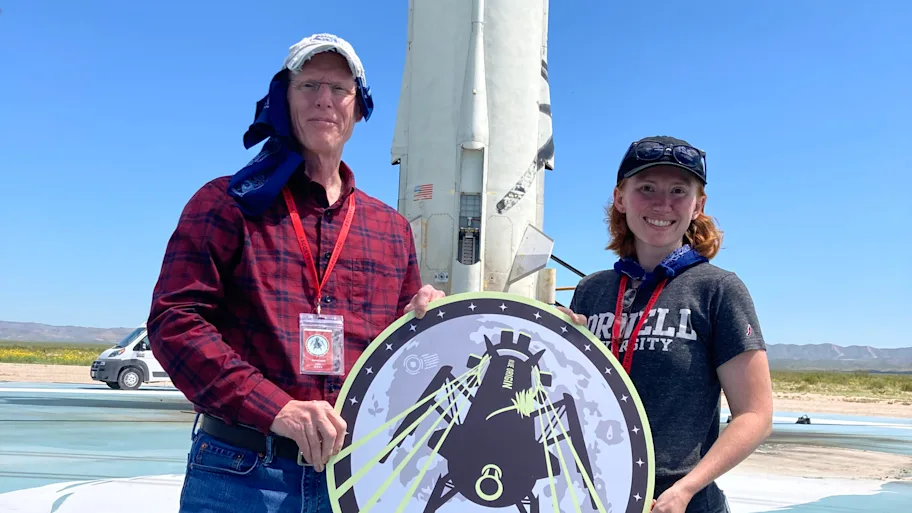
Dr Shiva Khoshtinat is a postdoctoral researcher at the Department of Chemistry, Materials and Chemical Engineering 'Giulio Natta' at Politecnico di Milano. With an interdisciplinary background spanning civil engineering, architecture, materials science, and biology, she explores how nature’s strategies can inspire sustainable construction on Earth and beyond. Her research focuses on biomineralization and microbial co-cultures as self-sustaining systems for construction. In a recent publication in Frontiers in Microbiology, Dr Khoshtinat and co-authors present a bold approach for construction on Mars, harnessing microbial partnerships to transform Martian regolith into structural materials, laying the scientific foundations for building the first habitats on the Red Planet.
Humanity had a dream: the alien world we hope to call home
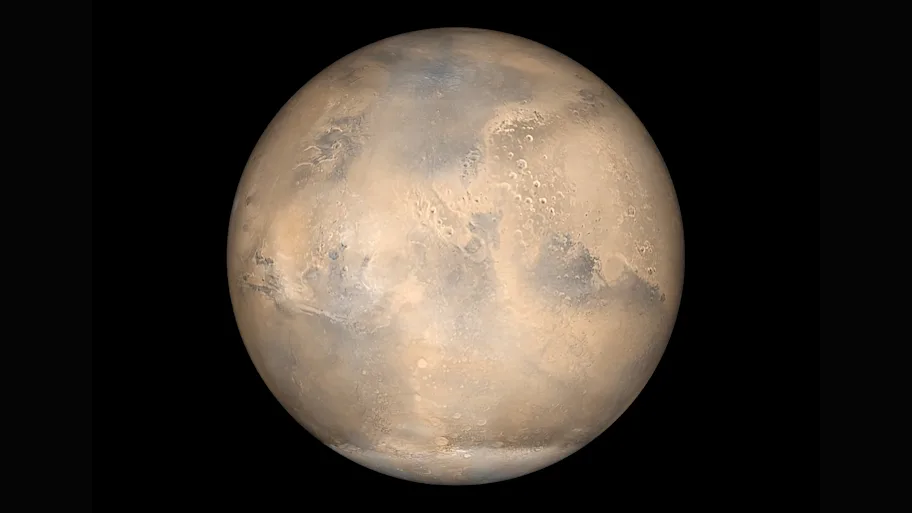
Since humanity’s first steps on the Moon, the aspiration to extend human civilization beyond Earth has been a central objective of international space agencies, targeting long-term extraterrestrial habitation. Among the celestial bodies within our reach, Mars is considered our next home. The Red Planet, with its stark landscapes and tantalizing similarities to Earth, beckons as the frontier of human exploration and settlement. But establishing a permanent foothold on Mars remains one of humanity’s boldest dreams and the most formidable scientific and engineering challenge.
The Red Planet, once draped in a thick atmosphere, has undergone dramatic transformation over billions of years. Its protective blanket vanished, leaving behind an environment nearly unrecognizable to terrestrial life. Today, its air is whisper-thin and rich in carbon dioxide, pressure is less than one percent of Earth’s, and temperatures swing wildly from a freezing –90°C to a mild 26°C. Add to this constant cosmic radiation and the absence of breathable air, and it becomes clear: creating shelter on Mars is about much more than building walls. It’s about crafting a life-supporting sanctuary that stands strong against an alien world. Transporting building materials from Earth is prohibitively expensive and impractical. The solution? Learning to build using what Mars itself offers. In situ resource utilization (ISRU), harnessing local materials, is the key to unlocking sustainable human presence on Mars.
As samples gathered by NASA’s Perseverance rover from Jezero Crater, an ancient Martian riverbed, may hold traces of primordial life, it invites us to dream beyond discovery. Could the same microbial fingerprints that once thrived on Mars also help us build on it?
From Earth to Mars
Once upon a time, life on Earth began with humble microorganisms in shallow pools and seas. These silent engineers transformed our planet, from filling the skies with oxygen to building resilient coral reefs that stand to this day. Now, as humanity’s gaze shifts skyward, these tiny creators may hold the key to turning a barren world into a vibrant home.
Our research pioneers a bold path, drawing inspiration from Mother Nature. In an internationally cross-disciplinary effort, we came together to harness a natural wonder: biomineralization. This phenomenon, which unfolds when microorganisms (bacteria, fungi, and microalgae) produce minerals as part of their metabolism, has shaped Earth’s landscapes for billions of years. These microorganisms that thrive not only in familiar waters but also in extreme environments like acidic lakes, volcanic soils, and deep caves may reveal the versatility needed for Martian adaptation.
Read and download original article
Guided by data from Mars rovers regarding the Martian soil (regolith) composition, our research explores multiple microbial mineralization pathways to discover which can forge strong building materials for Mars habitats without posing an interplanetary pollution risk. Among them, biocementation, which uses microorganisms to generate natural cement-like materials like calcium carbonate at room temperature, shines as the most promising. At the core of our research is a collaborative effort between two remarkable bacteria: Sporosarcina pasteurii, a well-known bacterium that produces calcium carbonate via ureolysis, and Chroococcidiopsis, a resilient cyanobacterium known for surviving extreme environments, including simulated Martian conditions. Together, they form a powerful partnership. Chroococcidiopsis breathes life into its surroundings by releasing oxygen, creating a welcoming microenvironment for Sporosarcina pasteurii. Moreover, the extracellular polymeric substance secreted by Chroococcidiopsis shields Sporosarcina pasteurii from harmful UV radiation on the Martian surface. In turn, Sporosarcina secretes natural polymers that nurture mineral growth and strengthen regolith, turning loose soil into solid, concrete-like material.
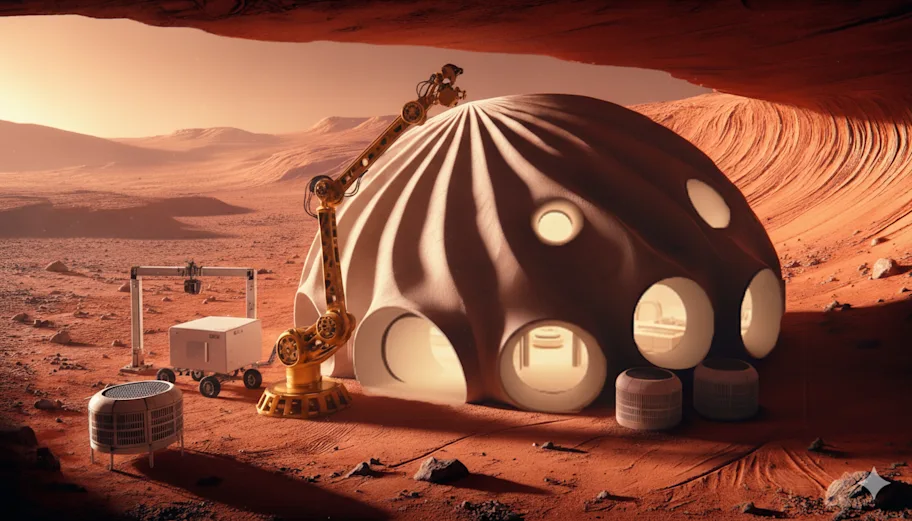
We envision this bacterial co-culture mixed with Martian regolith as feedstock for 3D printing on Mars. At the intersection of astrobiology, geochemistry, material science, construction engineering, and robotics, this synergistic system could revolutionize the potential for construction on the Red Planet, redefining the design-for-manufacturing on Mars.
But this microbial partnership offers benefits beyond construction. Chroococcidiopsis, with its ability to produce oxygen, could support not just habitat integrity but also the life-support systems for astronauts. Over longer timescales, the ammonia produced as a metabolic byproduct of Sporosarcina pasteurii might be used to develop closed-loop agricultural systems and potentially help in Mars's terraforming efforts.
One step at a time
Yet the journey is just beginning. Although international agencies plan to build the first human habitat on Mars in the 2040s, the Mars sample return is facing recurring delays, constraining experimental validation of Mars-specific construction technologies. As space agencies prepare for crewed Mars missions in the coming decade, we must advance our understanding of bio-derived extraterrestrial construction to be ready for the day to come.
From an astrobiology perspective, we must unravel how these microbial communities interact with Martian regolith and survive stressors from the planet’s hostile environment. Laboratory regolith simulants offer a pragmatic approach to testing co-cultures in conditions that echo those on Mars and to building predictive models for biocementation performance. On the robotics front, one major challenge is replicating Martian gravity on Earth to test 3D printing processes and optimize autonomous construction control for future Mars missions. Therefore, we must develop robust control algorithms and tailored protocols that will enable us not only to build more efficiently but also to redefine manufacturing methods for Mars’s unique environment. The journey is vigorous, but step by step, every discovery, each successful trial and tested protocol, brings us closer to the day when humanity will call Mars our home.
REPUBLISHING GUIDELINES: Open access and sharing research is part of Frontiers’ mission. Unless otherwise noted, you can republish articles posted in the Frontiers news site — as long as you include a link back to the original research. Selling the articles is not allowed.