- Science news
- Frontiers news
- News roundup from Davos Frontiers Science House day 2 and 3 and look ahead to day 4 and 5
News roundup from Davos Frontiers Science House day 2 and 3 and look ahead to day 4 and 5
Antimicrobial resistance: a “pandemic” killing more people than cancer by 2050 – Davos needs to talk about this
The science trust dividend: why data integrity matters
New AI platform building cities within planetary boundaries
Announcement of Europe’s first commercial cancer lab in space
Frontiers Science House Day 2–3 programs spotlighted urgent global risks and practical, science-led solutions – from antimicrobial resistance (AMR) and trust in science to AI-enabled sustainable cities and cancer research in microgravity.
Key stories of day 2-3 included:
Immediate global actions needed against the “AMR pandemic”
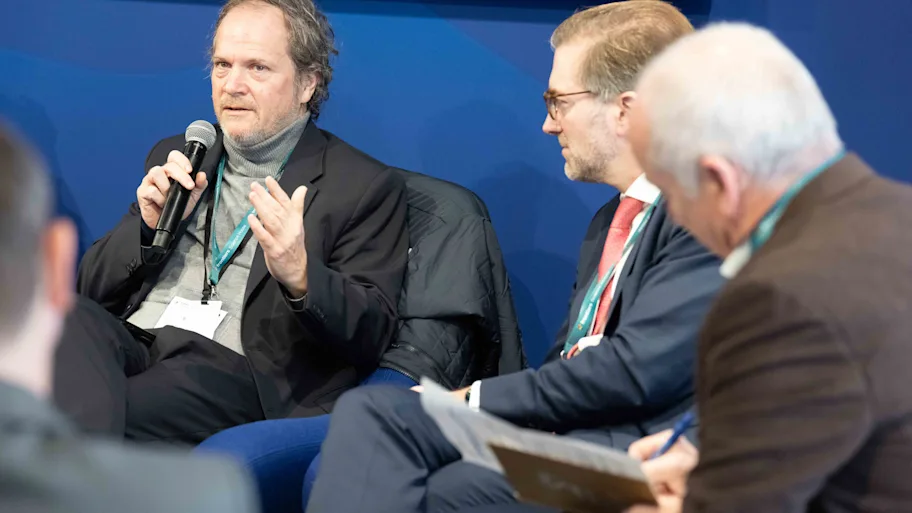
AMR is a fast-growing global threat, with the potential to kill more people than cancer by 2050, requiring urgent cross-sector action and investment. Laurent Ledru, Chief Public Health and Government Affairs Officer of Institut Merieux and bioMerieux; Peter Sands, Executive Director of the Global Fund to Fight AIDS, Tuberculosis and Malaria; and Adèle James, Co-founder & Chief Technology Officer of Phagos shared their insights: “Antimicrobial resistance pandemic will kill more people than cancer by 2050 and no one at Davos is talking about it" – leading scientists speak out at Frontiers Science House
Data integrity helps build trust in science
Speakers raised concerns that public mistrust in data and science can delay policy making and implementation, weakening society’s response to global challenges. The private sector, policymakers, and international organizations are the catalyst of building an international trustworthy and ethical science ecosystem grounded in equity, transparency, and openness.
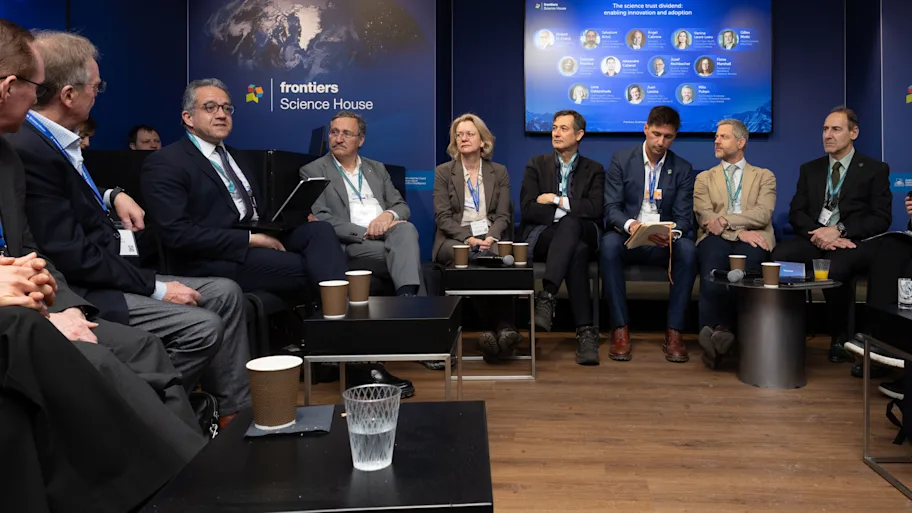
In “The science trust dividend: enabling innovation and adoption” session, Giles Moëc, Chief Economist of AXA Group added:
“For us [at AXA], respect for science is absolutely key for various reasons, among which is our absolute need for data integrity. Data integrity is key to what we do. Otherwise, we cannot actually insure risks accurately. Trust in science is also key to enabling people to protect themselves accurately against key risks.”
AI Polis: turning climate science into actionable urban planning
Genisys AI announced the launch of AI Polis, an AI-powered platform functioning as a city-level coordination system, integrating data, AI models, and governance frameworks to help cities design, prioritize, and scale projects that improve urban life while staying within planetary boundaries. Hear what Bart Becks, CEO of Genisys AI and board member of the European Innovation Council said: AI platform helps cities develop within planetary boundaries
Europe’s first commercial orbital cancer lab
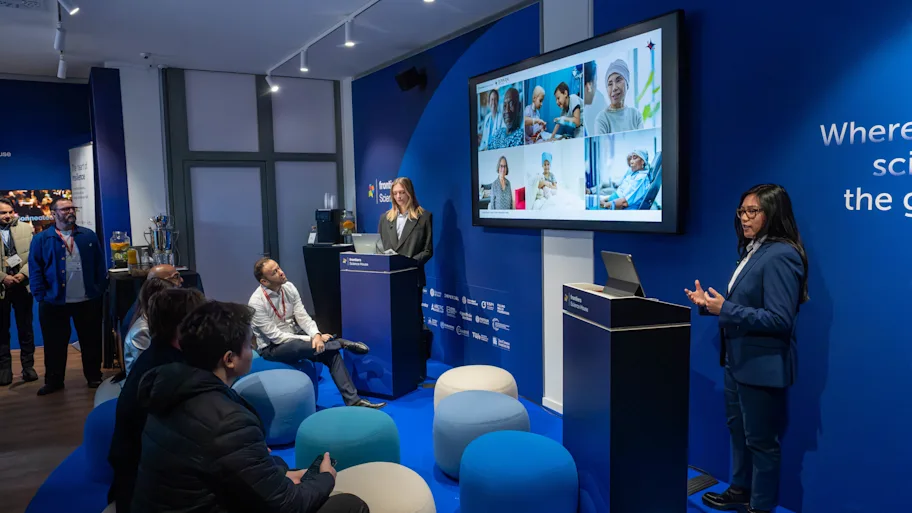
SPARK Microgravity GmbH revealed plans to build Europe’s first dedicated commercial orbital cancer lab, accelerating the path from discovery to therapy. Learn how microgravity enables research that is impossible on Earth: SPARK Microgravity announces plans for Europe’s first commercial cancer lab in space at Frontiers Science House in Davos
Highlights of Day 4, Thursday, 22 January – Technology, Intelligence, and Energy
07:30 CET – Funding the future of science
A debate on accountability, incentive structures, and new finance mechanisms.
Ángel Cabrera, President of the Georgia Institute of Technology
Christian Ehler, Member of the European Parliament
Erica Fuchs, Professor of Engineering and Public Policy of the Carnegie Mellon University
Gilles Moëc, Chief Economist of AXA Group
John Fairhurst, Head of Private Sector Engagement of the Global Fund
Michael Schaepman, President of the University of Zurich
Vanina Laurent Ledru, Chief Public Health and Government Affairs Officer of Institut Merieux and bioMerieux
Victor Ambros, Silverman Professor of Natural Sciences of the University of Massachusetts Chan Medical School
09:00 CET – Strengthening Europe's science and innovation engine
Senior architects of Europe’s innovation policy assess whether the continent is responding fast enough to its competitiveness crisis or missing another technological turning point.
Ann Mettler, Distinguished Visiting Fellow at Columbia University's Center on Global Energy Policy
Christian Ehler, Member of the European Parliament
Maria Leptin, President of the European Research Council
Robert-Jan Smits, Chairman of the Supervisory Board of Naturalis
Sue Duke, Managing Director for EMEA & LATAM and Head of Global Public Policy & Economic Graph of LinkedIn
10:15 CET – Convergence: all roads lead to AI
AI and biotech CEOs discuss how artificial intelligence is becoming the backbone of geopolitics, science, security, and economic growth.
Amanda Wolthuizen, Vice President for Strategic Engagement of Imperial College London
Hugh Brady, President of Imperial College London
Jason Kelly, CEO of Ginkgo Bioworks
Matt James, Chief Animal Officer of Colossal Biosciences
11:30 CET – Future of intelligence
Neuroscience meets art and AI as pioneers explore what lies beyond large language models, and how causal intelligence could redefine human–machine collaboration.
Adrian Monck, Founder of 7 Things
Anicka Yi, Artist of Anicka Yi Studio
Aseem Datar, Corporate Vice President of Product of Microsoft Discovery & Quantum
Henry Markram, Co-founder of Open Brain Institute and INAIT
Lila Tretikov, Head of AI of New Enterprise Associates
13:50 CET – Conquering quantum’s next frontier
A Nobel laureate joins CERN, UNESCO, NVIDIA, and the "quantum city" leader to map how quantum technologies could become transformative for society and industry as AI.
Amal Kasry, Chief of the Section for Basic Sciences, Research, Innovation and Engineering of UNESCO
Barry Sanders, Scientific Director of Quantum City of the University of Calgary
Elica Kyoseva, Director of Quantum Computing of NVIDIA Corporation
Enrica Porcari, Chief Information Officer of CERN
John Martinis, Nobel Laureate in Physics (2025); Professor Emeritus of the University of California
Nathan Baker, Partner Architect for Quantum Applications of Microsoft
15:15 CET – Fusion now: a coalition for commercialization
Top official (Director of LLNL) detail the next steps to abundant power and set out a timeline. Practitioner discussion (CEOs of Novatron and Marvel Fusion) on the key technologies that will drive real industry expansion (not just lab experiments).
Enrique García, Head of Fusion Technologies & Engineering of Fusion for Energy
Francesco Sciortino, Co-Founder and CEO of Proxima Fusion
Kim Budil, Laboratory Director of Lawrence Livermore National Laboratories
Nicolas Burkardt, CFO of Marvel Fusion
Peter Roos, CEO of Novatron Fusion
16:30 CET – Energy for the data center demand
Speakers will explore what it takes to balance rapid technological growth with environmental responsibility and resilient energy systems.
Ann Mettler, Distinguished Visiting Fellow at Columbia University's Center on Global Energy Policy
Atul Arya, Chief Energy Strategist of S&P Global
Chase Lochmiller, Co-Founder and CEO of Crusoe
David Gelles, Correspondent of the New York Times
Jason Bordoff, Founding Director of the Center on Global Energy Policy at Columbia University’s School of International and Public Affairs
19:00 CET – The Future of knowledge in the age of AI
A conversation and cocktail marking Wikipedia’s 25th anniversary, examining how open knowledge, trust, and information integrity can be preserved in an AI-driven world.
Jimmy Wales, Founder of Wikipedia
Bill Gross, CEO and Founder of ProRata ai
Kamila Markram, Co-founder and CEO of Frontiers
Mark-Alexander Doumba, Minister of Digital Economy Innovation of Gabonese Republic
Highlights of Day 5, Friday, 23 January – Science Diplomacy
10:00 CET – Restoring multilateralism with science diplomacy
Today's greatest security threats are often rooted in scientific and technological challenges. Science diplomacy can be a concrete tool for preventing conflict and strengthening global security.
Alexandre Fasel, State Secretary of Federal Department of Foreign Affairs Switzerland
Christian Ehler, Member of the European Parliament
Lise Korsten, President of the African Academy of Science
Josef Aschbacher, Director General of European Space Agency (ESA)
Martin Müller, Executive Director Science Anticipation of GESDA
About the Frontiers Science House
Frontiers Science House is a high-energy hub pioneered by Frontiers that brings science to the center of global dialogue and action. Launched at the World Economic Forum Annual Meeting in Davos 2026, Frontiers Science House brings together world leaders, investors, and decision makers to accelerate real-world impact. Through curated discussions, showcases, and partnerships, Frontiers Science House highlights how open science can drive coordinated action for people and the planet. In partnership with over 50 global organizations, Frontiers Science House embodies Frontiers’ mission to make science open and to ensure that knowledge serves everyone, everywhere.
About Frontiers
Frontiers is a leading research publisher. Our role is to provide the world’s scientists with a rigorous and efficient publishing experience. Scientists empower society and our mission is to accelerate collaboration and discovery by making science open – enabling researchers to find the solutions we all need for healthy lives on a healthy planet. Powered by custom-built technology, artificial intelligence, and a collaborative peer review, our community journals give experts in more than 1,700 academic fields an open access platform to publish high quality, high impact research. Through our outreach work to build strong partnerships with business, policymakers, and educators, we’re leading the transition to open science.