With the development of our society and technology, ionizing radiation (IR) and nano-particles (NP) have been widely included in the medical therapies. In respect of the toxicity of IR and NP, they are considered as potential health risks [1]. Increasing evidence from animal and cell experiments has reported that IR and NP can induce extensive DNA damage or genomic instability and lead to serious consequences for cells and organisms, for instance cancer [2]. Furthermore, IR and NP can also determine hereditary effects thus represent a major concern for human population health [3]. In-depth studies on the molecular mechanisms have indicated that epigenetic and related signaling pathways may play critical roles in the response to IR and NP. For example, more and more studies have mushroomed to demonstrate that microRNAs, long-coding RNAs(lncRNAs) and circle RNAs(circRNAs) can regulate or be regulated by IR and NP [4]. Many signaling pathways such as DNA damage repair pathways can be affected, and many repair-related genes and proteins may be involved in the regulation of IR and NP responses [5]. The outcome of these responses primarily depends upon the level and type of IR and NP as well as the genetic background of the exposed cell or organism and epigenetic factors [6].The present Research Topic hosts an overview by Ruixue Huang, Qunwei Zhang and Pingkun ZHou on the pathways in response to ionizing radiation and nano-particles. As discussed by the authors, IR and NPs often threaten human health in combinational status. Moreover, as IR and NP are commonly exposed in the environment, industrial activities and medical applications, their combinational effects on human health should be considered.The Overall, the article collection in this Research Topic provides a comprehensive overview of several regulatory signaling pathways and targets in response to IR or NPs, describing wellconsolidated effects, and discussing more recent findings highlighting the key regulator role of microRNA in IR-related disease, such as cancer.
Editorial27 May 2022
Editorial: Epigenetic and Related Signaling Pathways in Response to Ionizing Radiation and Nano-Particles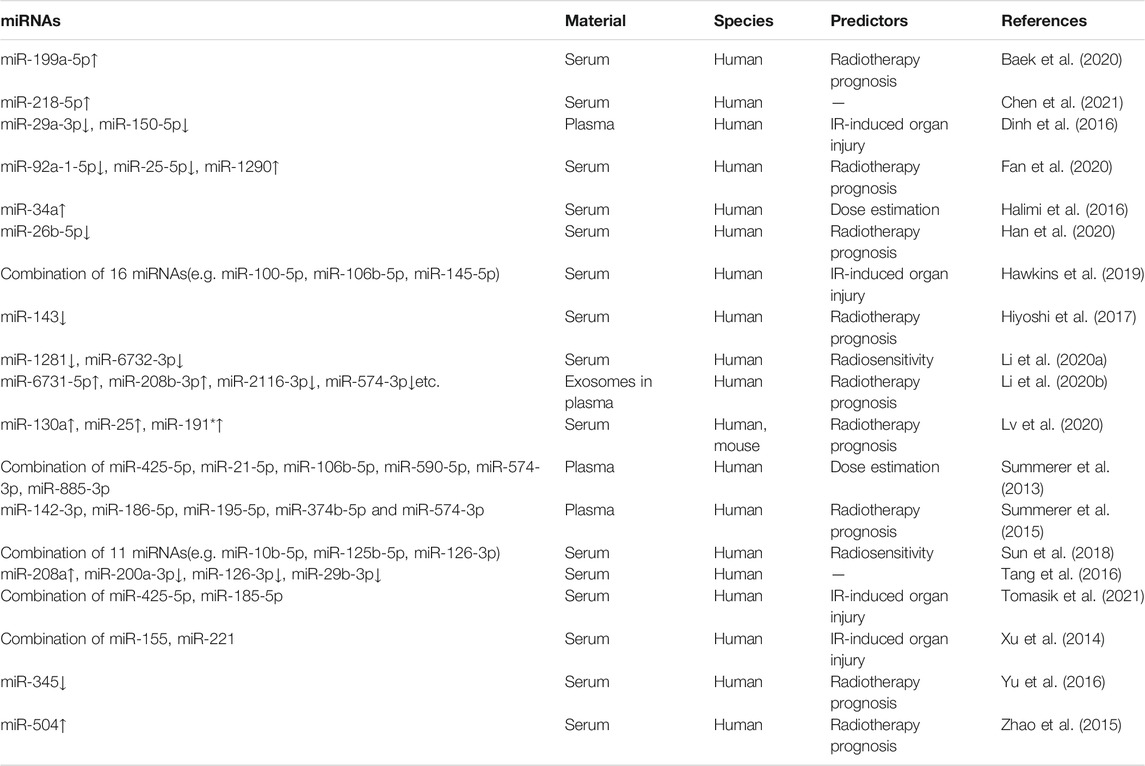
Accidental radiation exposures such as industrial accidents and nuclear catastrophes pose a threat to human health, and the potential or substantial injury caused by ionizing radiation (IR) from medical treatment that cannot be ignored. Although the mechanisms of IR-induced damage to various organs have been gradually investigated, medical treatment of irradiated individuals is still based on clinical symptoms. Hence, minimally invasive biomarkers that can predict radiation damage are urgently needed for appropriate medical management after radiation exposure. In the field of radiation biomarker, finding molecular biomarkers to assess different levels of radiation damage is an important direction. In recent years, microRNAs have been widely reported as several diseases’ biomarkers, such as cancer and cardiovascular diseases, and microRNAs are also of interest to the ionizing radiation field as radiation response molecules, thus researchers are turning attention to the potential of microRNAs as biomarkers in tumor radiation response and the radiation toxicity prediction of normal tissues. In this review, we summarize the production and distribution of microRNAs, the progress on research of microRNAs as markers of IR, and make a hypothesis about the origin and destination of microRNAs in vivo after IR.


Objective: Obesity caused by a high-fat diet (HFD) will expand adipose tissue and cause chronic low-grade systemic inflammation, leading to osteoporosis. Folic acid is a water-soluble vitamin that plays an important role in regulating blood lipids and antioxidants. However, the effects and underlying mechanisms of folic acid in osteoporosis induced by a high-fat diet remain poorly understood. This study aimed to investigate the effect of folic acid on the bone health by using high-fat diet (HFD)-induced osteoporosis mice.
Materials and Methods: Mice were fed a high-fat diet (HFD), normal diet or an HFD supplemented with folic acid (20 μg/mL in drinking water) for 16 weeks. Throughout the 16 weeks study period, the rats were weighed once every week. GTT, ITT and lipid indexes were detected to evaluate the effects of folic acid on lipid metabolism in high-fat diet-fed mice. Morphological and structural changes of the femur and tibial bone were observed using micro-CT, HE staining and bone conversion parameters. The expression of MDA, SOD and inflammatory factors were detected to evaluate the effects of folic acid on oxidative stress and inflammatory response in high-fat diet-fed mice. Quantitative real-time PCR and Western blot (WB) were used to investigate the AMPK signaling pathway.
Results: After the intervention of folic acid, the body fat rate of obese mice was reduced, and related metabolic disorders such as insulin resistance, hyperlipidemia, and systemic inflammation were alleviated. In correlation with those modifications, folic acid attenuated bone loss and improved bone microarchitecture accompanied the number of osteoclasts and adipocytes decreased. Furthermore, folic acid promoted the phosphorylation of AMPK, thereby promoting the expression of CPT1, Nrf2 and antioxidant enzymes.
Conclusions: These findings suggest that folic acid may modulate lipid metabolism and oxidative stress responses through the activation of AMPK signaling pathway, thereby alleviating high-fat diet-induced osteoporosis. The results from our study provide experimental evidence to prevent high-fat diet-induced osteoporosis.

The protein arginine methyltransferases (PRMTs) are involved in such biological processes as transcription regulation, DNA repair, RNA splicing, and signal transduction, et al. In this study, we mainly focused on PRMT5, a member of type II PRMTs, functions mainly together with interacting proteins. It has been shown to be overexpressed in a wide variety of cancers and other diseases, and is involved in the regulation of hepatitis and hepatocellular carcinoma, cell cycle and apoptosis, spliceosome and various signaling pathways. In this study we analyzed the regulatory roles of PRMT5 and interacting proteins in various biological processes, mentioned-above, to elucidates for the first time the interaction between PRMT5 and its interacting proteins, the systemic analysis will fulfill the biological theory and contribute to the development of novel therapies.