plishments along this line of research and that provide insights into the methodologies being developed and employed.The Research Topic features 15 articles. Several contributions focus on the uncertainty quantification in nuclear structure calculations. For instance, Alnamlah et al. discuss an effective field theory (EFT) for rotational bands in odd-mass nuclei and employ a Bayesian analysis to estimate uncertainties in rotational energy levels. They consider both experimental and EFT truncation uncertainties, utilizing Markov Chain Monte Carlo (MCMC) sampling to infer low-energy constants and the breakdown scale of the EFT. Becker et al. investigate alpha clustering and collective properties in nuclei using emulators within the ab initio symmetry-adapted no-core shell model framework. Their work highlights the importance of such emulators in quantifying uncertainties and improving the precision of nuclear structure calculations. They utilize the eigenvector continuation technique to study various nuclear properties in 6 Li and 12 C including excitation energies, point-proton root-mean-square radii, electric quadrupole moments, and transitions.Furthermore, Maris et al. examine uncertainties in theoretical ground state energies of p-shell nuclei using interactions from chiral EFT. They investigate the dependence of these energies on the chiral order and analyze two-and three-body data for fitting, addressing uncertainties stemming from basis truncations, omitted induced many-body forces, and EFT truncation. Acharya et al. focus on quantifying theoretical uncertainties in ab initio calculations of electromagnetic observables in light and medium-mass nuclei. They discuss different sources of uncertainties including approximations introduced by few-and many-body solvers and the truncation of the chiral EFT expansion.Regarding reactions in nuclei, some contributions are particularly noteworthy. Skibiński et al. investigate the nucleon-induced deuteron breakup reaction using the Faddeev approach at specific laboratory energies. They focus on quantifying theoretical uncertainties associated with the predicted cross-section, particularly in relation to the regulator cutoff parameter. Ceccarelli et al. concentrate on UQ for the muon capture reaction µ − +d → n+n+ν µ in the doublet hyperfine state. They address four sources of theoretical uncertainty including model dependence, chiral-order convergence, uncertainty in the single-nucleon axial form factor, and numerical techniques used for solving the A = 2 systems.Furthermore, Odell et al. focus on the estimation of uncertainties in resolved resonance cross section data in nuclear physics using the R-matrix framework. They introduce the Bayesian R-matrix Inference Code Kit (BRICK) by implementing a MCMC sampler, specifically the emcee algorithm, into the R-matrix code AZURE2. They apply Bayesian uncertainty estimation to simultaneously fit the 3 He(α, γ) 7 Be and 3 He(α, α) 3 He reactions, aiming to gain insights into the fitting of capture and scattering data. The data from both reactions are relevant to constrain the values of the bound state α-particle asymptotic normalization coefficients in 7 Be. Baker et al. investigate the effective interaction between a nucleon and a nucleus based on optical potentials, with a UQ perspective. They extracted elastic scattering observables for 4 He, 12 C, and 16 O at projectile energies between 65 and 200 MeV. Lastly, Vassh et al. employ a MCMC procedure to predict ground state masses for nucleosynthesis calculations and investigate conditions capable of producing the observed solar r-process rare-earth abundance peak. They examine how mass predictions change when using a few different sets of r-process solar abundance residuals that have been reported in the literature, with focus on uncertainty propagation.The research collection also includes a review article by Ekstrom et al. that provides a historical overview of the notion of ab initio in nuclear physics and discusses its current relationship with theoretical UQ.Furthermore some of the article discuss various advancements in UQ methodology. One of the topics covered is the use of projection-based, reduced-order emulators as fast surrogate models for complex high-fidelity models. Drischler et al. present a pedagogical introduction to these emulators, which effectively approximate complex models and offer an efficient approach to calculations while addressing the challenges of UQ. Additionally, Rothkopf discusses state-of-theart methods for extracting spectral functions using Bayesian inference, highlighting the importance of prior domain knowledge for regularization. The use of machine learning for spectral function reconstruction is also mentioned, noting its contribution to the Bayesian community's understanding of the topic.Verriere et al. focus on the challenges in studying atomic nuclei and the potential of nuclear density functional theory to accurately describe their properties with uncertainties. They explore the application of machine learning and artificial intelligence techniques to enhance DFT calculations and accelerate the understanding of nuclear phenomena. In the paper by Giuliani et al., the authors showcase the application of a principled Bayesian statistical framework for UQ in nuclear physics. By employing the reduced-based emulator and calibrating the energy density functional, they provide accurate model calculations with estimated uncertainties, supporting the nuclear theory community in delivering reliable predictions in the face of increasing data availability.Lastly, Jiang et al. address the usefulness of the sampling/importance resampling method in UQ for nuclear theory applications. By employing sampling/importance resampling to realistic scenarios, the authors demonstrate its effectiveness in inferring posterior distributions and estimating the predictive probability distribution of observables. Researchers in nuclear theory can benefit from employing this Bayesian sampling method to gain insights into uncertainties and make informed decisions based on the obtained posterior distributions.In conclusion, this Research Topic presents a comprehensive collection of articles that contributes to the advancement of UQ in nuclear physics. The diverse range of topics and methodologies highlights the progress made in addressing uncertainties and provides a solid foundation for future developments in the field. We are grateful to all the scientists participating in this project and hope that the reader will enjoy this Research Topic.
Editorial15 August 2023
Editorial: Uncertainty quantification in nuclear physics
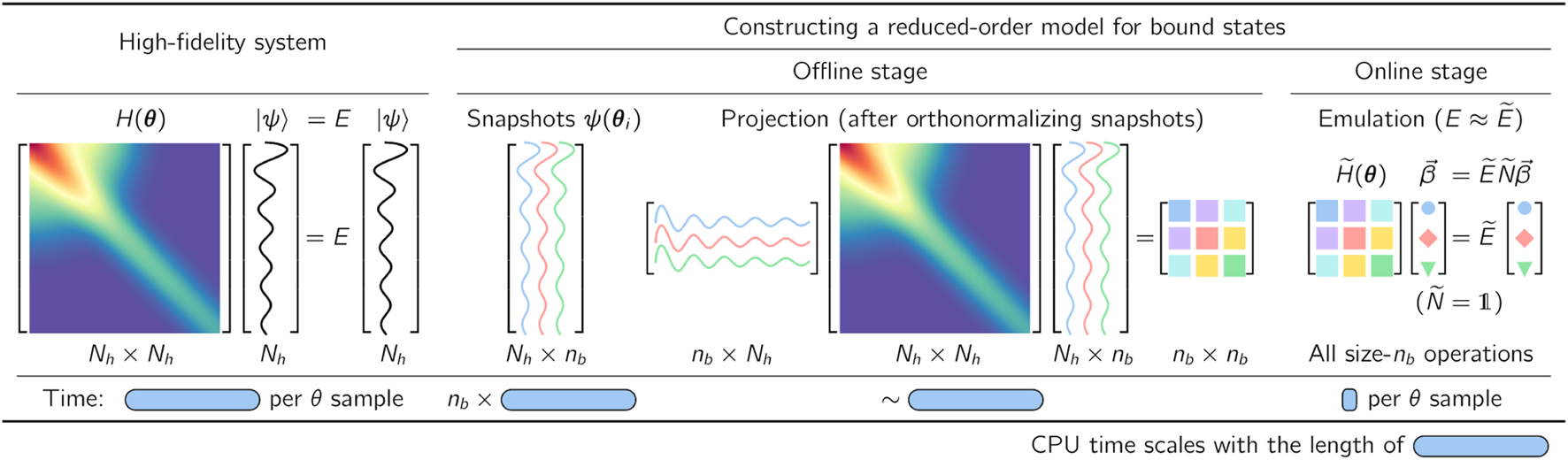

A covariant energy density functional is calibrated using a principled Bayesian statistical framework
informed by experimental binding energies and charge radii of several magic and semi-magic nuclei. The Bayesian sampling required for the calibration is enabled by the emulation of the high-fidelity model through the implementation of a reduced basis method (RBM)---a set of dimensionality reduction techniques that can speed up demanding calculations involving partial differential equations by several orders of magnitude. The RBM emulator we build---using only 100 evaluations of the high-fidelity model---is able to accurately reproduce the model calculations in tens of milliseconds on a personal computer, an increase in speed of nearly a factor of 3,300 when compared to the original solver. Besides the analysis of the posterior distribution of parameters, we present predictions with properly estimated uncertainties for observables not included in the fit, specifically the neutron skin thickness of $^{208}$Pb and $^{48}$Ca, as reported by PREX and
CREX collaborations. The straightforward implementation and outstanding performance of the RBM makes it an ideal tool for assisting the nuclear theory community in providing reliable estimates with properly quantified uncertainties of physical observables. Such uncertainty quantification tools will become essential given the expected abundance of data from the recently inaugurated and future experimental and observational facilities.

ORIGINAL RESEARCH
13 June 2022
Daniel Odell, 3 more and Som Nath Paneru
5 Authors
- DO
Daniel Odell
Department of Physics and Astronomy, United States
- CR
Carl R. Brune
Department of Physics and Astronomy, United States
- DR
Daniel R. Phillips
Department of Physics and Astronomy, United States
- RJ
Richard James deBoer
Department of Physics, United States
- SN
Som Nath Paneru
Department of Physics and Astronomy, United States
Phenomenological R-matrix has been a standard framework for the evaluation of resolved resonance cross section data in nuclear physics for many years. It is a powerful method for comparing different types of experimental nuclear data and combining the results of many different experimental measurements in order to gain a better estimation of the true underlying cross sections. Yet a practical challenge has always been the estimation of the uncertainty on both the cross sections at the energies of interest and the fit parameters, which can take the form of standard level parameters. Frequentist (chi-squared-based) estimation has been the norm. In this work, a Markov Chain Monte Carlo sampler, emcee, has been implemented for the R-matrix code AZURE2, creating the Bayesian R-matrix Inference Code Kit (BRICK). Bayesian uncertainty estimation has then been carried out for a simultaneous R-matrix fit of the 3He(alpha,gamma)7Be and 3He(alpha,alpha)3He reactions in order to gain further insight into the fitting of capture and scattering data. Both data sets constrain the values of the bound state alpha-particle asymptotic normalization coefficients in 7Be. The analysis highlights the need for low-energy scattering data with well-documented uncertainty information and shows how misleading results can be obtained in its absence.