1.1 Introduction
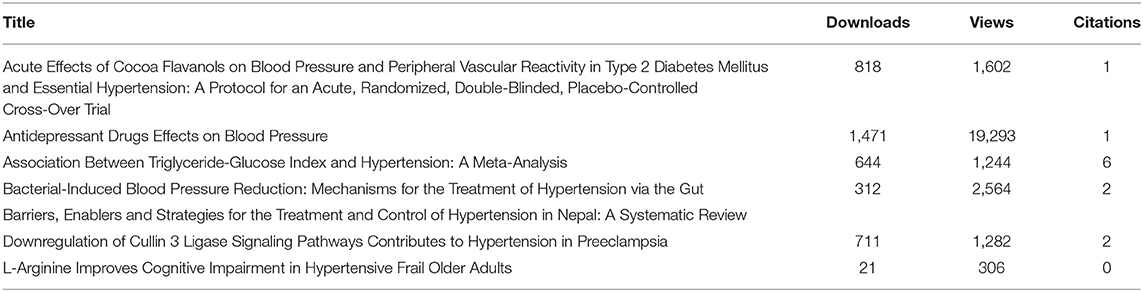
Hypertension remains the most relevant cardiovascular risk around the world, and many aspects of the physiopathology and clinical management of this condition are still to be evaluated. Frontiers in Cardiovascular Medicine – Hypertension metrics of the last years have positioned the journal in the high ranks of the specialized journals, with wide-open perspectives of consolidating the position in the next future. This collection aims to celebrate the seven top cited and accessed articles published by the journal in 2021 (Table 1)
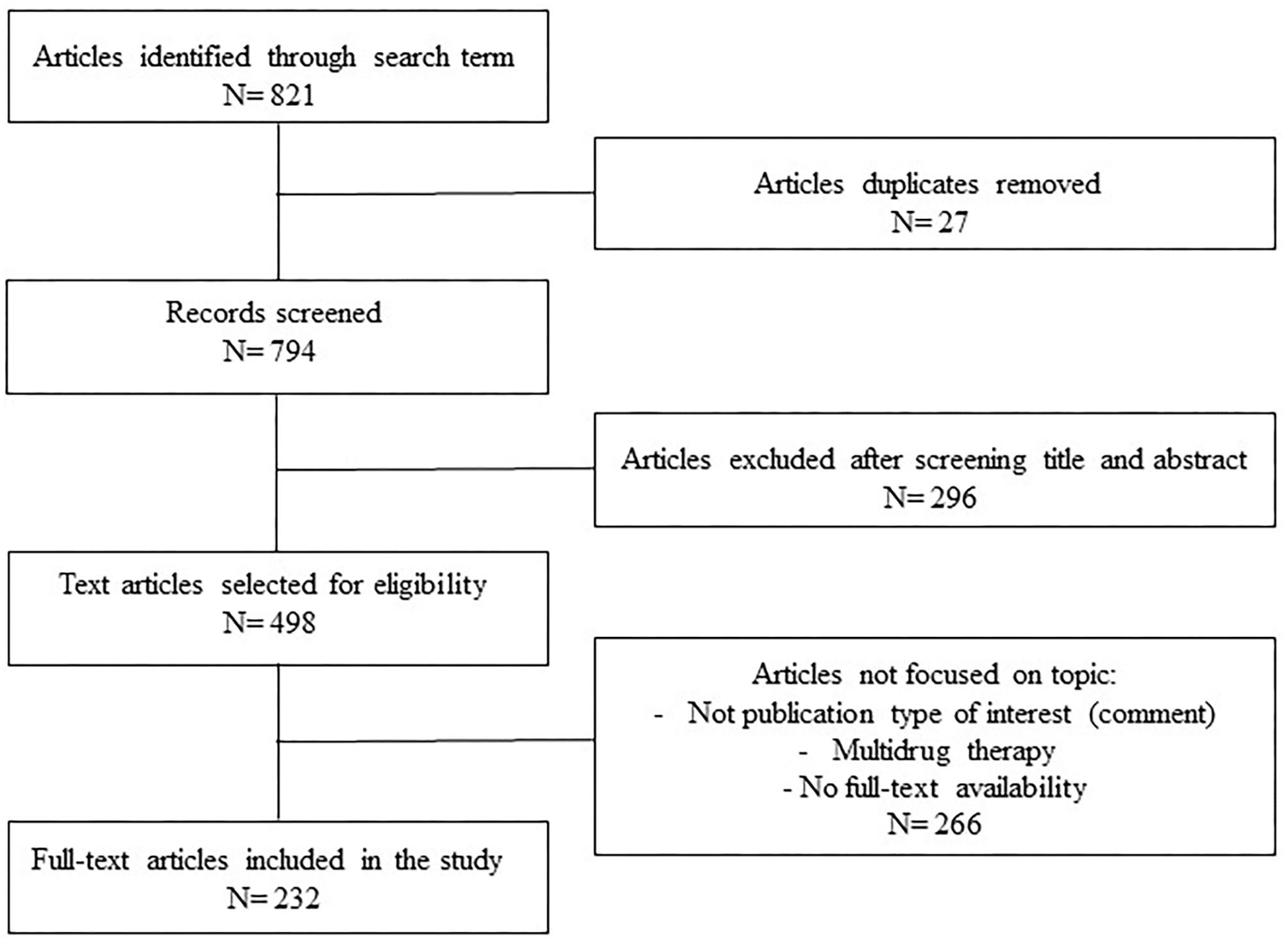
Seven out of over 70 papers published from first of January to 31st of December 2021 have been selected, that have been most read and cited, with the perspective to influence research in the next future. Interestingly, this collections is composed of a well calibrated mixture of basic, clinical and metanalysis researches, together with two reviews on hot topics for hypertension, and public health perspectives of the burden of this silent killer. This fact stands for the ability of Frontiers in Cardiovascular Disease - Hypertension to be interdisciplinary, putting together all the scientific stakeholders, from the lab to the clinicians to the policy advisors. In this Editorial we present these papers, organized by subheadings.
2.1 Endothelium as a mechanism of disease.
From the analysis of the top accessed papers, we also learn that the investigation of the mechanisms of the disease is still a major drive for hypertension research, and in particular the endothelium remains the focus of many investigators around the world.
As above anticipated, the endothelium is still a trend topic of hypertension research. Interestingly, the relevance of the endothelial dysfunction is investigated in never explored clinical implications of hypertension. The group of Santulli and others, introduces the important concept that the observed impairment of cognitive function in hypertension is indeed measurable with classical neurophysiological assessments (like the MoCA test), and that can be reversed by treatment (1). The Authors even provide a pathophysiological explanation, by suggesting that endothelial dysfunction can be responsible for the Cognitive Impairment, and that arginine can indeed ameliorate both. Many issues remain open on this regard, that need to be explored in larger studies with age matched normotensives, also considering the comorbidities and the cardiovascular risk evaluation. Also, MoCA remains a hard test to assess the Mild Cognitive Function, and probably cognitive tests that are easier to be administered like the questionnaire for Mild Cognitive Impairment (2) could facilitate the diffusion of the assessment of cognitive function in the larger population of hypertensive patients. This will finally allow to include the assessment of the brain function in the evaluation of the hypertension related target organ damage (3, 4).
Again, a defect in endothelial function is pivotal also for another threatening condition, Preeclampsia. In this case, the Zhang laboratory at the Shanghai Jiaotong University, in China, showed that impaired vasodilation, but also reabsorption of volume by the kidney in preeclampsia can be induced by the downregulation of the signaling of specific ligases (CURL3) (5). This set of ligases is therefore key to the balance of vasoconstriction and vasodilation and sodium reabsorption. Whether also other ligases can be involved in such mechanisms and in other hypertensive states remain the open question.
2.2 Clinical trial design
Along with the endothelium tread, Patrick Calders for the University of Gent and his group present a clinical trial that could shed sweet lights on the use of cocoa flavonoids in the management of hypertensive patients (6). They take ground from the increasing relevance of food supplements and functional foods in the management of acute and chronic conditions. In their study they will investigate whether cocoa flavanols have an acute impact on blood pressure and vascular reactivity in patients with type 2 diabetes with and without arterial hypertension. Almost 800 mgs of flavonoids in capsule will be assumed by patients and the acute effects will be assessed on vasodilation using the near-infrared spectroscopy to assess forearm muscle vasoreactivity. Again, endothelium represents the target of this strategy for modulating peripheral resistances.
2.3 Hot topics in hypertension
In 2021, two highly cited reviews focused on hot topics in hypertension: microbiota and behavioral disorders. The paper by Tyler Alexander Cookson from the University of Alberta, Canada, illustrates the mechanisms through which several metabolites that are produced in the gut by the living microbiota can interfere with distant organs, such as the gut, brain, kidneys, liver, heart, vasculature, and host immunity (7). These substances modulate the regulation of blood pressure homeostasis. The interesting emerging implication is that the use of selected microbiota strains could produce or reduce the production of appropriate metabolites to elicit a net anti-hypertensive effect. Indeed, the review proposes the gut microbiota as a possible therapeutic target in hypertension.
The group of Aderville Cabassi in Parma, Italy, reviewed the available evidence regarding the effects of several antidepressant drugs on blood pressure regulation, with a focus on the hypo- and the hypertensive responses of these drugs (8). The issue Is of growing interest, in the post COVID-19 season, with many patients suffering from depression due to the restriction imposed in the last years. Interestingly, many options are available for hypertensives to take care of this conditions without having significant impact on their blood pressure, nevertheless, caution needs to be paid, and the administration of antidepressant requires a pathophysiological reasoning.
2.4 Biomarkers
Going back to the physiopathology of hypertension, the investigation of easily accessible biomarkers of insulin sensitivity represents the aim of a continuous quest. In 2021, this paper investigated the predictive role of the novel triglyceride/glucose ratio (the TyG index) for hypertension, by performing a metanalysis of observational studies around the world (9). Results showed that compared with those with the lowest category of TyG index, subjects with the highest category of TyG index were associated with higher odds of hypertension. This index is therefore proposed as possible predictor of hypertension among the general population, thus favoring public health preventive intervention.
2.5 Public Health approaches to tackle hypertension
Again, a public health approach for the evaluation of the management of high blood pressure in a small (28M people living) south-Asian country, Nepal (10) shows the barrier and the constrains for the management of this condition. The health system in Nepal faces daunting challenges such as unequal distribution of health care services, poor infrastructures, inadequate supply of essential drugs, poorly regulated private providers, inadequate budget allocation for health, and poor retention of human resources in rural areas (11). In this context, the management of hypertension as a public health problem is exemplificative of such a situation: most hypertensive individuals are not aware of their condition (awareness = 40.0%); a half of those aware are not treated (treatment = 20.2%), and a half of those on treatment, the blood pressure was not controlled (control = 10.5%). The systematic review of the literature by the Australian group led by Maximilian De Courtain identifies gaps and barriers in the management of this public health problem and suggests specific interventions to tackle this problem in this corner of South Asia.
3.1 Conclusions.
The year 2021 represent a very important year for the growth of the journal, that has been led by specialty editor professor Michel Burnier, to whom is addressed my personal gratitude for being close to the associate editors and having shaped the directions of the journal. With growing visibility and number of submissions we are facing in this quarter of the year we can expect a further development of the journal, that aims to increase its reputation among researcher of the field of hypertension. Frontiers in Cardiovascular Medicine – Hypertension aims to consolidate the reputation among researcher’s, being at the same time the arena where researchers around the world, working in the several realms of hypertension wish to showcase their results.