56kviews
Editorial22 June 2023
Editorial: Early palliative care for cancer patients

In the past, oncological Palliative Care (PC) has been identified with "End-of-Life Palliative Care" 4 (EoLPC) and EoLPC always started carried out with a prognostic evaluation of short life expectancy, 5 while antitumor therapies had been exhausted. In recent years, however, this approach has been 6 modified, giving way to an activation of PC based on needs, not only at the end of life, and not only 7after having withdrawn all antineoplastic treatments. This non-EoLPC has been variously identified 8as Early Palliative Care (EPC), or Simultaneous Palliative Care (SPC), or Timely Palliative Care 9(TPC) (1,2,3). EPC is generally delivered together with anticancer therapies, while EoLPCs 10 represents the unique treatment delivered at that end of the disease trajectory. 11From an organizational point of view, EPC is mainly provided in the outpatient and consultant 12 settings within acute hospitals, while EoLPC mainly in home care programs or hospice residential 13 facilities (4). The best method of activation of palliative care and referral to the palliative care team 14 by oncologists is still the subject of studies and clinical research (5). Timely provision of seamless 15 palliative care across all settings must be guaranteed without interruptions (6).

EPC has among its aims a favorable impact on the quality of life, on the quality of care, and finally 17 on costs (7). In fact, in addition to objectives related to the individual patient benefit, a 18 personalization of treatment can allow a more appropriate use of health care services, and an impact 19 on indicators of therapeutic aggressiveness at the end of life: more timely referral to end-of-life 20 palliative care and reduction of futility of treatments (8). 21Clinical trials and systematic reviews have highlighted, among the outcomes on which efficacy has 22 been demonstrated: quality of life, symptom burden, satisfaction, communication, caregivers 23 outcomes, EoL care, and, with more controversial evidence, survival (9,10).

In some cases, systematically activated EPC did not have a clinically or statistically favorable impact.

Reasons for possible lack of effectiveness can be: model of EPC intervention (monoprofessional vs. 26 Multiprofessional; remote vs inperson specialized contact), risk of contamination and/or crossover 27 with the conventional arm, study duration, timing of evaluation, timeliness of cohort inception (this 28 will probably differ for different cancer types), level of symptom burden, and reduced QoL of 29 recruited patients (11). 30A topic under discussion is whether palliative care can be provided by professionals with two 31 different levels of expertise, a basic one (for example, oncologists capable of ensuring a good 32 palliative approach) and a specialized one (palliative care specialists who are dedicated full-time to 33 palliative care delivery). These two levels are indeed both essential and one of them alone cannot 34 exhaustively perform the functions of both (12,13,14 From what described above, it follows that some aspects relating to EPC have been confirmed, while 40for others further research is necessary. The project of carrying out a monographic issue on these 41 topics was aimed at highlighting issues still worthy of research as they have not been completely 42 clarified. 43

2,156 views

4 citations

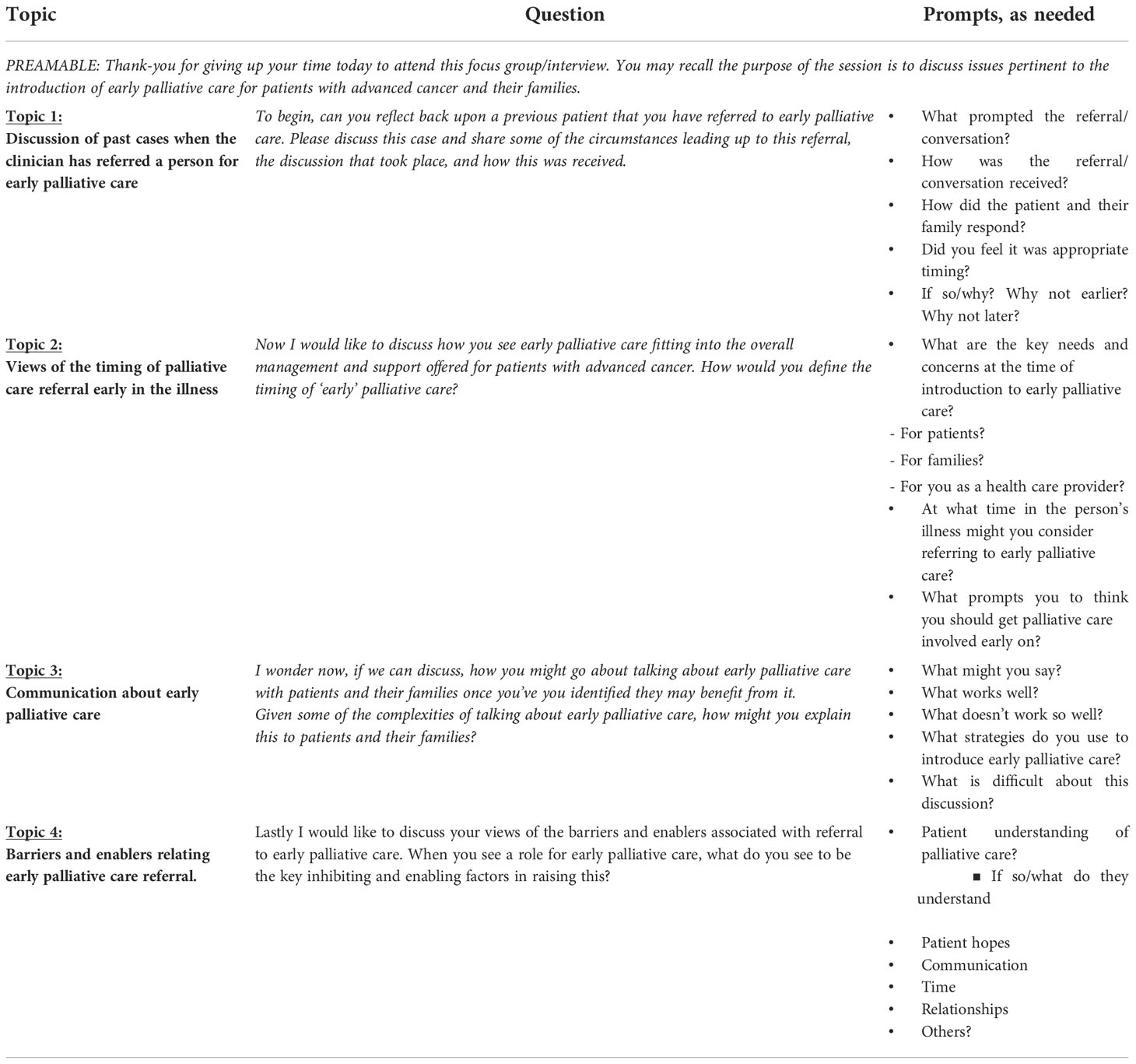
Communication about early palliative care: A qualitative study of oncology providers’ perspectives of navigating the artful introduction to the palliative care team
ORIGINAL RESEARCH
9 December 2022
Communication about early palliative care: A qualitative study of oncology providers’ perspectives of navigating the artful introduction to the palliative care team
Anna Collins, 3 more and Jennifer Philip
Background: Despite robust evidence for the integration of early palliative care for patients with advanced cancer, many patients still access this approach to care late. Communication about the introduction of Early Palliative Care is an important skill of healthcare providers working in this setting. In the context of limited community understanding about palliative care, patients and their families may express fear or negative reactions to its early introduction. Health professionals may lack the confidence or skill to describe the role and benefits of early palliative care. Aim: This study sought to explore clinicians’ perspectives on communication about referral to early palliative care, specifically identifying facilitators in undertaking this communication task. Methods: An exploratory qualitative study set within a tertiary oncology service in Victoria, Australia. Semi-structured interviews were conducted with purposively sampled oncology clinicians exploring their perspectives on communication about referral to early palliative care. A reflexive thematic analysis was undertaken by two researchers, including both latent and semantic coding relevant to the research question. Reporting of the research was guided by the Consolidated Criteria for Reporting Qualitative Research (COREQ) checklist. Results: Twelve oncology clinicians (58% female, with 67% > 15 years clinical experience) from medical oncology, surgical oncology, and haematology participated. The artful navigation of communication about early palliative care was characterised by the need for a ‘spiel’ involving the adoption of a series of strategies or ‘tactics’ when introducing this service. These themes included: 1) Framing in terms of symptom control; 2) Framing as additive to patient care; 3) Selling the service benefits of early palliative care; 4) Framing acceptance of referral as an altruistic act; 5) Using carefully selected and rehearsed language; and 6) Adopting a phased approach to delivering information about palliative care. Implications: This study highlights the wide ranging and innovative communication strategies and skills required by health professionals to facilitate referral to early palliative care for cancer patients and their families. Future focus on upskilling clinicians around communication of this topic will be important to ensure successful implementation of models of early palliative care in routine cancer care.

9,119 views

11 citations

Gratitude among advanced cancer patients and their caregivers: The role of early palliative care
ORIGINAL RESEARCH
24 October 2022
Gratitude among advanced cancer patients and their caregivers: The role of early palliative care
Eleonora Borelli, 9 more and Elena Bandieri

6,760 views

28 citations

ORIGINAL RESEARCH
14 October 2022
Simultaneous care in oncology: Assessment of benefit in relation to symptoms, sex, and age in 753 patients
Antonella Galiano, 21 more and Vittorina Zagonel

3,720 views

9 citations

ORIGINAL RESEARCH
15 September 2022
The feasibility of triggers for the integration of Standardised, Early Palliative (STEP) Care in advanced cancer: A phase II trial
Anna Collins, 5 more and Jennifer Philip

3,335 views

8 citations

ORIGINAL RESEARCH
16 August 2022
Prognostication in palliative radiotherapy—ProPaRT: Accuracy of prognostic scores
Marco Maltoni, 9 more and Romina Rossi

2,584 views

10 citations