Bridging The Gap of Unmet Need in Stroke Care in Developing Countries

Cover image for Research Topic "Bridging The Gap of Unmet Need in Stroke Care in Developing Countries"
87kviews
BRIEF RESEARCH REPORT
27 March 2026
Assessing the cost of acute stroke care in Ethiopian public tertiary hospitals: a multicenter study
Kemal Ali, 4 more and Yared Mamushet Yifru

2,469 views

ORIGINAL RESEARCH
19 February 2026
Public health implications of lifestyle and sociocultural determinants of stroke risk and serum biochemical markers among older adults in northern Thailand
Pattaranai Chaiprom, 4 more and Pornanan Boonkorn

1,874 views

ORIGINAL RESEARCH
27 October 2025
A comparative analysis of TOAST and ASCOD criteria in etiologic subtyping of acute ischemic stroke at a tertiary hospital in Tanzania
Mukasa Mohammed, 3 more and Philip Adebayo

2,878 views

ORIGINAL RESEARCH
25 September 2025
Stroke knowledge and attitudes influence early hospital arrival in acute ischemic stroke: a multicenter cross-sectional survey from Hubei Province, China
Xiangbo Wu, 7 more and Guangming Xia

2,889 views

4 citations

SYSTEMATIC REVIEW
7 October 2025
Risk prediction models for discharge disposition in patients with stroke: a systematic review and meta-analysis
Chaoran Xu, 7 more and Xiaomei Zhang

2,909 views

3 citations

PERSPECTIVE
1 September 2025
Pragmatic recommendations to improve access to rehabilitation robots, assistive technologies and neurorehabilitation services in Africa: proceedings from ICORR-SASNET Ghana neurorehabilitation workshop, 2024
Ebenezer Ad Adams, 26 more and Michelle J. Johnson

3,975 views

1 citations

ORIGINAL RESEARCH
7 August 2025
Toward improved stroke care in Nepal: insights from a qualitative study on barriers and success factors
Christine Tunkl, 21 more and Christoph Gumbinger

2,774 views

1 citations

REVIEW
17 September 2025
The impracticality of radiomics research in acute ischemic stroke: from the perspective of primary healthcare institutions
Shaojun Zhangand Jiehao Tu

2,572 views

1 citations

A predictive model for early neurological deterioration after intravenous thrombolysis in patients with ischemic stroke
ORIGINAL RESEARCH
17 February 2025
A predictive model for early neurological deterioration after intravenous thrombolysis in patients with ischemic stroke
Liping He, 5 more and Ran Chen
ObjectiveIntravenous thrombolysis (IVT) is the treatment of choice for acute ischemic stroke (AIS), but some patients develop early neurological deterioration (END) within 24 h after IVT. Therefore, we aimed to identify predictors of END in AIS patients following treatment with IVT.MethodsWe retrospectively analyzed the clinical data of 621 AIS patients who received IVT with recombinant tissue-type plasminogen activator (rt-PA) at the Stroke Centre of the People’s Hospital of Lu’an City, China, from July 2018 to July 2023. Clinical data, including demographic characteristics, clinical assessment results, underlying diseases, and laboratory indices, were collected at the time of admission. The patients were divided into training and validation cohorts, after which LASSO regression was applied to select the most important predictor variables, and multivariate logistic regression was used to construct a nomogram. The discriminative power of the model was determined by calculating the area under the curve (AUC), and calibration and decision curve analyses (DCA) were performed.ResultsThe platelet-to-lymphocyte ratio (PLR) (OR 1.01, 95% CI 1.01–1.01, p < 0.001), mean platelet corpuscular volume (MPV) (OR 2.12, 95% CI 1.67–2.69, p < 0.001), and admission NIHSS score (OR 1.25, 95% CI 1.16–1.36, p < 0.001) were significantly associated with the development of END. The AUC of the prediction model constructed from these three factors was 0.896 (95% CI 0.862–0.93), and the calibration curve was close to the diagonal.ConclusionThis predictive model can be used for the early identification of the risk of developing END after IVT and development of active interventions to improve the prognosis of AIS.

3,153 views

8 citations

ORIGINAL RESEARCH
6 June 2025
Effect of PDCA-optimized good limb positioning on hemiparetic rehabilitation outcomes in acute cerebral infarction
Wei Liu, 2 more and Xin He

3,913 views

Developmental trajectory of care dependency in older stroke patients
ORIGINAL RESEARCH
20 May 2024
Developmental trajectory of care dependency in older stroke patients
Qinger Lin, 2 more and Hongzhen Zhou

9,785 views

2 citations

ORIGINAL RESEARCH
8 October 2024
Development and validation of a nomogram to predict acute postoperative urinary retention in ischemic stroke patients following femoral artery puncture
Minfang Zhu, 2 more and Juanbi Gao

1,925 views

ORIGINAL RESEARCH
1 May 2024
Stroke awareness and knowledge in Sudan: a cross-sectional analysis of public perceptions and understanding
Eyman M. Eltayib, 14 more and Hassan Hosseini

4,452 views

8 citations

ORIGINAL RESEARCH
1 February 2024
Challenges in adapting a stroke unit in a middle-income country: warning about costs and underfunding to achieve the Brazilian Ministry of Health’s benchmark
Natalia Cristina Ferreira, 12 more and Rodrigo Bazan

2,581 views

3 citations

2,049 views

3 citations

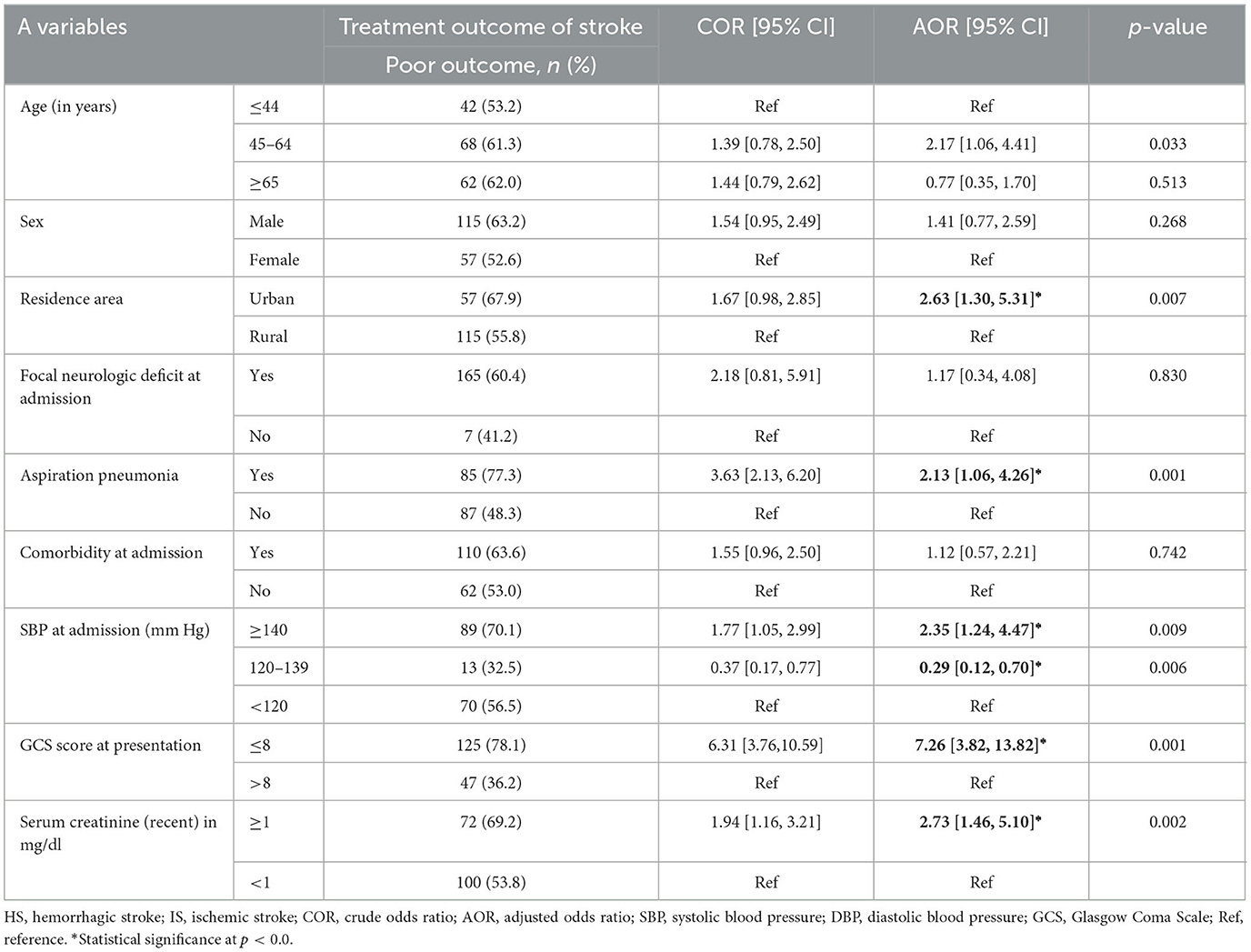
Background: Stroke is a significant health problem in both industrialized and developing nations. It is the world's second leading cause of death worldwide. Stroke incidence, prevalence, and death rates have grown internationally, with low-and middle-income nations suffering the greatest proportion of the burden. Stroke is a leading cause of long-term physical impairment, affecting a person's quality of life, societal engagement, independence, emotions, and productivity. Objective: To determine the magnitude and factors associated with poor treatment outcomes in hospitalized adult patients with stroke. Methods: A hospital-based cross-sectional study was conducted from January 2019-June to 2021 in stroke patients admitted to the Hiwot Fana Comprehensive Specialized Hospital. This study included 290 patient charts. Data were collected by reviewing the medical charts using a well developed data abstraction form. Data were entered into Epi-Data version 3.2 and exported to SPSS version 25.0. Descriptive statistics were used to describe study variables. Additionally, bivariable and multivariable logistic regression analyses were used to identify factors associated with poor stroke treatment outcomes. Statistical significance was set to declare statistical significance. Results: Among 290 enrolled patients, 172 (59.3 %) had poor stroke treatment outcomes. The mean age of the patients was 54.7(±SD:16.1) years and more than half 182(62.8%) of the participants were males. The overall average length of stay hospital Stays in stroke patients was 8±3.3 days. Age of 45-64 years (AOR:2.17, 95% CI: 1.06, 4.41), aspiration pneumonia (AOR:2.13, 95%CI: 1.06, 4.26), SBP ≥140 mmHg/dl (AOR:2.35, 95%CI: 1.24, 4.47), GCS of <8 (AOR:7.26, 95%CI: 3.82, 13.8), and serum creatinine level of ≥1 mg/dl (AOR:2.73, 95%CI: 1.46, 5.10) were significantly associated with poor treatment outcome in adult stroke patients. Conclusion: Six out of ten stroke patients had poor treatment outcomes. Age between 45 and 65 years, uncontrolled hypertension, aspiration pneumonia, low Glasgow coma scale at admission, and renal injury were identified as significantly associated with poor treatment outcomes in stroke patients.

2,998 views

8 citations

ORIGINAL RESEARCH
12 January 2024
The facilitators and barriers to home-based robotic rehabilitation in India: a pilot feasibility study
Aravind Nehrujee, 8 more and Sivakumar Balasubramanian

4,748 views

5 citations