55kviews

3,822 views

7 citations

ORIGINAL RESEARCH
27 November 2023
Availability of emergency contraception in large Brazilian municipalities: a guaranteed right?
Ana Carolina Gomes Pinheiro, 6 more and Rafael Santos Santana

4,547 views

ORIGINAL RESEARCH
18 September 2023
Cardiovascular adverse effects associated with the use of anti-HER2 in breast cancer treatment
Patricia Marques Soares Valente, 3 more and Selma Rodrigues de Castilho

2,137 views

3 citations

Drug utilization research (DUR) is used to provide evidence-based data to inform policies and make decisions. The aim of this study was to map and describe available data sources for DUR in Peru. We performed a search of data sources providing information on medication use on the website of governmental organizations. We also conducted a literature review using PubMed, LILACs, and BVS. Independently, researchers screened eligible data sources. Data characterization included accessibility, coverage data provider, type of data sources, and setting. We performed a descriptive analysis. We identified seven data sources, VIGIFLOW, ENSUSALUD, ICI, and IDI (SISMED) from MINSA and CRI-ESSALUD, Central Planning and Budget Management, and Hospital Management from ESSALUD. These presented information on adverse drug reactions (n=2), drug consumption, and distribution (n=2), prescription and drug dispensing (n=1), and surveys addressed to medication users (n=2). ENSUSALUD was the only data source publicly available. VIGIFLOW and ENSUSALUD have a national granularity from the public and private sectors. The setting of the data sources was both hospital and ambulatory care. Two data sources have individual-level data on adverse drug reactions and one on prescriptions. Four studies on drug utilization research in Peru were derived from ENSUSALUD. In Peru, few data sources are available for DUR. There is an increased need to monitor medications for decision-making purposes. Local and international initiatives and partnerships of the government with academic institutions and the private sector might be a good strategy to increase the transparency of health data and for supporting decision-making using DUR.

5,941 views

8 citations

ORIGINAL RESEARCH
5 January 2023
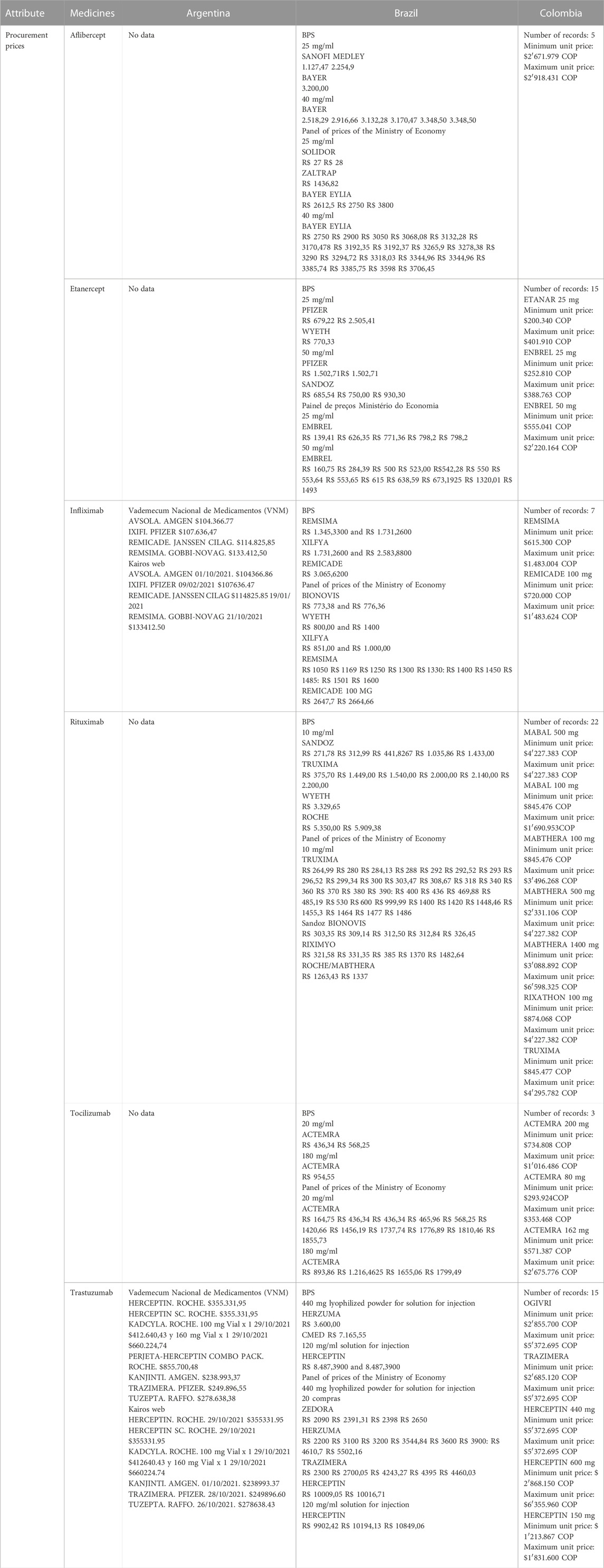
Transparency of data on the value chain of medicines in Argentina, Brazil, and Colombia
Alane Andrelino Ribeiro, 4 more and Silvana Nair Leite
Introduction: The transparency of data on the value chain of medicines is crucial for the study and monitoring of the pharmaceutical system. It may impact medicines´s pricing negotiations, contribute to people's access to pharmaceutical products and strengthen public health systems. Objective: This article analyses the national strategies to ensure the transparency of data from medicines cost development to marketing in Argentina, Brazil and Colombia. Method: A descriptive study was carried out by searching databases, contents of reports, documents and scientific articles between january and august 2022 related to the rules on transparency and databases available about 1) Marketing authorization; 2) Pricing; 3) Intellectual property; 4) clinical trials; 5) Research & Development (R&D) and 6) Health Technology Assessment (HTA) of selected biopharmaceuticals. Results: Transparency data, rules and information are not uniform. We provide evidence that as for infostructure (organizational capacity for collecting and distributing information) about the pharmaceutical value chain, the three countries face limitations to take appropriate measures to publicly share data and evidence about the pre-clinical, clinical data and costs. None require transparency about data on research and development costs. All the countries present similar publicization of data on marketing authorization and intellectual property, with the due peculiarities. Argentina presents important limitations, such as the absence of formal price regulation and of data on volume of purchases of medicines and respective amounts paid. Brazil, among the three, presents a higher degree of information transparency, perhaps due to the legal regulation that guarantees citizens access to information of public interest. This country stands out especially in terms of publicity of HTA reports and pricing, in addition to the highest volume of information. Colombia, on the other hand, drew attention to a decree that determines 5 years of trials data exclusivity for new medicines, going against data transparency. Despite the different stages of transparency, no country has shown a robust use of these data in public policy decision-making. Conclusion: information asymmetry between stakeholders, data fragmentation, data gaps and overlapping, and difficulty in comparing available data across the three countries, and also to the use of data nationally to produce evidence.
Transparency of data on the value chain of medicines in Argentina, Brazil, and Colombia

8,107 views

10 citations

BRIEF RESEARCH REPORT
23 December 2022
Objective. Evaluate data on the psychotropic drugs dispensed of psychotropic drugs by private community pharmacies before and during the SARS-CoV-2 pandemic. Methods. This cross-sectional study compared the quarterly and annual consumption per Defined Daily Dose per 1000 inhabitants-day (DHD) of psychotropic drugs. Interrupted time series were also constructed to expose changes in the consumption pattern in the periods before and after March 2020. Results. Among the 20 most consumed psychoactive drugs, 12 were antidepressants, escitalopram (DHD 7.996 and 10.626; p<0.001), and sertraline (DHD 6.321 and 8.484; p<0.001), in addition to the hypnotic zolpidem (DHD 6.202 and 8.526; p<0.001). The time series reveals (R2 value) a variation in drug dispensing, in DHD values, during the pandemic. Conclusion. Despite the higher variance, a significant increase is clearly seen in the consumption trends of psychoactive drugs, particularly antidepressants, consistent with the pandemic´s influence on the general population´s mental health.
Dispensing of psychotropic drugs in the Brazilian capital city before and during the COVID-19 pandemic (2018–2020)

5,496 views

18 citations