Using Behavioral Theories to Improve Medication Use

Cover image for Research Topic "Using Behavioral Theories to Improve Medication Use"
73kviews
Editorial11 March 2026
Editorial: Using behavioral theories to improve medication use

patient engagement across diverse populations and care settings. Spanning different healthcare contexts, policy changes, disease states, and behavioral frameworks, these articles demonstrate that medication use emerges from a complex interplay of individual beliefs, social norms, healthcare professionals' interactions, and environmental factors.Theoretical models can specify mechanisms that drive decision-making, and articulate why patients with similar demographic profiles may adopt different medication use patterns. A coherent narrative of this Research Topic is that medication use is best understood as a dynamic and complex behavioral process, depending on individuals' belief systems, past experiences, and social influences. For

1,162 views

Attention-deficit hyperactivity disorder medication shortage in the United States: a qualitative assessment of Reddit posts
ORIGINAL RESEARCH
7 July 2025
Attention-deficit hyperactivity disorder medication shortage in the United States: a qualitative assessment of Reddit posts
Shikhar Shrestha, 2 more and Saloni Dev
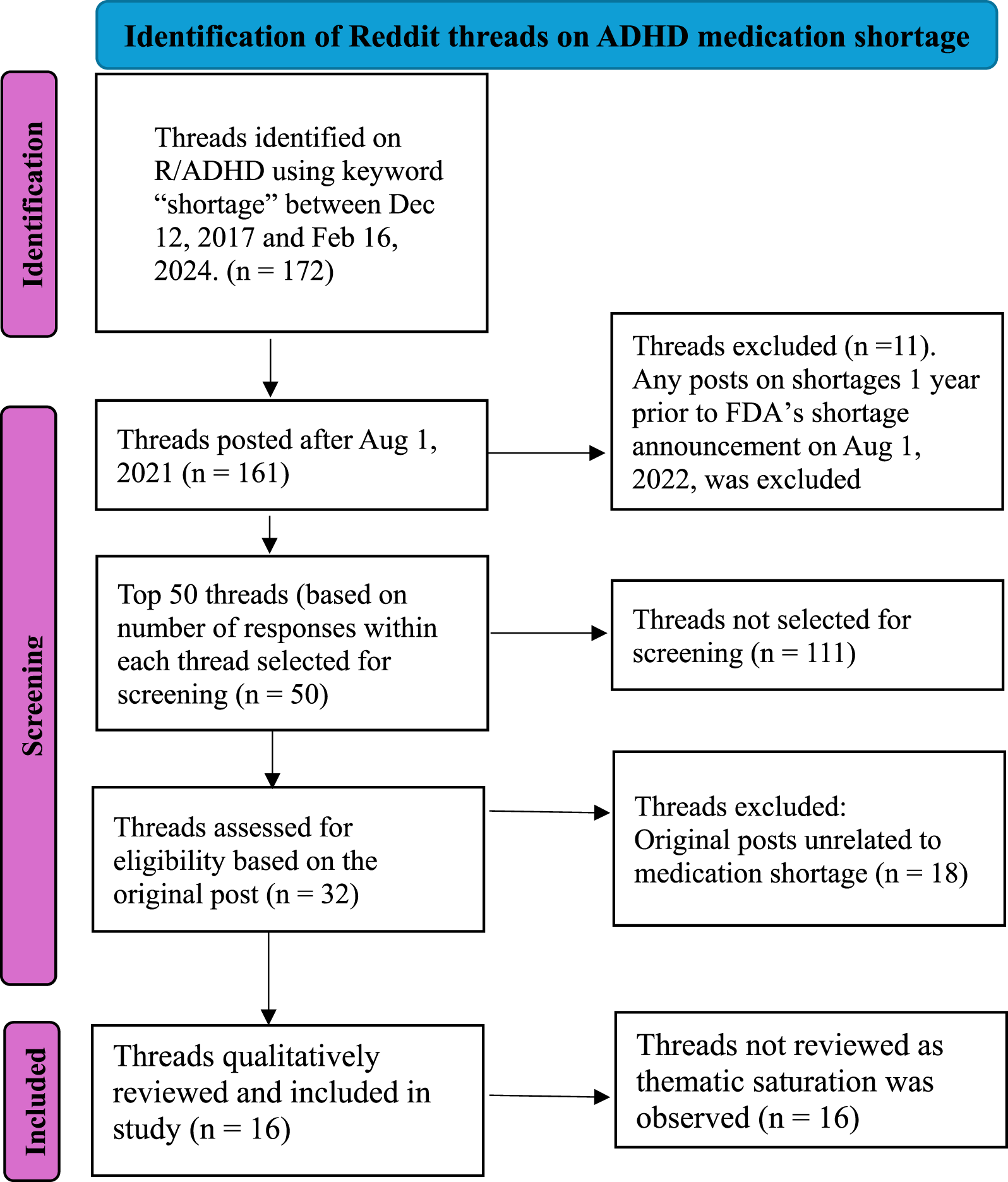
IntroductionApproximately 6% of the US population had been diagnosed with attention-deficit hyperactivity disorder (ADHD) in 2023, and approximately 33% of the patients received stimulants to manage it. Recent ADHD medication shortages in the United States have caused substantial disruptions in access to these medications. The objective of our study was to investigate how individuals respond psychologically and behaviorally to ADHD medication shortage in the United States using public discussions on Reddit.MethodsWe extracted Reddit threads from “r/ADHD” that consisted of the keyword “shortage.” After identifying relevant threads, we qualitatively analyzed 16 threads relevant to our study to reach thematic saturation. We used a hybrid inductive–deductive thematic analysis grounded in stress and coping theory to perform a qualitative analysis of the posts between August 2021 and February 2024.ResultsOur findings show that redditors consuming ADHD medication experienced significant cognitive, emotional, and functional impacts due to medication shortage (primary appraisal). Redditors reported challenges with accessing medication due to complex medical systems, unsupportive healthcare providers, financial strain, and limited understanding of the causes of the shortage (secondary appraisal). Redditors also reported a range of pharmacological (change in dosage/medication, skipping dosage, saving medication, caffeine, and nicotine) and non-pharmacological (meditation and exercise) changes to behavior to manage the shortage (coping strategies). In addition, the Reddit community fostered support, positivity, and resource-sharing to navigate the shortage.ConclusionOur study highlights the urgent need for healthcare policies that support individuals with ADHD amid shortages, emphasizing the role of transparent communication from pharmacies, healthcare providers, and regulatory bodies.

8,234 views

8 citations

Transforming respiratory diseases management: a CMO-based hospital pharmaceutical care model
ORIGINAL RESEARCH
23 October 2024
Transforming respiratory diseases management: a CMO-based hospital pharmaceutical care model
Borja Zarate-Tamames, 6 more and Ramon Morillo-Verdugo
Introduction Respiratory diseases encompass a diverse range of conditions that significantly impact global morbidity and mortality. While common diseases like asthma and COPD exhibit moderate symptoms, less prevalent conditions such as pulmonary hypertension and cystic fibrosis profoundly affect quality of life and mortality. The prevalence of these diseases has surged by approximately 40% over the past three decades. Despite advancements in pharmacotherapy, challenges in drug administration, adherence, and adverse effects persist. This study aimed to develop and perform an interim validation of a Capacity-Motivation-Opportunity (CMO) model tailored for respiratory outpatients to enhance pharmaceutical care, which is the direct, responsible provision of medication-related care for the purpose of achieving definite outcomes that improve a patient’s quality of life, and overall well-being. Methodology This cross-sectional, multicenter study was conducted from March 2022 to March 2023. It comprised four phases: (1) forming an expert panel of 15 hospital pharmacists, (2) selecting respiratory pathologies based on prevalence and severity, (3) developing the CMO model's pillars, and (4) integrating and conducting an interim validation of the model. The Capacity pillar focused on patient stratification and personalized care; the Motivation pillar aligned therapeutic goals through motivational interviewing; and the Opportunity pillar promoted the use of information and communication technologies (ICTs) for telemedicine. Results The model included eight respiratory diseases based on expert assessment. For the Capacity pillar, 26 variables were defined for patient stratification, leading to three priority levels for personalized pharmaceutical care. In a preliminary test involving 201 patients across six hospitals, the stratification tool effectively classified patients according to their needs. The Motivation pillar adapted motivational interviewing techniques to support patient adherence and behavior change. The Opportunity pillar established teleconsultation protocols and ICT tools to enhance patient monitoring and care coordination. Conclusion The CMO model, tailored for respiratory patients, provides a comprehensive framework for improving pharmaceutical care. By focusing on patient-centered care, aligning therapeutic goals, and leveraging technology, this model addresses the multifaceted needs of individuals with respiratory conditions. Future studies are necessary to validate this model in other healthcare systems and ensure its broad applicability.

4,554 views

11 citations

ORIGINAL RESEARCH
9 October 2024
Preferences of patients with multiple chronic diseases for medication in rural areas of an Eastern Province China: a discrete choice experiment
Xiaona Li, 8 more and Zhongming Chen

3,261 views

1 citations

ORIGINAL RESEARCH
14 August 2024
Continuities and discontinuities in pharmaceutical treatment and medication use among older chronically ill patients of Turkish descent in Germany: a qualitative structuring content analysis
Hürrem Tezcan-Güntekin, 7 more and Ilknur Özer-Erdoğdu

2,605 views

1 citations

ORIGINAL RESEARCH
16 September 2024
The approach of Norm Balance in predicting pharmacists’ intention to collaborate with physicians to improve medication therapy
Yifei Liu, 4 more and William R. Doucette

1,881 views

1 citations

Consumer awareness and knowledge regarding use of non-steroidal anti-inflammatory drugs (NSAIDs) in a metropolitan area
ORIGINAL RESEARCH
20 June 2024
Consumer awareness and knowledge regarding use of non-steroidal anti-inflammatory drugs (NSAIDs) in a metropolitan area
Paolo Montuori, 7 more and Maria Triassi

8,327 views

18 citations

ORIGINAL RESEARCH
3 April 2024
Preschool children’s asthma medication: parental knowledge, attitudes, practices, and adherence
Jianlan Tang, 5 more and Nan Luo
Preschool children’s asthma medication: parental knowledge, attitudes, practices, and adherence
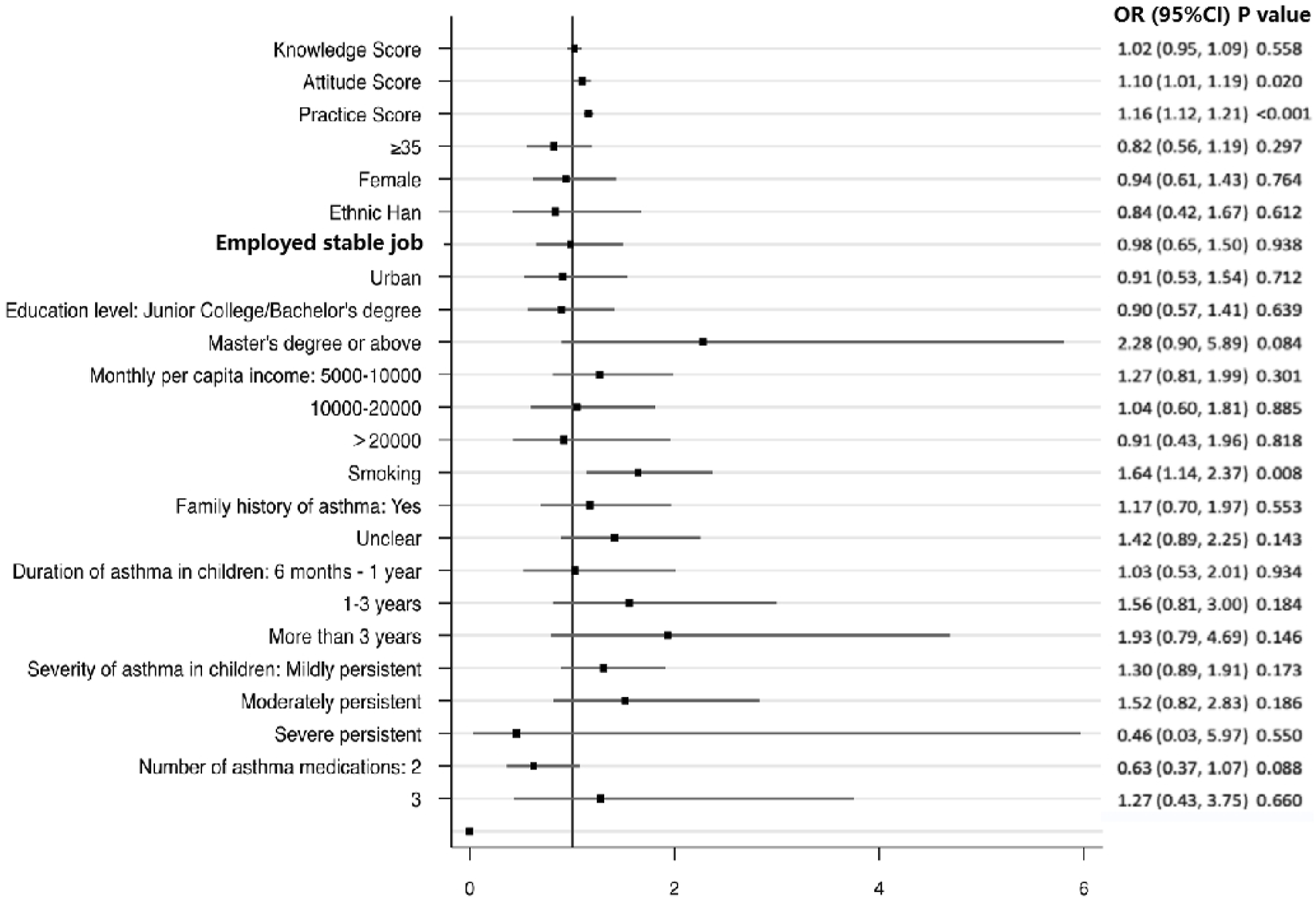
This study aimed to analyze the knowledge, attitudes, and practices (KAP) toward asthma medication and adherence among preschool-aged asthmatic children’s parents and explore the factors influencing adherence. This cross-sectional study was conducted between February 2023 and April 2023. Parents of preschool children with asthma were asked to complete the questionnaire containing knowledge, attitude, practice dimensions, and demographic characteristics. The Morisky Medication Adherence Scale (MMAS) was used to investigate adherence. A total of 632 valid questionnaires (154 male and 478 female) were included. Parents showed moderate knowledge (9.49±2.86, 63.27%, possible range: 0-15) and moderate attitudes (26.18±2.51, 74.80%, possible range: 7-35) towards asthma medication, while their practices (27.46±5.26, 91.53%, possible range: 6-30) were proactive; however, medication adherence was low (4.84±1.78, total score: 8). The attitude scores (OR=1.10, 95%CI: 1.01-1.19, P=0.020), practice scores (OR=1.16, 95%CI: 1.12-1.21, P<0.001), and smoking (OR=1.64, 95%CI: 1.14-2.37, P=0.008) were associated with medication adherence. Preschool-aged asthmatic children’s parents showed moderate knowledge, attitudes, and proactive practice toward asthma medication. Continuous training and education programs should be provided for parents to improve asthma medication management in preschool children.

4,645 views

12 citations

5,627 views

9 citations

Objective: This study aimed to examine the factors affecting medication literacy in community-dwelling older adults with hypertension, guided by social learning theory. It sought to analyze the pathways these factors influenced and provide a theoretical foundation for designing targeted intervention programs. Study design:This is a cross-sectional study. Methods: From October 2022 to February 2023, a total of 432 community-dwelling older adults with hypertension from Linghe District, Guta District, and Taihe District, Jinzhou City, Liaoning Province, China, were selected using convenience sampling. Data were collected using a socio-demographic questionnaire, a medication literacy questionnaire, the Brief Illness Perception Questionnaire, the General Self-efficacy Scale, and the Perceived Social Support Scale. The collected data were analyzed with Kruskal-Wallis and Mann-Whitney tests, correlation analysis, multiple stepwise regression analysis, and structural equation modeling (SEM). Results: The medication literacy score among the participants was 3.83 ± 1.91. Multi-factor analysis revealed key factors affecting their medication literacy, including blood pressure-control status, utilization of community health education resources, receiving guidance for medication usage, marital status, number of annual visits, social support, self-efficacy, and disease perception. The SEM based on social learning theory showed that general self-efficacy mediated the relationship between social support, disease perception, and medication literacy. Conclusion: The present study developed a model and provided potential intervention strategies to improve medication literacy, knowledge, and safety among community-dwelling older adults with hypertension, considering the relationships between the identified variables.

6,494 views

25 citations