
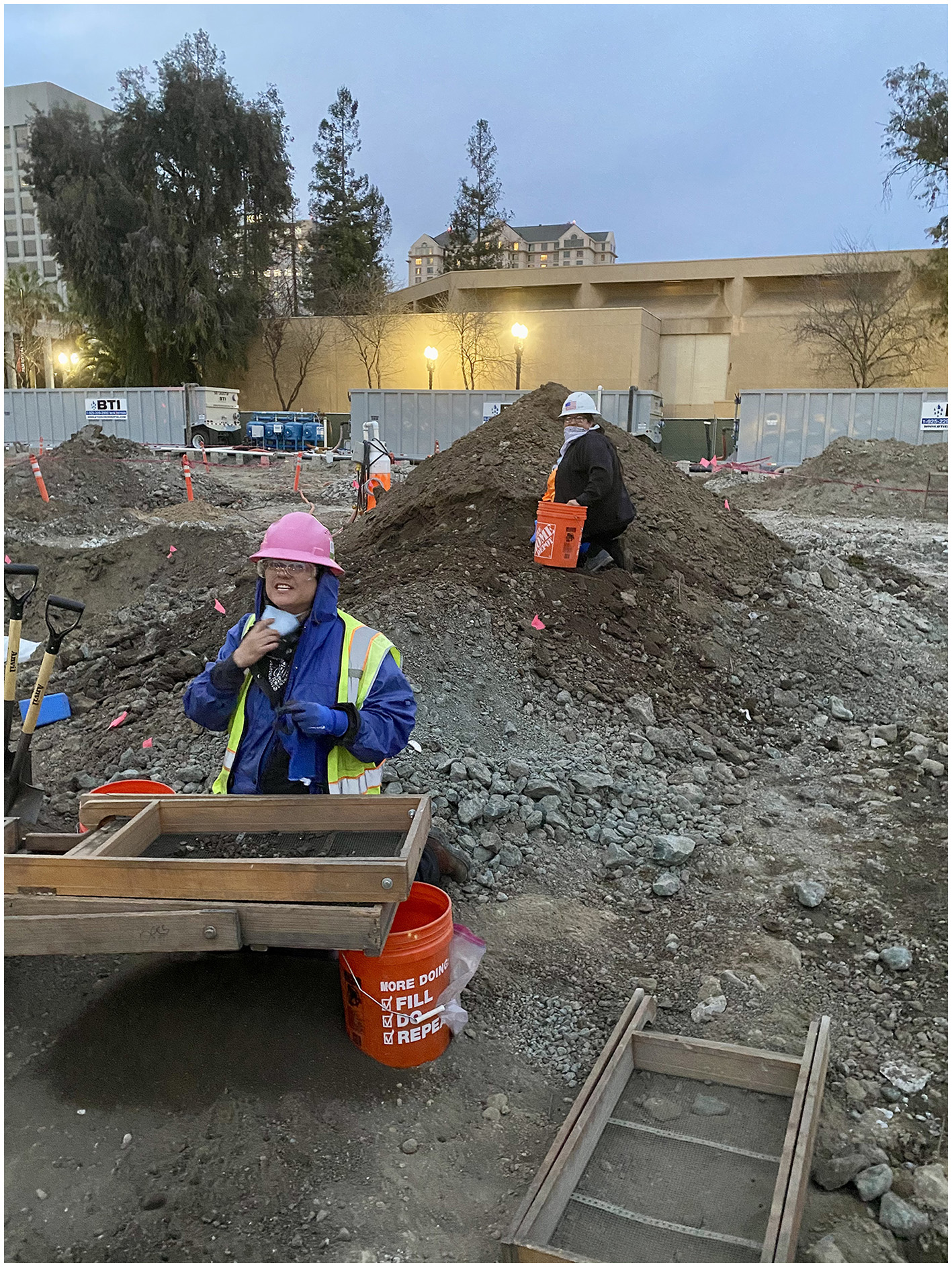
The study of Indigenous stewardship practices is a growing component of archaeological, ecological, and biological studies. In ecology, Indigenous stewardship is often synonymous with discussions of sustainability, adaptive management, traditional ecological knowledge (TEK), and traditional resource and environmental management (TREM) (Berkes, Colding and Folke, 2000;Berkes, 2009Berkes, , 2026;;Fowler and Lepofsky, 2011;Lepofsky, 2009;Nadasdy, 1999;Turner, Ignace and Ignace, 2000).Yet, the study of subsistence practices (e.g., diet breadth, caloric value, carrying capacity) has been a staple of environmental archaeology for decades and has also contributed to our baseline understandings of landscapes, foodways, and other related topics. Through an archaeological lens, the topic of Indigenous stewardship often builds from Fowler and Lepofsky's (2011) conceptualization of traditional resource and environmental management. Similarly, Lightfoot and colleagues (2021;2025) define Indigenous stewardship "as the application of traditional ecological knowledge to maintain or enhance the abundance, diversity and/or availability of natural resources or ecosystems." Indigenous stewardship is more closely aligned with discussions of resource management, but we use the term stewardship to reflect Indigenous perspectives and relationality (Apodaca et al., 2024;Sigona, Apodaca and Lopez, 2021;Tynan, 2021;Wildcat and Voth, 2023). This special issue highlights how Indigenous peoples engage with their cultural heritage through archaeology, heritage management, and environmental science. Through these case studies, the authors document the interconnections among Indigenous stewardship in the past, present, and future. The articles highlighted in this volume demonstrate the diverse ways that Indigenous people and their research collaborators are engaging with the field of archaeology to support the stewardship of cultural landscapes and heritage, which, in turn, is changing the methods and theoretical perspectives in our discipline. We believe this is accomplished in five ways, which include 1) creating change in cultural heritage management; 2) informing the training of the next generation of Tribal and non-Tribal practitioners; 3) building diverse co-management pathways with state, federal, and private landholding agencies; 4) stewardship of cultural sites through protection, mitigation, interpretation, monitoring, renaming, and other means (e.g., activism, easements, ownership, co-management agreements); and 5) tracking the impact of collaborative approaches within the field (Apodaca et al., 2024;Carney, 2024;Kelly et al., 2024;Panich et al., 2024;Sanchez et al., 2024;Sunseri, Moore and Allen, 2025;McFarland, 2026;Tushingham, Carney and Scher, 2026). As Indigenous communities continue to practice and contribute to archaeology, the discipline has benefited from innovative approaches to field and laboratory methods, as well as interpretative frameworks. While non-Indigenous archaeologists have historically conceived of archaeological data and cultural resources as separate from contemporary environmental resources, such as animals, plants, and broader landscapes, these perspectives are unaligned with many Indigenous ontologies. Instead, Indigenous peoples often recognize that archaeological sites are just one element among many to be considered when encompassing broader cultural landscapes and heritage resources over time.Specifically, Panich et al. (2024) highlight how the Muwekma Ohlone Tribe has engaged with archaeology for over four decades, both in collaboration with academic and cultural resource management (CRM) archaeologists and through the creation of their own CRM firm. As highlighted in the article, the Muwekma Ohlone played a critical role in the reinterpretation and reclamation of Indigenous cultural heritage, especially within colonial spaces, such as the Spanish Mission system. Through these efforts, the Tribe is working to highlight Muwekma Ohlone heritage in the past, present, and future. Carney (2024) highlights the tension in eco-archaeological research interrogating humanenvironment relationships, which is often conducted from an evolutionary perspective. She notes the differences between these evolutionary approaches and many Indigenous peoples' engagement with and understanding of place, plants, and animals as kinship relations. Carney (2024) suggests scholars should work to adopt the phrase stewardship to recognize and uphold notions of respect, reciprocity, and relationships that are common within many Indigenous worldviews and advocates for the use of pluralistic approaches to our collaborative scholarship. Apodaca et al. (2024) demonstrate how the Amah Mutsun Tribal Band (AMTB) and the Amah Mutsun Land Trust (AMLT) use eco-archaeology and historical ecology to steward terrestrial and aquatic ecosystems. In the article, Apodaca and colleagues outline the history of the AMTB's engagement with archaeology, particularly studies on the long-term use of cultural burning and the stewardship of plants and animals through sustainable harvesting. Beyond archaeological studies, the article outlines how the AMTB and AMLT steward ancestral lands through the Cultural Resource Program, Native Stewardship Corps, Native Monitoring Program, Native Plant Propagation, and Ocean and Coastal Stewardship. Kelly et al. (2024) provide a critical example of how the K'ómoks First Nation in British Columbia stewards their cultural heritage, which is threatened by development, private property rights, and colonial planning. The authors explore the role of policy and planning in local heritage management. Through the Xwe'etay/Lasqueti Archaeological project (XLAP), the research team conducted interviews with First Nations, settler policy makers, and planners. The article provides an important example of how Indigenous communities exert self-determination over their Indigenous Cultural Heritage (ICH); how ICH interacts with local planning; and how local governments can respond to strengthen ICH protection at the local level. Sanchez et al. (2024) provide an example of a collaborative archaeology project between the Esselen Tribe of Monterey County, the Hastings Natural History Reservation, and the University of Oregon. Through landscape-scale surveys, geophysics, and small-scale excavations, the historical ecological studies at the Hastings Natural History Reservation identified Spanish Mission-era occupations within the reserve, which provide evidence of Indigenous cultural persistence, survivance, and resilience contrary to the narratives of culture loss and erasure espoused by 20th-century California anthropology regarding the Indigenous societies that occupied the central California coast. Sunseri, Moore, and Allen (2025) outline the use of low-impact archaeology and geophysics by tribes in California, including Nisenan, Maidu, Washoe, and Miwok. The goals of their collaborative research include the use of non-invasive technologies and the co-creation of a collaborative research agenda. The project includes the United Auburn Indian Community, the University of California, Berkeley, the Colfax-Todds Valley Consolidated Tribe, the Shingle Spring Band of Miwok Indians, and staff at the UC-Blodgett Research Forest, Eldorado, and Tahoe National Forests. The team is learning to integrate the cultural fire with communityacceptable archaeological research and tracking changes in forest management practices. Tushingham, Carney, and Scher (2026) highlight the critical role of archaeological field schools in training the next generation of archaeologists. Through a collaborative field school that involved the Kalispel Tribe of Indians, Washington State University (WSU), and Far Western Anthropological Research Group, the authors identify three entrenched barriers in training: (1) conflicting institutional goals and data-ownership conventions; (2) financial and accessibility constraints that limit participation; and (3) disciplinary fragmentation separating academic, CRM, and Indigenous archaeology. By advocating for a rethinking of archaeological field schools the authors argue for the inclusion of "braided perspectives" toto realign archaeological training with the evolving realities of academic and public archaeology. Lastly, McFarland (2026) provides a case study exploring whether Indigenous stewardship of California mussels (Mytilus californianus) could be identified from a series of archaeological sites in Northwestern California spanning the last 2700 years. Through this study, McFarland examined eight archaeological sites and over 9,000 mussel umbones to estimate ancient mussel harvesting strategies. Through this study, McFarland suggests Indigneous people employed selective harvesting practices that not only sustained but also enhanced mussel abundance and size over time.Through this collection of eight studies, we seek to highlight innovations relevant to the holistic understanding of cultural landscapes and heritage resources and to serve as models for Indigenous and non-Indigenous archaeologists across the globe. Our collection of original research articles, systematic reviews, and perspective articles highlights Indigenous engagement with archaeology and other sciences that support long-term evaluations of the interactions and relationships between Indigenous peoples and the environment.

8 Authors
- MK
Mary Kelly
School of Resource and Environmental Management, Simon Fraser University, Canada
- JM
Jesse Morin
Consulting Archaeologist/Ethnohistorian, Canada
- LT
Lia Tarle
K'ómoks First Nation, Canada
- CN
Candace Newman
Intergovernmental Relations, K'ómoks First Nation, Canada
- RB
Raini Bevilacqua
K'ómoks First Nation, Canada
- SB
Sheriden Barnett
Intergovernmental Relations, K'ómoks First Nation, Canada
- SM
Sean Markey
School of Resource and Environmental Management, Simon Fraser University, Canada
- DL
Dana Lepofsky
Department of Archaeology, Simon Fraser University, Canada

5 Authors
- LM
Lee M. Panich
Department of Anthropology, Santa Clara University, United States
- MV
Monica V. Arellano
Muwekma Ohlone Tribe, United States
- MW
Michael Wilcox
Center for Comparative Studies in Race and Ethnicity, Stanford University, United States
- GF
Gustavo Flores
Department of Anthropology, San Jose State University, United States
- SC
Samuel Connell
Department of Anthropology, Foothill College, United States