
diffusion of artificial intelligence create technical possibilities that profoundly transform organizations (Kette/Tacke 2021). Algorithms increasingly define spaces of action and decisionmaking (Wendt 2021), placing renewed emphasis on formal structures (du Gay 2020), which both gain importance and become subject to new forms of relativization. Digital systems operate with considerable autonomy and shape social processes in their own right (Manhart/Wendt 2021). At the same time, digital infrastructures generate new modes of interaction within organizations (Bormann/Truschkat 2022), and it is becoming clear that human perceptual and creative capacities can be substituted by technological systems. It is therefore unsurprising that "fluid," "temporary," "virtual," and "unconventional" organizational forms (Besio/Tacke 2023) increasingly coexist with classical forms, prompting renewed questions about governance logics and the diffusion of organizational concepts (Bromley/Meyer 2021). Against this backdrop, this research topic assembles contributions that illuminate these dynamics and advance organizational research on digitization.The opening contribution provides a conceptual reconstruction of the foundational shifts that make digitization possible in the first place. Sebastian Manhart demonstrates how societal practices of measuring, calculating, and datafication have historically differentiated themselves from communication, establishing a new semiotic order of digital intelligence -an order that simultaneously produces specific organizational and educational conditions for subjective learning and agency. This perspective on the deep structures of digital culture complements the empirical and theoretical insights presented in the subsequent contributions.Building on this, Cristina Besio, Marco Jöstingmeier, and Christine Posner examine the opposite pole of organizational dynamics. Using the case of a German public administration, they show that not only rigidity but also ongoing and uncoordinated change can impede digital transformation.Their concept of organizational restlessness highlights that sustainable digitization requires a nuanced balance between stability and change, challenging long-standing assumptions about bureaucratic organizational logic.Linda Maack extends these considerations by theoretically reframing the boundary between organization and digitality. Drawing on neo-materialist approaches, she illustrates how relational entities emerge within digitalized settings, transforming the meaning of organizational practices themselves. In this perspective, digitalization appears not merely as an external influence but as an ontological dynamic through which organizations and technologies mutually constitute one another.The historical-semantic dimension of organizational change is taken up by Tamara Freis, who reconstructs shifting emotional expectations within organizational contexts. She demonstrates how modern organizations increasingly require their members to regulate emotions and engage in empathic communication -processes that are intensified by digital transformation. From this angle, emotions do not stand in opposition to rationalization but emerge as historically evolved organizational principles that are reconfigured through digitization.A different angle on the logic of collective action in the digital age is offered by Christian Schröder, who applies the concept of transpoiesis to analyze social movements. Using the example of the World Social Forum, he shows how movements negotiate the tension between decentralization and strategic coherence while adapting digital communication formats. His analysis demonstrates that digitization not only transforms formal organizations but also networked collectives whose learning and identity formation require new theoretical perspectives.Questions of social inequality are foregrounded by Leoni Vollmar, who proposes an organizationaltheoretical shift in perspective. She argues that digital inequalities always emerge in organizationspecific ways because digital practices and infrastructures are embedded in concrete organizational settings. This reframing redirects analytical attention from technology-centered to organizationcentered mechanisms of inequality production and introduces a methodological framework that reshapes the study of digitalized work.Focusing more closely on leadership theory, Tamara Freis and Andreas Schröer examine how concepts of digital leadership further relativize classical leadership models under conditions of increasing complexity. Drawing on discourse analysis and initial empirical insights from metaorganizations, they show that digital leadership should be understood less as a rupture than as an extension of unheroic leadership concepts that place greater emphasis on informal structures and processes of subjectivization.The research topic concludes with a contribution by Luisa Peters and Inga Truschkat, who investigate social start-ups as novel actors within the digitization discourse of social services. Due to their hybrid structures and inherently digital organizational modes, these organizations significantly shape discourses, practices, and innovation pathways in the field. Their analysis demonstrates how such organizational forms introduce alternative interpretations and models of socio-digital practice that challenge established providers.Taken together, the contributions offer a multifaceted perspective on digitization as an organizational, cultural, social, and semantic transformation process. The research topic thus positions itself as an invitation to understand digitization research more explicitly and more profoundly as organizational research.
Editorial05 January 2026
Editorial: Organizations between continuity and disruption – The organization and management of perpetual change in times of digitalizationThe article provides a clarification of the concept of digitalization, bringing together its two dimensions: electronic-physical information transformation and the social aspect of connection through the sense-making and creation of meaning via numbers. This is done both conceptually and by presenting the historical development of this socially complex synthesis of causality, sense-making and meaning. Fundamental aspects of social change from communication to information processing, from facts to data, from true nature to virtual possibility, from face-to-face sociality to digital habituation, from human to digital intelligence are presented in their development using historical examples. The focus is on the practices of counting, calculating, and measuring, whose gradual differentiation from communication enables the unlikely process of social implementation of an operationally meaningful but at the same time completely reference-less (digital) semiosis. The analysis of these specifically modern organizational and pedagogical developments as a prerequisite for digitization allows conclusions to be drawn about some aspects of digital subjectivity and society in the age of artificial intelligence.
1,651 views
1 citations
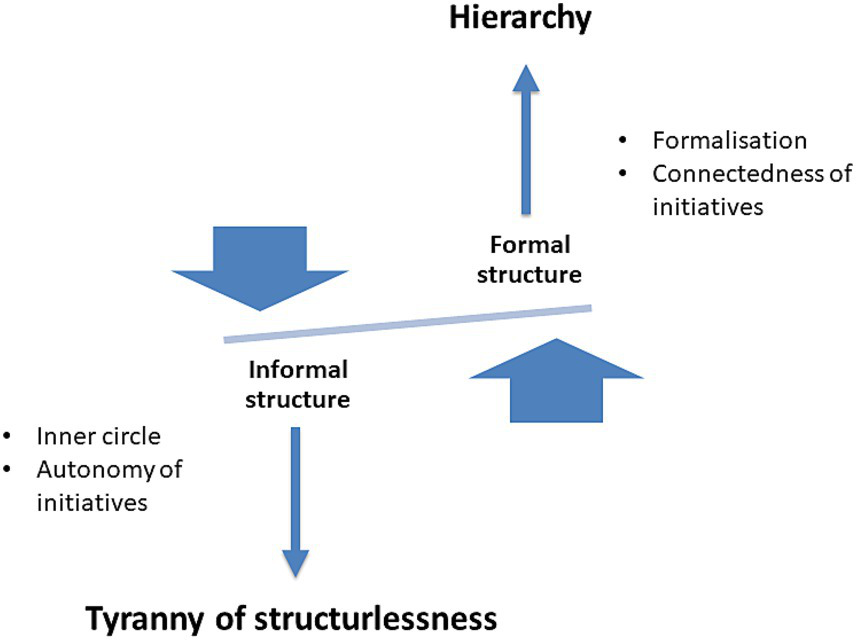
This paper uses the concept of transpoiesis to describe the mechanisms that sustain social movements. Emerging from ethnographic research on the World Social Forum (WSF) and inspired by systems theory, transpoiesis emphasizes the dynamic balance within social movements between decentralized organization and strategic coherence. This differentiates it from autopoiesis, which focuses on self-sustaining systems that maintain and reproduce their structure autonomously through internal processes, rather than emphasizing the dynamic balance between decentralized organization and strategic coherence. Transpoiesis offers a particularly instructive model in the digital age, when classical explanations often fail to account for the rapid pace of change, innovation, flexibility and decentralized collaboration that characterize modern organizations. The concept aids in understanding how social movements build collective identities, navigate organizational dynamics, structure collective learning, and contribute to social change. Moreover, it reflects the broader shift toward network-based arrangements in contemporary organizations, an adaptation to the complexities of the digital environment.
The aim of this article is to take an analytical look at Social Start-Ups as organizational discourse actors of a digitalization discourse in the field of social services. The digital transformation is understood as an all-encompassing socio-cultural phenomenon that gives rise to new discourse arenas in the field of social services, in which Social Start-Ups occupy a special position. So far, however, little is known about the actual role of Social Start-Ups in the digitization discourse of social service work, although they differ from established social services and thus occupy a special spokesperson position. Firstly, Social Start-Ups are characterized by a hybrid organizational structure in that they want to realize social services as commercial enterprises and thus reconcile economic and social goals. Secondly, their entire organizational structure and service practice is a priori based on digital tools and practices that established social services tend to negotiate critically for themselves. Against this background, the article empirically discusses and critically examines the discursive influence of Social Start-Ups on the digitization discourse of social work. The article contributes to understanding how Social Start-Ups influence the digitalization discourse in social services, offering new insights into their unique role as hybrid organizations balancing economic and social goals. By examining their use of digital tools, the research sheds light on alternative models that challenge traditional service providers. This is crucial for advancing research on the evolving role of digitalization in social services and its practical implications for improving service delivery.
1,761 views
Organizations, as central actors in societal structure, undergo significant transformations due to the impact of digitalization, often resulting in disruptive changes. Consequently, organizations increasingly view digitalization as an ongoing process of negotiation, which has led to the emergence of new operational modes and organizational norms. In this context, the interaction between organizations and digital technologies is characterized by recursive dynamics, which blur conventional boundaries. This presents a challenge in defining the distinct domains of the digital and the organizational within the framework of recursivity. This article draws upon new materialism and agential realism to propose an ontological-relational approach to understanding organizational digitality. This approach suggests a reconceptualization of organizational digitality as a mechanism that generates relational entities, thereby reshaping their inherent meanings. By transcending traditional boundaries between organizations and digital, this perspective provides a nuanced understanding of digital phenomena within organizational contexts.
2,861 views
2 citations
The impact of digitalisation at work on existing inequalities is a growing concern. Social inequality is not solely determined by material circumstances, but also by the new social practises that arise in the workplace. However, the discourse about the digitalisation of work lacks specific organisational references. From an organisational theory perspective, it is important to note that digitality always takes place in an organisation-specific manner. Therefore, digitality and organisation are in a reciprocal relationship, resulting in the development of new organisational practises that impact organisational actors as structural conditions of organisational digitality. How the changes at the organisational level affect the mechanisms of production of social inequality in the course of digitalisation has not yet been taken into account, which means that previous research on inequality in digitalised work only allows an organisation-unspecific view of the subject. In contrast, this article places the organisation at the centre of the debate and presents a methodical approach for researching social inequality in the digitalisation of work from the perspective of organisational theory.
1,821 views
1 citations