
Technical Briefs in Mechanical Engineering: Advances and Innovations

Cover image for Research Topic "Technical Briefs in Mechanical Engineering: Advances and Innovations"
42kviews
Optimization of crashworthiness design of foam-filled crash boxes under oblique loading for electric vehicles
ORIGINAL RESEARCH
26 August 2024
Optimization of crashworthiness design of foam-filled crash boxes under oblique loading for electric vehicles
I. Renreng, 2 more and Q. Li
To increase the energy-absorbing capability of frontal collision management systems and improve vehicle crash safety, foam-filled crash boxes should be optimized. On the basis of a double tubular construction, a novel foam-filled crash box with a different design is developed. The energy absorption capacity, initial peak force, and deformation modes of the original and improved crash boxes were examined using impact models. As opposed to the full-filling design, it is demonstrated that the filling design may utilize less foam while increasing specific energy absorption. The stability of continuing deformation after the first buckling is determined by the foam-filled crash box. For the foam-filled crash box, a better-optimized design technique is suggested using the Taguchi method and principal component analysis (PCA). Compression tests are used to validate the design concept. Therefore, the optimal design technique of the crash box is suitable and practical for the crashworthiness design of crash boxes, considering the combined effect of significant indicators for electric vehicles.
3,999 views

10 citations

Experimental investigation of shell and helical coiled heat exchanger with Al2O3 nano-fluid with wide range of particle concentration
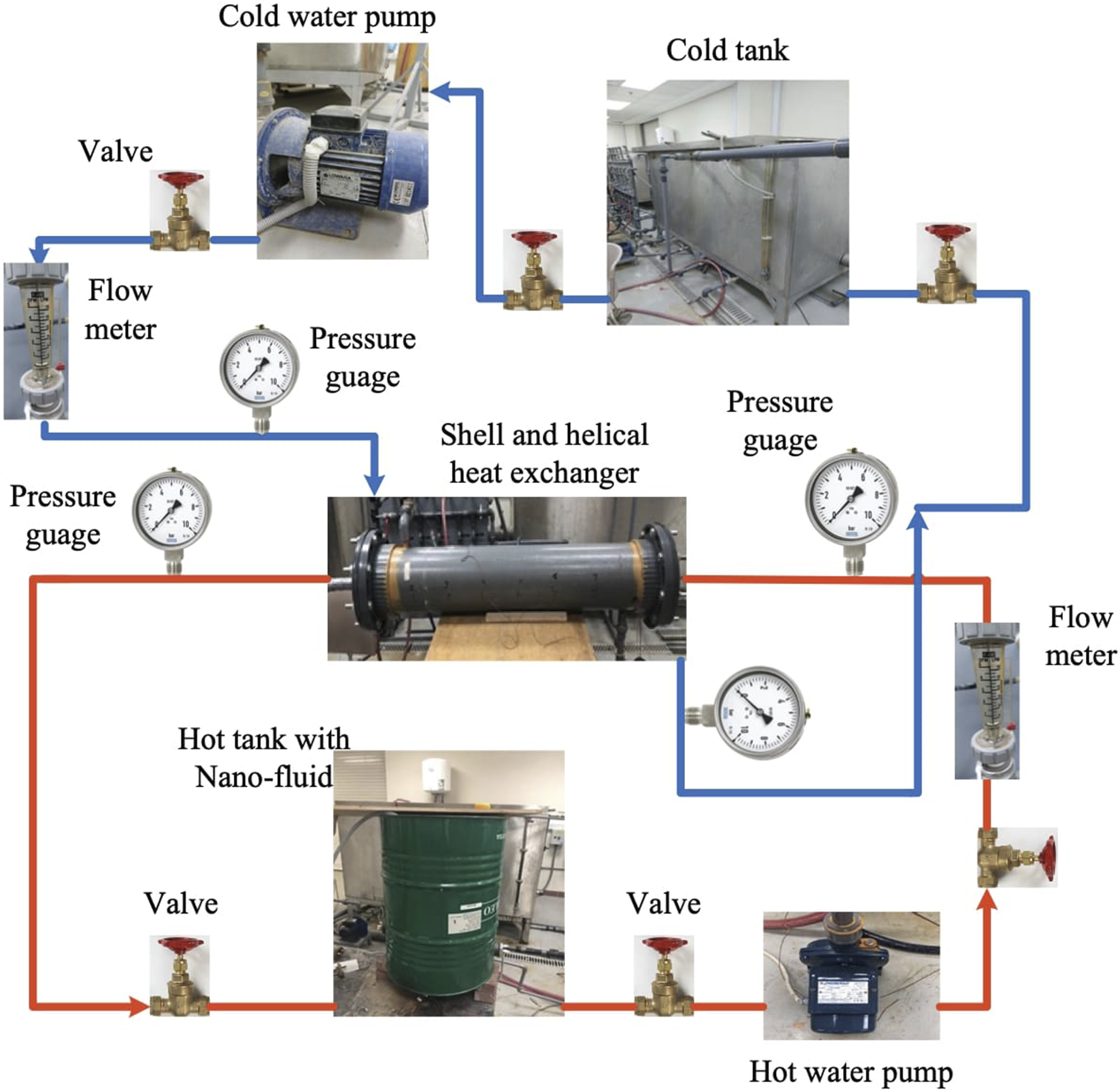
The purpose of this study is to experimentally enhance the heat exchange rate of the shell and helical coil tube heat exchanger by mixing water with aluminum oxide (Al2O3) nanoparticles, as well as to explore the effect of inlet thermal parameters on the performance of the heat exchanger.A test rig was constructed to investigate the influence of particle concentration, and inlet temperatures on the performance of nano-fluid. Parameters such as Nusselt number, pressure drop, performance evaluation criteria (PEC) are considered to rate the performance of the nano-particle with the heat exchanger. In this study a wider range of particle concentration is considered, which varies from 0.0 -0.75 %. Experiments with and without nanoparticles are carried out under identical working conditions. By analyzing the experimental data, it was found that nanoparticles significantly improve the coefficient of heat transfer inside the helically coiled tube. From sensitivity analysis, it is obseerved that there is a slight decrease in Nusselt number of the nanofluid with increase in inlet temperatures of the nano-fluid and the cooling water. Furthermore, it is concluded that an 8.5 % increase in PEC value is observed with increase in particle concentration from 0.15 % to 0.75 %.

2,864 views

16 citations