
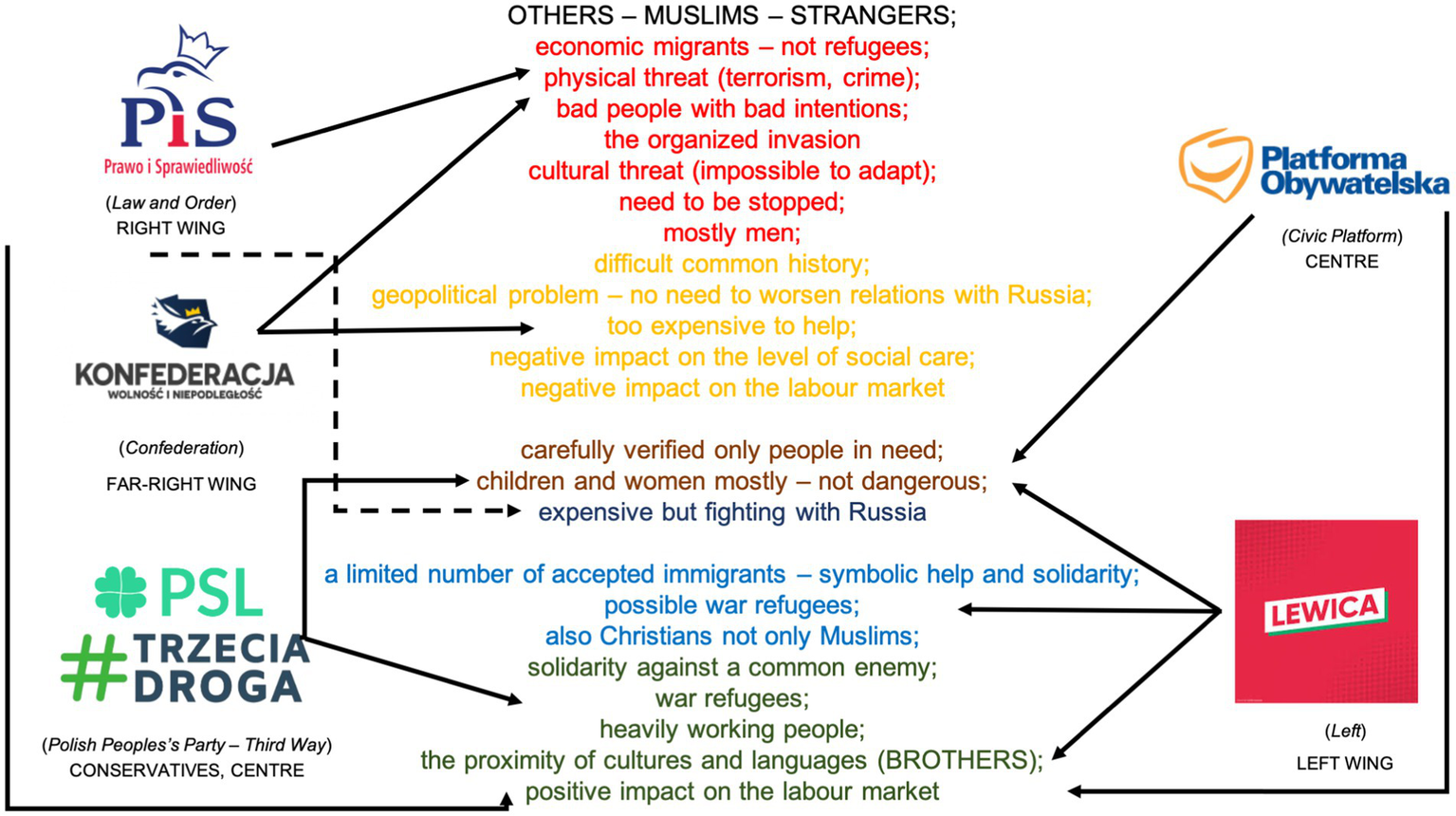
Addressing these questions is essential for understanding how contemporary societies can reconcile the legitimate need for security with the preservation of democratic governance, civil liberties, and inclusive social orders in an increasingly unstable international environment.This special issue aspires to advance current debates and to offer a fresh frame of reference on securitization and desecuritization in the whole range of the security sectors that the Copenhagen School proposed: military, economic, political, societal, environmental and health.According to the Copenhagen School, securitization occurs when an issue is articulated as an existential threat requiring exceptional measures, thereby shifting it from the realm of normal politics into that of emergency politics (Buzan, Waever, & de Wilde, 1998;McDonald, 2008;Dimari et al 2025). The Copenhagen School has introduced five sectors of security where securitizations occur: military, political, economic, societal and environmental (Buzan et al. 1998, cited in Dimari & Papadakis 2023: 579). These theoretical lenses have been widely applied across various sectors-including health (Lo & Thomas, 2010), pandemics (Curley & Herington, 2011;Dimari & Papadakis 2023), and migration (Karyotis, & Skleparis 2020;Papadakis & Dimari 2023;Dimari et al, 2025)-revealing the political consequences of framing issues and even people as threats.Indeed, the notion of securitization originates from the Copenhagen School, which conceptualized security as a speech act whereby political actors frame an issue as an existential threat demanding extraordinary measures (Buzan, Waever, & de Wilde, 1998). This theoretical move shifted the study of security away from its traditional military focus toward a broader social constructivist lens, identifying multiple sectors (military, political, societal, economic, and environmental) as potential sites of securitization (Bigo, 2006). McDonald (2008) advanced this approach by emphasizing how security is constructed through discursive practices among the mega-actors (in Foucault's terms), while Balzacq and Guzzini (2015) highlighted the methodological plurality of securitization theory, ranging from discursive to sociological and practiceoriented perspectives. It should be mentioned at this point that the Paris School of Security, based on political sociology (and in particular on Bourdieu's and Foucault's theoretical insights), has moved the focus towards practices, security professionals and "dispositifs" (in Michel Foucault's termssee Raptis & Papadakis, 2026) that "normalize" insecurity through institutions and routines, resulting in "governance through members" paradigm (Bigo & Guild 2005).Against this background, this Research Topic brings together nine high-quality contributions-articles authored by 20 scholars from across Europe, Asia, and Latin America. Collectively, these contributions provide diverse theoretical perspectives and empirical insights into the evolving relationship between securitization, desecuritization, governance and democracy, in an era of multiple and overlapping crises. Together, they advance scholarly debates on the dynamics of security governance while illuminating the challenges of reconciling legitimate security concerns with the principles of liberal democracy, social inclusion, and social cohesion. Stivas (2024) opens the collection by examining the narratives of the European Council, the European Commission, and the European Parliament during the European refugee crisis. Rather than finding a fundamental clash among the institutions, the study identifies a shared tendency to frame the crisis in security terms, combined with significant variation in the intensity of the respective narratives. The European Council deployed the strongest existential-threat rhetoric, the Commission used a comparatively milder but still securitizing language to advance agenda-setting and resource mobilization, and the European Parliament placed greater emphasis on solidarity and human rights. The article's Securitization Narratives Continuum is an important methodological contribution because it treats securitization as scalar rather than simply present or absent. It also demonstrates that institutional competencies, strategic expectations, and audience relations shape the intensity of security discourse, while common emergency measures can emerge even when the participating institutions articulate the threat differently. Polko (2025) applies Rita Floyd's framework of just and unjust securitization to Poland's responses to migration from Middle Eastern and North African countries and from Ukraine between 2015 and 2023. The comparison reveals a profound asymmetry. Migrants from MENA countries were more frequently represented as threatening and were subjected to forms of securitization that the study assesses as largely unjust, because they were driven by fear, prejudice, Islamophobia, and racialized assumptions rather than by a demonstrated existential threat. Ukrainian refugees, by contrast, were more readily accepted, with cultural proximity operating as a powerful desecuritizing condition. The article therefore shows that securitization is not a neutral response to the scale of migration. It is filtered through perceptions of religion, origin, identity, and belonging. Its normative contribution is especially significant: the migration-security nexus must be evaluated not only in terms of political effectiveness, but also in terms of discrimination, social inclusion, proportionality, and the unequal distribution of protection and vulnerability.Dimari, Tzagkarakis, Papadakis, and Citkowska-Kimla (2025) revisit the concept of flexicuritization as a strategy designed to reconcile state-security imperatives with the human security and rights of migrants. Combining the analysis of 120 securitizing speech acts from 2011 to 2019 with a secondary qualitative analysis of 75 interviews with market actors in Lesvos, the article demonstrates that migration securitization in Greece is deeply connected to political culture, historical memory, national identity, and perceptions of cultural erosion, especially in relation to Muslim populations. The study advances flexicuritization from an abstract compromise formula toward a culturally informed and context-sensitive desecuritization strategy. It classifies flexicuritization within a fifth generation of desecuritization approaches and argues that durable normalization cannot be achieved through technical policy adjustments alone. It also requires alternative narratives, integration policies, civic education, and a critical engagement with the historical myths and stereotypes through which insecurity is socially produced.Chiliquinga-Amaya, Faytong-Haro, Sánchez, Andrade, Vásquez, and Alvarez-Muñoz (2025) contribute a longitudinal Study Protocol focused on the relationship between insecurity, political trust, and democratic attitudes in Ecuador. The planned monthly survey of higher-education students from April 2025 to April 2026 examines how perceptions of security, trust in the president and institutions, approval of executive performance, and gender-role attitudes relate to support for democracy or for political arrangements involving greater military power. Because this is a protocol, it does not present final empirical results; its contribution lies in the research design and in the questions it makes measurable. The study moves the audience dimension of securitization from a theoretical assumption to an empirical object of longitudinal investigation. It is particularly relevant to the meta-security debate because it addresses the possibility that prolonged insecurity and support for 'iron-fist' leadership may reinforce one another, potentially normalizing militarized governance and weakening democratic resilience.Yoon (2025) asks why the dramatic development of North Korea's nuclear capabilities has not produced a clearly identifiable 'third' Korean nuclear crisis. By comparing the discursive patterns of the first and second nuclear crises with the contemporary period, the article argues that the securitization of the North Korean nuclear threat has become routinized. Repetition has reduced the performative urgency of crisis language even while the material capabilities involved have grown. This paradox is central to understanding a meta-security era: the constant invocation of crisis can eventually weaken the distinction between crisis and non-crisis, encourage short-lived and inconsistent measures, and obscure more pragmatic policy alternatives. Yoon therefore proposes riskification as a potentially more measured grammar for managing protracted threats. The article reminds us that under-securitization and over-securitization are not the only possibilities; habitual or misplaced securitization may also undermine strategic coherence and public understanding.Liu (2025) compares Italy's withdrawal from China's Belt and Road Initiative with the Baltic States' withdrawal from the 17+1 cooperation mechanism. Through a mostdifferent-systems design and process tracing, the study identifies shared drivers, including allied pressure, ideological differences, geopolitical change, and economic calculation, but also distinct national pathways. Italy's gradual withdrawal followed a predominantly utilitarian logic centered on disappointing economic returns and the costs and benefits of alliance alignment. The Baltic States followed a stronger ontological-security logic, shaped by historical memory, dependence on NATO, the war in Ukraine, and the association of China with Russia and authoritarianism. The comparison demonstrates how economic cooperation can be transformed into a security problem through narratives of strategic dependence, supply-chain vulnerability, technological risk, and the weaponization of interdependence. It also illustrates how the contemporary language of "de-risking" may operate as a less dramatic but institutionally consequential form of economic securitization. Koskina, Angelakis, Plionis, and Georgantas (2026) extend the Research Topic beyond terrestrial politics by analyzing lunar governance in the emerging post-terrestrial era. Their Policy and Practice Review compare the Outer Space Treaty and the Moon Agreement with the Artemis Accords and the Sino-Russian International Lunar Research Station initiative across four dimensions: governance and access, peaceful purposes, state accountability, and responsible utilization. The article identifies continuity in several foundational legal principles, but also growing fragmentation, competing governance blocks, contested resource rules, and increasing reliance on dual-use technologies. Its central conclusion is that geopolitics, more than resource exploitation alone, is the primary driver of lunar securitization and possible militarization. By conceptualizing the Moon as a global strategic common, the contribution exposes the tension between national competition and collaborative stewardship. It thus raises an early but urgent question: can law and commons-based governance prevent security competition from becoming the default institutional architecture of humanity's expansion into space? Kivimäki (2026) analyzes the confrontation between Presidents Donald Trump and Volodymyr Zelensky in the Oval Office on 28 February 2025 as a clash between competing declaratory speech acts and alternative social realities. The article interprets Trump's intervention not as a straightforward denial of the threat posed by the war in Ukraine, but as an attempt to relocate the conflict from the field of security to the institution of peacemaking. Kivimäki calls this move "peacification": an emphasis on relational breakdown, dialogue, and bargaining rather than an agent-centered account focused on defeating or containing the threatening actor. The concept adds an important category to debates on desecuritization, because peacification does not necessarily remove existential danger; it reconstructs its source and the appropriate response. The analysis also shows that speech acts in international politics depend on partial and contested audience uptake, material leverage, and meta-bargaining over the very rules through which conflict is understood. Raptis and Papadakis (2026) investigate whether the EU Artificial Intelligence Act constructs AI as an existential threat or embeds it within the Union's liberal regulatory tradition. The article introduces the Securitization-Liberalization Balance Index, a replicable quantitative framework applied to the full text of the Act. The findings reject a binary interpretation. Securitizing elements are concentrated in prohibited practices and high-risk systems, but liberalizing provisions predominate in both average intensity and cumulative regulatory weight, especially in relation to innovation, market harmonization, governance, and proportionality. The AI Act therefore represents a selective, bounded, and regulated form of securitization in which security concerns are normalized through ordinary law rather than elevated above it. This methodological and substantive contribution is especially important for the meta-security thesis: security can become pervasive without always taking the form of overt emergency politics, because it may be stabilized within complex regulatory and administrative architectures.The principal lesson of this Research Topic is that Governments and international institutions have a responsibility to respond to war, violence, technological harm, nuclear proliferation, coercive interdependence, uncontrolled exploitation, and other serious dangers. The democratic problem arises when the invocation of security becomes self-validating; when the existence, magnitude, or distribution of a threat is insulated from scrutiny; when exceptional measures become indefinite; or when certain groups bear disproportionate costs without meaningful voice or protection.The nine contributions assembled here offer both conceptual and empirical breadth. They show that the emerging meta-security order is neither uniform nor uncontested. It contains intense and weak securitizations, justified and unjustified measures, exceptional declarations and routinized practices, resistance and normalization, as well as hybrid arrangements in which security is constrained through law and liberal institutions. Future research could build on these insights through comparative longitudinal studies, systematic measurement of securitization intensity, analysis of implementation and termination, and closer investigation of the actors and institutions that resist desecuritization. Ultimately, the decisive question is whether security can remain subject to politics in its democratic sense while avoiding an overdetermining form of overall securitization that, in turn, undermines fundamental rights, political liberalism, and social inclusion and cohesion. Preserving that possibility is probably the central intellectual, value-based, and political challenge of the metasecurity era.
Editorial17 September 2026
Editorial: The securitization of ‘everything'. Towards a new meta-security era of counter-desecuritization attempts?This article analyses, through the lens of speech act theory, the confrontation between two declarations, each enacting an alternative social reality, made by Presidents Volodymyr Zelensky and Donald Trump in the Oval Office on the 28th of February 2025. This confrontation between alternative framings has continued, with the EU often siding with the security framing while the US defending Trump's peace framing. The clash is interpreted in this article as Trump's attempt to redefine the war in Ukraine by means of a declaratory speech act. Instead of situating the war within the domain of security, Trump's declaration can be seen to have placed it within the realm of peacemaking. He did not desecuritise the issue by denying the existential threat the war poses; rather, he reframed the threat as relational, focusing on the risk of a breakdown in relationships rather than a breakdown of security. In doing so, he can be interpreted to have mobilized the constitutive rules of the institution of peacemaking and challenged the traditional substantialist, agent-centric perspective. By advancing a peace-focused rearticulation of the war in Ukraine, Trump performs an act that I call “peacification” – shifting attention from security measures to relational dynamics, wherein dialogue, rather than militarisation, is framed as the means of alleviating existential threats. While clarifying the Trump–Zelensky clash, the case is used for theory-building related to the theory of speech acts in politics. It explicates the act of peacification and by highlighting the complications that arise from partial and conflicting audience uptake when analyzing speech acts in international politics.
2,584 views
2 citations
IntroductionThe beginning of the 21st century has fundamentally changed how humans interact with space, as we have moved past the characteristic rivalry of the Cold War into a new period where space is more accessible and holds major economic and strategic importance. This new “post-terrestrial era” seems to also require, though, a new regulatory approach to space and lunar activities, as it shifts from traditional, state-focused geopolitics to a bipolar governance perspective which sees the Moon not just as a new territory to be commercially exploited, but as a global strategic commons where economic interest must be balanced with defense, governance, and environmental protection. In this context, the rapid increase in Moon missions, fueled by strategic goals to control its important resources and build permanent bases, highlights the major shortcomings of current International Space Law (ISL) initiatives: rather than fostering a unified governance system, they seem to pave the way for regulatory fragmentation, which is prone to tensions and rivalry. At the same time, this dynamic underscores a pressing need to re-evaluate the rules that should govern humanity’s future on the Moon.MethodsThis study conducts a systematic comparative analysis of the legal frameworks shaping lunar activities. The methodology is based on the evaluation of two distinct generations of governance instruments, through the selection of four core thematic pillars: Lunar Governance (addressing authority and access), Peaceful Purposes (concerning non-militarization), State Accountability (for national activities), and Responsible Utilization (encompassing environmental and safety standards). The first generation is represented by the multilateral treaties of the 1960s-70s: the Outer Space Treaty (OST) of 1967 and the Moon Agreement of 1979. The second generation comprises the two competing contemporary frameworks: the U. S.-NASA Artemis Accords (2020) and the Sino-Russian International Lunar Research Station (ILRS) initiative (2021).ResultsThe analysis identifies a critical paradigm shift in lunar governance. Thus, the first-generation treaties established a foundational, principle-based model of democratization, enshrining space as the “province of all mankind,” mandating exclusive peaceful use, and prohibiting national appropriation. However, their general provisions and/or low ratification rate created a legal vacuum for resources use and management, which now appears to be feasible. In response, the second-generation instruments offer more practical rules for operational challenges –particularly concerning resource extraction– but they do so through a fragmented, coalition-based approach. Consequently, the emergence of two competing visions paves the way for the securitization of lunar activities, legitimizing proprietary rights over resources, reflecting terrestrial geopolitical divides, and indirectly accelerating the militarization of space by prioritizing national strategic interests over collective governance.DiscussionThe findings reveal that the governance of space, and lunar activities in particular, is at a crossroads, shifting from inclusive multilateralism and commons-based management, to exclusive bilateralism, privatization and militarization. The research concludes that while the existing core of International Space Law (ISL) remains resilient, its foundational principle of non-appropriation is being reinterpreted to the point of alteration, to serve national and commercial agendas. In this context, it appears that the perceived necessity for space and lunar militarization stems not only from the technical requirements of mining operations and the protection of related sites, that could well be managed under an adapted international regime (i.e., similarly to other commons), but also from a weakening commitment to multilateral cooperation itself. Such weakening of cooperation encourages competitive and exclusionary policies. A more sustainable and peaceful path forward in the post-terrestrial era will therefore necessitate a clearer commitment to inclusive, widely ratified international frameworks that balance emerging economic ambitions with the original cosmopolitical vision of the Moon as a shared commons for humanity; such an approach is essential to prevent any destructive arms race and ensure the Moon’s equitable and responsible exploration and utilization.
4,115 views
1 citations
This observational survey protocol aims to investigate public opinion about security and democracy in Ecuador during the critical period in 2025 and 2026. This study will focus on university students, exploring the relationships between trust in the president, approval of his administration, and support for democracy versus the possibility of moving toward regimes with greater military power. The main objective is to understand how trust in different social groups and institutions, perceptions of security, and gender roles influences these political attitudes. Data will be collected monthly from April 2025 to April 2026 using an online questionnaire administered to a representative sample of higher-education students at Milagro State University (UNEMI). The longitudinal design ensured continuity of the same respondents’ data over time. Statistical analyses, including descriptive statistics, nonparametric tests, and logistic regression models, were used to identify the trends and correlations. This study aims to provide anticipated insights into how security perceptions and gender roles could influence policy support, based on data collected in 2025 and 2026. This study emphasizes the importance of balancing security needs with democratic principles, contributing to a more informed and strategic approach to governance in Ecuador.
4,229 views
1 citations
