
Allergic and pulmonary disorders in childhood involve a complex interplay of genetic, developmental, 15 environmental, and technological factors. Volume II of our Research Topic builds upon Volume I, 16presenting nine diverse studies-from large-scale epidemiological surveys and biomarker discoveries 17 to epigenetic insights and AI-driven innovations-that collectively map respiratory health from birth 18 through adolescence. 19Yan and Li's epidemiological study in Bayannur City, China, revealed an alarming allergic rhinitis 20 prevalence of 39.8% among elementary school children, more than twice the national average. They 21 identified male sex, minority ethnicity, antibiotic use, and urban residence as key risk factors, 22 highlighting the need for integrated public health interventions, including air-quality management, 23 urban planning, and responsible antibiotic use, to curb pediatric allergic conditions (1). 24Gao and colleagues reinforced the concept of united airways diseases (UAD) through Mendelian 25 randomization, establishing causal links between pediatric asthma and related conditions such as 26 chronic rhinitis and bronchitis. This evidence underscores the necessity for comprehensive clinical 27 strategies that treat the respiratory tract as a unified system (2). 28In their longitudinal study, Alonso-Lopez et al. found adolescents born moderately to late preterm 29 faced a three-fold higher risk of asthma and persistent lung function deficits at 12-15 years. These 30 findings stress the importance of sustained respiratory monitoring beyond infancy, advocating for 31 routine spirometry, symptom tracking, and early intervention strategies to support affected individuals 32(3). 33 Dastgheib et
Editorial15 July 2025
Editorial: An overview on allergic and pulmonary diseases: from birth to childhood, volume II
This review provides a comprehensive overview of the evolving insights into the epigenetic mechanisms associated with bronchopulmonary dysplasia (BPD). It specifically highlights the roles of DNA methylation, histone modifications, and RNA regulation in the development of BPD in premature infants. BPD results from complex interactions among genetic factors, environmental exposures, and neonatal stressors. Key findings suggest that intrauterine hypoxia, hyperoxia, and nutrition can lead to epigenetic alterations, affecting gene expression and methylation, which may serve as biomarkers for early BPD detection. RUNX3 is identified as a critical transcription factor influencing lung development and inflammation, while changes in DNA methylation and histone dynamics in cord blood are linked to immune dysregulation associated with BPD. The role of m6A RNA methylation regulators from the IGF2BP family affects mRNA stability and gene expression relevant to BPD. Additionally, specific histones and microRNAs, particularly from the miR-17∼92 cluster, are implicated in pulmonary development and vascular regulation. Long non-coding RNAs (lncRNAs), such as MALAT1, also play a role in gene regulation via competitive endogenous RNA networks, indicating their potential as biomarkers and therapeutic targets. The interplay of these epigenetic mechanisms underscores the need for further research to develop targeted interventions aimed at reducing BPD severity and enhancing health outcomes for at-risk neonates.
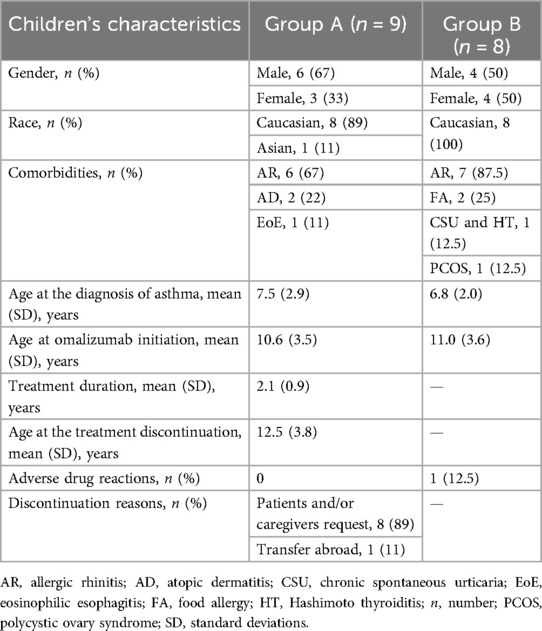
IntroductionSeveral trials documented safety and efficacy of omalizumab, but there are a few data about its effects after discontinuation. This study aims to evaluate the maintenance of efficacy of omalizumab in pediatric asthmatic patients one year after its suspension.MethodsA retrospective analysis was conducted on 17 subjects aged 6–18 years, divided into two groups: Group A (9 patients) who discontinued omalizumab after 18 months, and Group B (8 patients) who continued the therapy. Data on respiratory function (FEV1%), the number of exacerbations, need for hospitalizations, use of oral corticosteroids, and Asthma Control Test (ACT) scores were collected and analyzed at three time points: baseline (T0), after 18 months of treatment (T1), and 36 months (T2).ResultsIn Group A, significant differences were observed between T0 and T1, and T1 and T2, in FEV1% values, the number of exacerbations, the need for oral corticosteroids, and ACT scores. Group B showed significant differences in these parameters over time, with a notable reduction in exacerbations and improvement in ACT scores. The comparative analysis revealed that Group B had a higher number of exacerbations compared to Group A at T0 and greater use of oral cortico-steroids at T1. By T2, Group A had a higher ACT score than Group B at T0, whereas Group B showed higher ACT scores at T2 compared to Group A.DiscussionThe study confirmed the efficacy and safety of omalizumab, with its benefits persisting one year after treatment discontinuation in terms of lung function, reduction in exacerbations, decreased need for oral corticosteroids, and improved quality of life. Further research is necessary.

Background: Allergic rhinitis (AR) is an inflammatory condition of the nasal mucosa triggered by exposure to non-harmful substances. Over the past decade, the prevalence of AR in Chinese children has been steadily increasing. However, detailed epidemiological data on AR in children from Bayannur City are lacking.Methods: This study randomly selected six primary schools in Bayannur City. Electronic questionnaires were distributed via the web, and parents and children completed the questionnaires by scanning the two-dimensional code within a designated timeframe. Statistical analysis was performed on the collected data.Results: A total of 4754 valid responses were obtained. The self-reported prevalence of AR among children in Bayannur city was 39.79%. Multivariate analysis revealed that male gender, belonging to an ethnic minority, a history of food or drug allergies, frequent antibiotic use (≥3 times per year in the past two years, with each course lasting ≥3 days), and residence in urban or pastoral areas was associated with an increased prevalence of AR in children. The proportion of children experiencing moderate to severe AR hat impacted their studies or daily life was 48.78%. Chronic AR was reported in 56.71% of cases. Among AR patients with other allergic conditions, the incidence rates were as follows: bronchial asthma 35.99%, upper airway cough syndrome (UACS) 64.32%, secretory otitis media (SOM) 22.41%, obstructive sleep apnea hypopnea-syndrome (OSAHS) 49.58%, allergic dermatitis (AD) 48.72%, and allergic conjunctivitis (AC) 85.20%. The prevalence of AR was 50.30% in urban areas, 13.733% in rural areas and 20.90% in pastoral areas. Seasonal effects on AR prevalence were notably significant in urban and pastoral regions.The prevalence of AR among children in Bayannur city was 39.80%.Of those with AR, 48.72% experienced significant impacts on their learning or daily life, while only 14.80% had no other allergic conditions. There were significant variations in the prevalence and onset of AR among children between urban, agricultural and pastoral areas.
