The application of new technologies such as new vaccines, therapeutic cytokines and antibodies, and antiviral drugs in the prevention and treatment of animal infectious diseases

Cover image for Research Topic "The application of new technologies such as new vaccines, therapeutic cytokines and antibodies, and antiviral drugs in the prevention and treatment of animal infectious diseases"
88kviews
ORIGINAL RESEARCH
21 March 2025
Immunological and pathobiological characteristics of a novel live Salmonella Typhimurium-vectored Campylobacter vaccine candidate for layer chickens
Jamieson B. Mcdonald, 15 more and Robert J. Moore

3,979 views

2 citations

ORIGINAL RESEARCH
19 March 2025
D-amino acid enhanced the sensitivity of avian pathogenic Escherichia coli to tetracycline and amikacin
Jing Wu, 4 more and Lili Zhang

3,252 views

8 citations

Research advances in replication-deficient viral vector vaccines
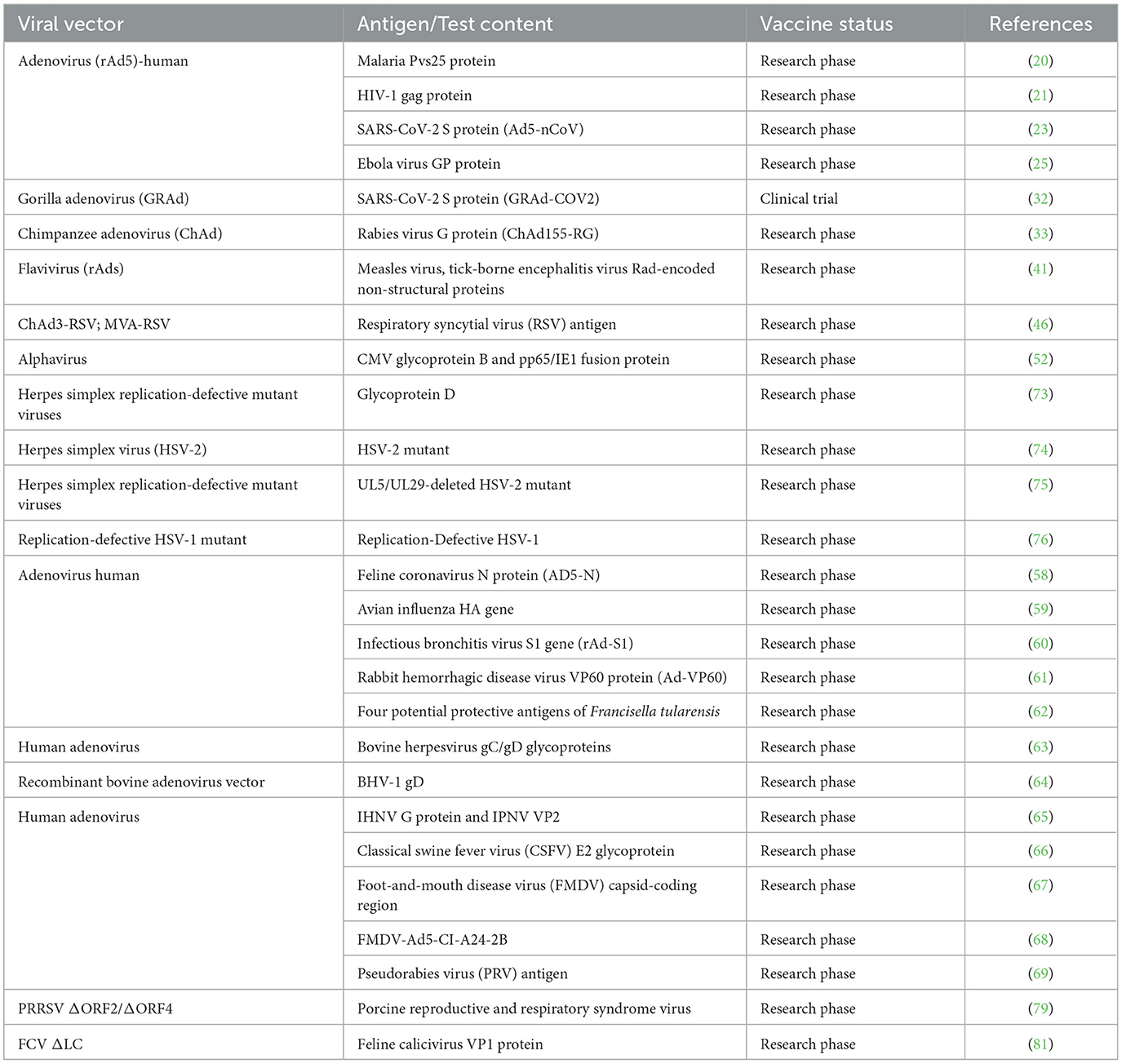
In recent years, replication-deficient viral vector vaccines have attracted much attention in the field of vaccine research and development due to their high safety and immunogenicity. These vaccines use genetic modifications to engineer viral vectors that make them unable to replicate but effective in expressing recombinant proteins and induce immune responses. Currently, replication-deficient adenovirus vectors and poxvirus vectors are widely used in vaccine R&D for a variety of infectious diseases in humans and animals, including AIDS, hepatitis B, pseudorabies, avian influenza, infectious bronchitis in poultry, and foot-and-mouth disease. Replication-deficient viral vaccines have been shown to effectively induce neutralizing antibodies and cellular immune responses, thereby providing effective immune protection. Future development of genetic engineering technology and continuous in-depth research on viral vectors should lead to replication-deficient viral vector platforms that have an essential role in preventing and controlling existing and emerging infectious diseases.

7,974 views

10 citations

ORIGINAL RESEARCH
10 March 2025
The preventive effect of probiotic Lactobacillus plantarum X86 isolated from raw milk on Staphylococcus aureus-induced mastitis in rats
Xiulan Xie, 6 more and Jian Zhao

3,257 views

8 citations

REVIEW
5 February 2025
Current status of recombinant duck enteritis virus vector vaccine research
Wen-Feng Jia, 4 more and Shan-Yuan Zhu

3,642 views

6 citations

ORIGINAL RESEARCH
13 November 2024
A subunit vaccine based on P97R1, P46, P42, and P65 from Mycoplasma hyopneumoniae can induce significant immune response in piglets
Yintao He, 14 more and Jinding Chen

3,732 views

3 citations

Machine learning tools used for mapping some immunogenic epitopes within the major structural proteins of the bovine coronavirus (BCoV) and for the in silico design of the multiepitope-based vaccines
IntroductionBCoV is one of the significant causes of enteritis in young calves; it may also be responsible for many respiratory outbreaks in young calves. BCoV participates in the development of bovine respiratory disease complex in association with other bacterial pathogens. Our study aimed (1) to map the immunogenic epitopes (B and T cells) within the major BCoV structural proteins. These epitopes are believed to induce a robust immune response through the interaction with major histocompatibility complex (MHC class II) molecules (2) to design some novel BCoV multiepitope-based vaccines.Materials and MethodsThe goal is achieved through several integrated in silico prediction computational tools to map these epitopes within the major BCoV structural proteins. The final vaccine was constructed in conjugation with the Choleratoxin B toxin as an adjuvant. The tertiary structure of each vaccine construct was modeled through the AlphaFold2 tools. The constructed vaccine was linked to some immunostimulants such as Toll-like receptors (TLR2 and TLR4). We also predicted the affinity binding of these vaccines with this targeted protein using molecular docking. The stability and purity of each vaccine construct were assessed using the Ramachandran plot and the Z-score values. We created the in silico cloning vaccine constructs using various expression vectors through vector builder and Snap gene.Results and discussionThe average range of major BCoV structural proteins was detected within the range of 0.4 to 0.5, which confirmed their antigen and allergic properties. The binding energy values were detected between −7.9 and −9.4 eV and also confirmed their best interaction between our vaccine construct and Toll-like receptors. Our in silico cloning method expedited the creation of vaccine constructs and established a strong basis for upcoming clinical trials and experimental validations.ConclusionOur designed multiepitope vaccine candidates per each BCoV structural protein showed high antigenicity, immunogenicity, non-allergic, non-toxic, and high-water solubility. Further studies are highly encouraged to validate the efficacy of these novel BCoV vaccines in the natural host.

4,277 views

18 citations

OPINION
25 September 2024
Rabies virus as vector for development of vaccine: pros and cons
Yan Li, 3 more and Fuxiao Liu

3,976 views

4 citations

ORIGINAL RESEARCH
3 September 2024
Cell-penetrating peptides TAT and 8R functionalize P22 virus-like particles to enhance tissue distribution and retention in vivo
Shibo Su, 13 more and Fandan Meng
Cell-penetrating peptides TAT and 8R functionalize P22 virus-like particles to enhance tissue distribution and retention in vivo
Virus-like particles (VLPs) are used as nanocontainers for targeted drug, protein, and vaccine delivery. The phage P22 VLP is an ideal macromolecule delivery vehicle, as it has a large exterior surface area, which facilitates multivalent genetic and chemical modifications for cell recognition and penetration. Arginine-rich cell-penetrating peptides (CPPs) can increase cargo transport efficiency in vivo. However, studies on the tissue distribution and retention of P22 VLPs mediated by TAT and 8R are lacking. This study aimed to analyze the TAT and 8R effects on the P22 VLPs transport efficiency and tissue distribution both in vitro and in vivo. We used a prokaryotic system to prepare P22 VLP self-assembled particles and expressed TAT-or 8R-conjugated mCherry on the VLP capsid protein as model cargoes and revealed that the level of P22 VLP-mCherry penetrating the cell membrane was low. However, both TAT and 8R significantly promoted the cellular uptake efficiency of P22 VLPs in vitro, as well as enhanced the tissue accumulation and retention of P22 VLPs in vivo. At 24 h postinjection, TAT enhanced the tissue distribution and retention in the lung, whereas 8R could be better accumulation in brain. Thus, TAT was superior in terms of cellular uptake and tissue accumulation in the P22 VLPs delivery system. Understanding CPP biocompatibility and tissue retention will expand their potential applications in macromolecular cargo delivery.

4,342 views

8 citations