Symbiotic Interactions in Microbial-facilitated Vegetation Restoration and Agricultural Management

Cover image for Research Topic "Symbiotic Interactions in Microbial-facilitated Vegetation Restoration and Agricultural Management"
71kviews
ORIGINAL RESEARCH
18 November 2025
Mechanisms of root exudates and soil microbial responses to nitrogen reduction and companion cropping for tomato yield increase and quality improvement
Deyang Liu, 5 more and Xia Wu

3,170 views

5 citations

ORIGINAL RESEARCH
14 November 2025
Investigating the growth-promoting effects of entophytic fungi isolated from Camellia luteflora on tomato seedlings
Xiaojie Bai, 4 more and Li Wang

2,900 views

ORIGINAL RESEARCH
20 October 2025
Changes of soil bacterial community composition and functional groups in different altitude gradients of Potentilla fruticosa shrub in eastern Qinghai-Tibet Plateau
Lele Xie, 3 more and Ying Liu

2,368 views

5 citations

ORIGINAL RESEARCH
21 August 2025
Ecological effects of B. subtilis C3 in kiwifruit rhizosphere soil and its prevention and control against root rot disease
Xu Guoyi, 6 more and Si Peng

3,215 views

2 citations

ORIGINAL RESEARCH
8 August 2025
Dual microbial inoculation for tripartite benefits: soybean biomass enhancement, root rot control and chlorothalonil residue reduction
Weiguang Jie, 4 more and Lianbao Kan

2,942 views

3 citations

SYSTEMATIC REVIEW
18 July 2025
Global trends in Trichoderma secondary metabolites in sustainable agricultural bioprotection
Anthony Apolinario Cortez-Lázaro, 12 more and Santos Triunfo Leiva Espinoza
The use of Trichoderma spp. constitutes a promising biotechnological strategy for sustainable agriculture, owing to its capacity to control phytopathogens and to produce bioactive secondary metabolites. This study, one of the first of its kind, addresses the absence of a comprehensive bibliometric assessment in this field. A systematic bibliometric analysis was conducted on 235 publications indexed in Scopus (2000–2025). Advanced tools such as VOSviewer and Bibliometrix were employed to track publication trends, identify key research themes, map collaborative networks, and assess the influence of leading authors and institutions. An exponential increase in scientific output was observed, peaking in 2023. Four principal research clusters were identified: antifungal activity, gene regulation, secondary metabolite production, and biosynthesis. India and China accounted for the highest publication volume, while Italy, represented by authors such as Francesco Vinale, accounted for the greatest scientific impact. International collaboration was extensive, particularly between Asia and Europe. The analysis indicates a progression from applied biocontrol studies to research focusing on molecular and genetic mechanisms, highlighting the need for multidisciplinary approaches that integrate biotechnology, agronomy, and microbial ecology. This bibliometric study provides an overview of Trichoderma secondary metabolites in agricultural biocontrol and outlines a research agenda emphasizing field validation, interdisciplinary collaboration, and the adoption of innovative technologies to bridge the gap between research and on-farm application in sustainable agriculture.
Global trends in Trichoderma secondary metabolites in sustainable agricultural bioprotection

7,023 views

25 citations

Co-application of sheep manure and commercial organic fertilizer enhances plant productivity and soil quality in alpine mining areas
ORIGINAL RESEARCH
27 November 2024
Co-application of sheep manure and commercial organic fertilizer enhances plant productivity and soil quality in alpine mining areas
Zhongyang Yu, 4 more and Changhui Li
Background and aimsThe addition of organic fertilizers and sheep slat manure have important effects on soil quality in alpine mining areas, but how they affect soil physicochemical properties and microorganisms is not yet known.MethodsThe current study employed field-controlled experiments and high-throughput sequencing technology to investigate differences in soil physicochemical properties, microbial community structures, and diversity under four treatments: no fertilization (CK), 100% sheep manure (SM), a combination of 50% sheep manure and 50% commercial organic fertilizer (MF), and 100% commercial organic fertilizer (OF).ResultsAboveground biomass increased by 191.93, 253.22, and 133.32% under SM, MF and OF treatments, respectively, when compared to CK treatment. The MF treatment resulted in significantly higher soil total nitrogen, total phosphorus, organic matter, and available nitrogen content compared to other treatments. Soil total nitrogen content, total phosphorus content, organic matter, available nitrogen content and available phosphorus content were 211, 120, 380, 557, and 271% higher, respectively, under the MF treatment than the CK treatment. Different nutrient additions significantly influenced soil microbial community composition. The SM and MF treatments notably increased soil bacterial and fungal community Operational Taxonomic Units (OTUs) indices and Chao 1 indices, while nutrient addition had no meaningful effect on the Simpson indices for microbial communities. There was a highly significant positive correlation between aboveground biomass and observed soil nutrient content.ConclusionThe combined application of sheep manure and commercial organic fertilizer is more conducive to improving soil quality and enhancing plant productivity in alpine mining areas.

3,516 views

11 citations

ORIGINAL RESEARCH
9 October 2024
Intercropping of tobacco and maize at seedling stage promotes crop growth through manipulating rhizosphere microenvironment
Junmei Ma, 13 more and Yating Liu
Intercropping of tobacco and maize at seedling stage promotes crop growth through manipulating rhizosphere microenvironment
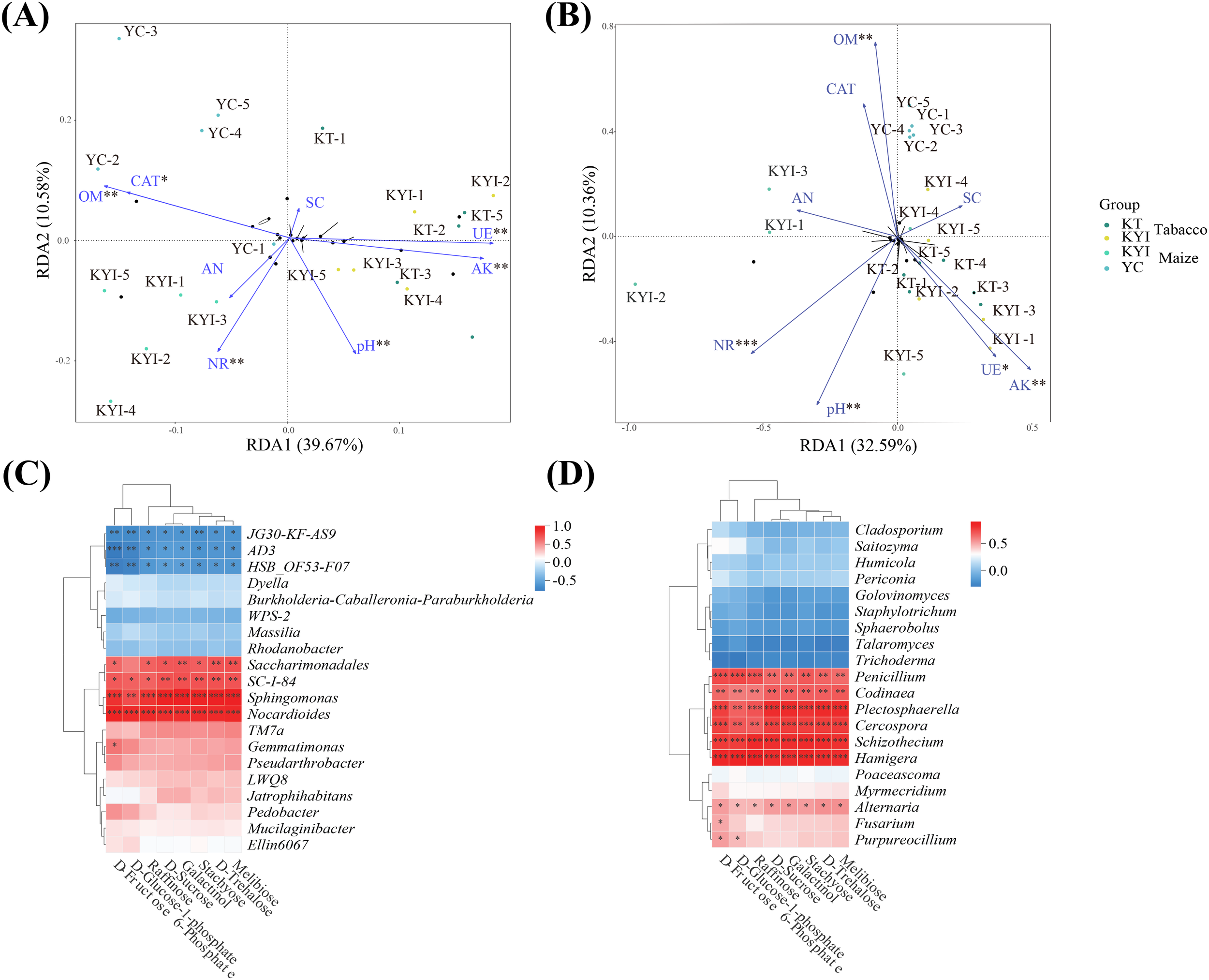
Changes in the rhizosphere microbiome and metabolites resulting from crop intercropping can significantly enhance crop growth. While there has been an increasing number of studies on various crop combinations, research on the intercropping of tobacco and maize at seedling stage remains limited. This study is the first to explore rhizosphere effects of intercropping between tobacco and maize seedling stages, revealing important effects on soil microbial community composition and metabolite profiles, thereby regulating crop growth and improving soil balance. Compared with mono-cropping, intercropping increased the biomass of the two crops and promoted the nutrient absorption of nitrogen, phosphorus and potassium. Under intercropping conditions, the activities of sucrase, catalase and nitrate reductase in tobacco rhizosphere soil and the content of available potassium, the activities of nitrate reductase and acid phosphatase in maize rhizosphere soil were significantly increasing. Rhizosphere soil bacterial and fungal communities such as Sphingomonas, Massilia, Humicola and Penicillium respond differently to crop planting patterns, and soil dominant microbial communities are regulated by environmental factors such as pH, Organic Matter, Available Potassium, Nitrate Reductase, and Urease Enzyme. Network analysis showed that soil microbial communities were more complex after intercropping, and the reciprocal relationship between bacteria and fungi was enhanced. The difference of metabolites in soil between intercropping and monocropping system was mainly concentrated in galactose metabolism, starch and sucrose metabolism pathway, and the content of carbohydrate metabolites was significantly higher than that of monocropping soil. Key metabolites such as D-Sucrose, D-Fructose-6-Phosphate, D-Glucose-1-Phosphatel significantly influence the composition of dominant microbial communities such as Sphingomonas and Penicillium. This study explained the effects of intercropping between flue-cured tobacco and maize on the content of soil metabolites and soil microbial composition in rhizosphere soil, and deepened the understanding that intercropping system can improve the growth of flue-cured crops seedlings through rhizosphere effects.

3,884 views

32 citations

ORIGINAL RESEARCH
18 November 2024
Tobacco/Isatis intercropping system improves soil quality and increase total production value
Zhongyan Wang, 11 more and Xin Hou

2,608 views

9 citations

Effect of different vegetation restoration patterns on community structure and co-occurrence networks of soil fungi in the karst region
Introduction: The Grain for Green Project (GGP) by the Chinese government was an important vegetation restoration project in ecologically fragile and severely degraded karst regions. Soil fungi play a facilitating role in the cycling of nutrients both above and below the ground. , which is crucial for maintaining ecosystem function and stability. In karst regions, their role is particularly critical due to the unique geological and soil characteristics, as they mitigate soil erosion, enhance soil fertility, and promote vegetation growth. However, little is known about how the implementation of this project shifts the co-occurrence network topological features and assembly processes of karst soil fungi, which limits our further understanding of karst vegetation restoration.Methods: We By usinged MiSeq high-throughput sequencing combined with null model analysis technology, we detected community diversity, composition, cooccurrence networks, and assembly mechanisms of soil fungi under three GGP patterns (crop, grassland, and plantation) in the southwestern karst region.Results: Ascomycota and Basidiomycota were the main fungal phyla in all the karst soils. Returning crop to plantation and grassland had no significant effect on α diversity of soil fungi (p P > 0.05), but did significantly affect the β diversity (p P = 0.001). Soil moisture and total nitrogen (TN) were the main factors affecting the community structure of soil fungi. Compared with crop, soil fungi networks in grassland and plantation exhibited a higher nodes, edges, degree, and relatively larger network size, indicating that vegetation restoration enhanced fungal interactions. The soil fungi networks in grassland and plantation were more connected than those in crop, implying that the interaction between species was further strengthened after returning the crop to plantation and grassland. In addition, null-model analysis showed that the assembly process of soil fungal communities from crop to grassland and plantation shifted from an undominant process to dispersal limitation. Discussion: These data indicated that GGP in karst region changed the composition and assembly mechanisms of the soil fungal community and enhanced the interaction between fungal species, which can contribute to a better understanding of the fungal mechanisms involved in the restoration of degraded karst soils through vegetation recovery.

2,982 views

20 citations

ORIGINAL RESEARCH
23 September 2024
Effects of mulch films with different thicknesses on the microbial community of tobacco rhizosphere soil in Yunnan laterite
Shuaibing Wang, 8 more and Dandan Li

2,589 views

13 citations

Exopolysaccharide is required by Paraburkholderia phytofirmans PsJN to confer drought-stress tolerance in pea
ORIGINAL RESEARCH
9 August 2024
Exopolysaccharide is required by Paraburkholderia phytofirmans PsJN to confer drought-stress tolerance in pea
Cahya Prihatnaand Qing Yan
Paraburkholderia phytofirmans PsJN is a plant symbiotic bacterium that can colonize a broad spectrum of plant hosts and frequently shows beneficial effects on plant growth. Exopolysaccharide (EPS) is known to be important in plant-bacteria interactions. Previously, we reported that EPS is required for PsJN to survive from drought stress and colonize in pea (Pisum sativum) under drought condition. However, whether EPS is necessary for PsJN to promote plant growth remains unknown. In this work, a comparative study was conducted between the wild-type PsJN and its ∆bceQ mutant that lacks EPS to investigate the role of EPS in PsJN to confer drought-stress tolerance on pea plant. Our results showed that wild type PsJN, but not the ∆bceQ mutant, promoted pea seed germination and seedlings growth under drought stress. Pea plants inoculated with the wild type PsJN had a higher level of drought tolerance, as shown by a better vegetative growth and enhanced nodule formation, than plants inoculated with the ∆bceQ mutant. Moreover, EPS plays a role in the plant colonization under drought stress, because the ∆bceQ mutant was unable to colonize pea seeds and roots as effective as the wild type PsJN. Further, expression of the EPS biosynthesis genes in the bceOVN operon of the wild type PsJN was induced by the presence of glucose. Overall, this study demonstrated that PsJN

2,808 views

15 citations

Mitigating aluminum toxicity and promoting plant resilience in acidic soil with Penicillium olsonii TLL1
Aluminum (Al), prevalent in the crust of the Earth, jeopardizes plant health in acidic soils, hindering root growth and overall development. Penicillium olsonii TLL1 strain (POT1; NRRL:68252) emerges as a novel solution for plant resilience under Al-rich acidic soils, marking a significant advancement in sustainable agriculture and environmental cleanup. Our research illustrates the extraordinary tolerance of POT1 to both high Al concentrations and acidic conditions, showcasing its potential to alleviate Al-induced stress in plants. Metabolite analysis reveals that POT1 detoxifies Al through organic acid-dependent chelation mechanisms, significantly reducing Al stress in Arabidopsis and Pak Choi plants. Consequently, plant growth conditions improved, and the Al content in plant tissues decreased. Transcriptome analysis indicates that POT1 treatment downregulates genes associated with Al and oxidative stress such as MATE, ALS3, NIP1-2 and several peroxidases, highlighting its effectiveness in lessening Al-induced damage. Comparative assessments highlight the superior performance of POT1 compared to other Al-tolerant Penicillium species, attributed to its ability to thrive in diverse pH levels and effectively detoxify Al. These findings position POT1 as a promising agent for enhancing crop resilience in Al-compromised acidic soils, offering new avenues for promoting plant health and bolstering food security through increased crop yield and safety.

4,126 views

18 citations