
Innovative Nutritional Strategies for Cardiovascular Health in Aging Populations

Cover image for Research Topic "Innovative Nutritional Strategies for Cardiovascular Health in Aging Populations"
45kviews
ORIGINAL RESEARCH
28 October 2025
Association of plant-based food intake in daily diets and hypertension in older adults: a cohort study
Xiang Wang, 3 more and Miao Dai

4,018 views

2 citations

ORIGINAL RESEARCH
3 September 2025
Surrogate insulin resistance indices are associated with left atrial thrombus in patients with nonvalvular atrial fibrillation
You Zhou, 3 more and Haixia Fu

8,280 views

1 citations

ORIGINAL RESEARCH
10 February 2025
Association between pan-immune-inflammation value and coronary heart disease in elderly population: a cross-sectional study
Ruicong Ma, 4 more and Yanchun Ding
Association between pan-immune-inflammation value and coronary heart disease in elderly population: a cross-sectional study
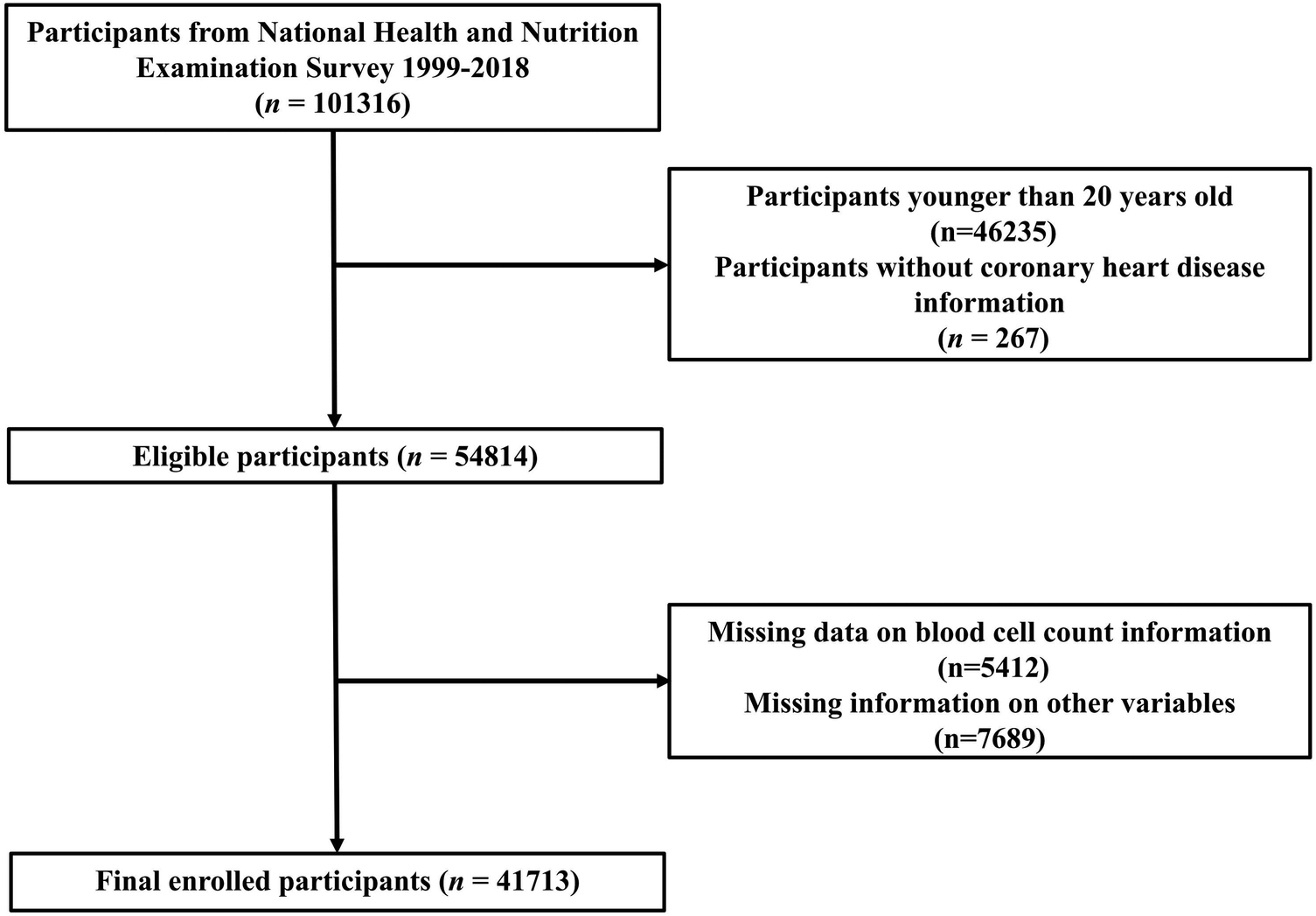
BackgroundSystemic inflammation, immune and nutrition status are closely linked to the occurrence and development of coronary heart disease (CHD). Pan-immune-inflammation value (PIV) is a new method for evaluating systemic inflammation and immune status. Our objective is to explore the connection between PIV and CHD especially in elderly people, as well as the diagnostic value of PIV combined with controlling nutritional status (COUNT) score for CHD.MethodsParticipants eligible for the study were sourced from NHANES data from 1999 to 2018. Logistic regression models were employed to evaluate the link between PIV and CHD. Additionally, restricted cubic spline was utilized to explore the correlations. Subgroup analysis was adopted in order to ensure the credibility of the results. The receiver operator characteristic (ROC) curve was used to explore the predictive value of PIV combined with COUNT score for CHD.Results41,713 individuals qualified for analysis. The individuals with CHD had higher levels of PIV. In the logistic regression model, PIV was positively related to CHD [Q4 vs. Q1, OR = 1.23 (1.03–1.48, P < 0.001)]. Restricted cubic spline indicated a positive non-linear relationship (P for overall <0.001, P for non-linear = 0.009). However, restricted cubic spline shows that this positive correlation is only significant in the elderly population aged 60 and above. Subgroup analysis shows that the relationship between PIV and CHD is more significant in the elderly population (P < 0.001). The ROC curve shows that PIV has better diagnostic value for CHD than other common inflammatory indicators. Furthermore, the combination of PIV and COUNT score is superior to PIV or COUNT score.ConclusionsA positive link between PIV and CHD, especially in the elderly. The combination of PIV and COUNT score has better diagnostic value for CHD.

4,021 views

15 citations

ORIGINAL RESEARCH
30 May 2025
Cardiovascular health assessed using Life’s Essential 8 is associated with all-cause and cardiovascular disease mortality among community-dwelling older men and women in the InCHIANTI study
Vivek Sarma, 4 more and Toshiko Tanaka

3,927 views

7 citations

Geriatric nutritional risk index as a predictor of 30-day and 365-day mortality in patients with acute myocardial infarction: a retrospective cohort study using the MIMIC-IV database
ORIGINAL RESEARCH
5 February 2025
Geriatric nutritional risk index as a predictor of 30-day and 365-day mortality in patients with acute myocardial infarction: a retrospective cohort study using the MIMIC-IV database
Xiaolong Zheng, 2 more and Minghua Liu

8,898 views

16 citations

ORIGINAL RESEARCH
10 October 2024
Association of body roundness index with abdominal aortic calcification among middle aged and elderly population: findings from NHANES
Ji Wu, 1 more and Xiang Chen
We aim to investigate the association between body round indexbody roundness index (BRI) and abdominal aortic calcification (AAC) among middle aged and elderly US residents. Methods: This cross-sectional study used data from the National Health and Nutrition Examination Survey (NHANES) 2013-2014 cycle, including 3,079 middle-aged and elderly participants aged 40 and above. Abdominal aortic calcification (AAC) scores for these participants were assessed using dual-energy X-ray absorptiometry (DXA).The Body Roundness Index (BRI) was calculated from participants' height and waist circumference, with all measurements conducted by trained surveyors using standardized methods. The relationship between BRI and AAC was analyzed using weighted multivariate logistic regression, adjusting for confounding variable.Additionally, restricted cubic splines (RCS) analysis was also employed to visualize the relationship between BRI and the risk of AAC.We found that those with AAC were significantly older and had a higher prevalence of smoking and chronic kidney disease (CKD) prevalence compared to those without AAC. Using weighted multivariable logistic regression, we determined that an increase of one unit in BRI was associated with a 22% higher risk of AAC.Additionally, higher BRI quartiles (Q2, Q3, Q4) showed significantly increased risks of AAC compared to the lowest quartile. Visualization using restricted cubic splines (RCS) indicated a gradual increase in AAC risk with higher BRI, which plateaued beyond a BRI of 7.2. This relationship was significant across different age and gender group.There is a positive association between abdominal obesity (as measured by BRI) and AAC in the middle-aged and elderly population. This suggests that attention should be paid to the impact of abdominal obesity on vascular health and that this factor should be considered in public health strategies.
Association of body roundness index with abdominal aortic calcification among middle aged and elderly population: findings from NHANES

4,021 views

11 citations