
Mechanisms and Interventions for Post-Operative Neurocognitive Disorder and Sleep Disruptions

83kviews
Editorial25 September 2025
Editorial: Mechanisms and interventions for post-operative neurocognitive disorder and sleep disruptions

Postoperative neurocognitive disorder (POND), encompassing postoperative delirium (POD) and postoperative cognitive dysfunction (POCD), represents a spectrum of cognitive impairments following surgery, particularly in elderly populations. These conditions are associated with prolonged hospital stays, increased healthcare costs, and diminished quality of life. Sleep disturbances, often driven by circadian rhythm disruptions, are closely linked to POND, exacerbating cognitive decline through a vicious cycle of neuroinflammation and physiological stress. This special issue, Mechanisms and Interventions for Postoperative Neurocognitive Disorder and Sleep Disruptions, presents 16 cutting-edge studies exploring the underlying mechanisms and evaluating novel interventions. This review synthesizes these findings, categorizing studies into those addressing mechanisms, interventions, or both, and discusses their implications for clinical practice and future research.

Neuroinflammation is a central mechanism driving POND. Gou et al. utilized transcriptomic analysis to identify differentially expressed genes (DEGs) such as COL18A1 and CXCL9, which interact with pro-inflammatory cytokines (e.g., IL-6, IL-1β) in elderly patients with POD. Their study employed correlation charts and immune infiltration plots to highlight the role of immune microenvironment interactions in neuroinflammation. Similarly, Liu et al. developed a predictive model for postoperative pulmonary infections (PPI) in elderly orthopedic patients, identifying six clinical risk factors associated with POND. Their model, validated through calibration curves and decision curve analysis, underscores systemic inflammation as a key driver, despite limitations from retrospective data collection. Qin et al. further elucidated the role of inflammation, demonstrating that elevated preoperative highsensitivity C-reactive protein (Hs-CRP) levels significantly increase POD risk, particularly in older and female patients. Their findings position Hs-CRP as a potential biomarker for early risk stratification. Wei et al. identified preoperative biomarkers, including neutrophil-to-lymphocyte ratio (NLR) and systemic immune-inflammation index (SII), as predictors of pre-poststroke depression, which shares mechanistic overlap with POND, reinforcing the role of inflammatory pathways.

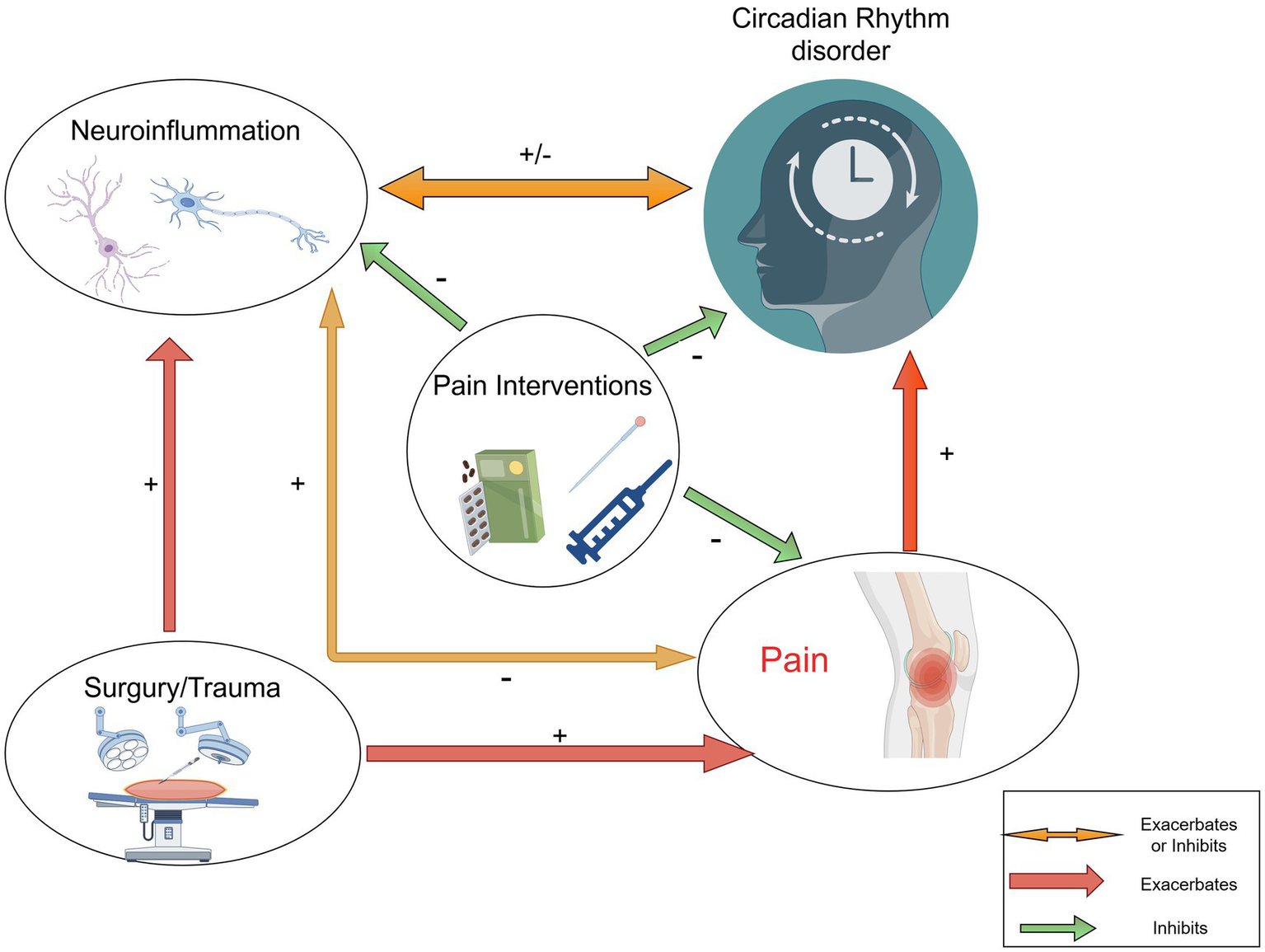
Xiang et al. investigated the influence of cognitive reserve, finding that lower educational levels were associated with an increased POD risk in abdominal surgery patients (odds ratio: 0.6, 95% CI: 0.8-0.9). This suggests that cognitive reserve modulates neurocognitive outcomes, highlighting the need for preoperative cognitive assessments. Wu et al.'s meta-analysis revealed sex-specific vulnerabilities in neurological outcomes, with forest plots indicating that gender differences may influence POND risk, necessitating tailored intervention strategies.Circadian Rhythm Dysregulation Ma et al. explored the interplay between postoperative pain, circadian rhythm disruptions, and neurocognitive outcomes. Their review highlighted how pain-induced stress disrupts circadian rhythms, exacerbating POND through neuroinflammation and hormonal imbalances. These findings underscore the importance of addressing pain management to mitigate sleep disturbances and cognitive decline. Tailored Surgical and Perioperative Approaches Wang et al. compared perioperative outcomes in 527 patients with and without pheochromocytoma, using odds ratios to assess complication risks. Their findings advocate for tailored surgical strategies to optimize perioperative conditions and reduce POND risk. Yang et al.'s systematic review emphasized standardized guidelines for POD assessment, using a literature screening flowchart to ensure consistent diagnostic approaches, which are critical for effective management.

The studies in this special issue highlight the multifactorial nature of POND and sleep disruptions, driven by neuroinflammation, systemic inflammation, and circadian dysregulation. Interventions such as acupuncture, ultrasound-guided nerve blocks, and novel pharmacological agents like remimazolam show promise in mitigating these complications. However, challenges remain, including the need for prospective studies to overcome limitations of retrospective data (e.g., Liu et al.) and the standardization of diagnostic criteria (e.g., Yang et al.). Future research should focus on validating biomarkers like Hs-CRP and NLR, refining predictive models, and exploring personalized interventions based on demographic factors such as education and gender.

This special issue underscores the complex interplay between POND, sleep disturbances, and their underlying mechanisms, including neuroinflammation, systemic inflammation, and circadian misalignment. Innovative interventions, ranging from non-pharmacological approaches like acupuncture and ultrasound-guided nerve block to pharmacological and perioperative strategies, offer promising avenues for improving postoperative outcomes. By addressing these challenges through rigorous research and tailored interventions, we can enhance recovery and quality of life for surgical patients, particularly in vulnerable populations.

B.Y: Writing-original draft and Conceptualization. ZL.H: Writing-original. Q.C-review and editing.

1,945 views

1 citations

Perioperative neurocognitive disorders: a comprehensive review of terminology, clinical implications, and future research directions
REVIEW
26 August 2025
Perioperative neurocognitive disorders: a comprehensive review of terminology, clinical implications, and future research directions
Xuli Ren, 6 more and Fang Wang

8,057 views

24 citations

CLINICAL TRIAL
20 November 2025
Effects of electroacupuncture on the incidence of postoperative supraventricular arrhythmia and sleep quality in patients undergoing thoracoscopic surgery: a randomized controlled trial
Jie Liu, 5 more and Caineng Wu

2,627 views

SYSTEMATIC REVIEW
13 June 2025
Evidence summary for the management of sleep disorders after malignant tumor surgery
Chang Yang, 5 more and Hongli Ma

4,541 views

1 citations

CLINICAL TRIAL
13 June 2025
Association between educational level and postoperative delirium in older patients undergoing abdominal surgery: a two-sample cohort study
Mingju Xiang, 4 more and Jia Tang

2,283 views

4 citations

REVIEW
28 April 2025
The impact of postoperative pain interventions on circadian rhythm disruptions: mechanisms and clinical implications
Dongmei Ma, 2 more and Jianhong Xu
The impact of postoperative pain interventions on circadian rhythm disruptions: mechanisms and clinical implications
Postoperative pain is a prevalent clinical issue that significantly impacts patient recovery, making its management crucial for rehabilitation. Recent studies have shown that postoperative pain not only affects the physiological state of patients but may also disrupt their circadian rhythms, leading to decreased sleep quality and physiological dysfunctions. This review aims to explore the effects of postoperative pain interventions on circadian rhythm disturbances, analyze the underlying mechanisms, and summarize the effective strategies currently used in clinical practice. Through a comprehensive analysis of the relevant literature, we will highlight the importance of pain management during the recovery process and emphasize its potential role in regulating circadian rhythms. Pharmacological treatments like NSAIDs and melatonin have shown efficacy in regulating circadian rhythms and improving sleep quality in postoperative patients. Multimodal analgesia combining pharmacological and non-pharmacological methods (e.g., CBT, acupuncture) can optimize pain relief while minimizing side effects. However, further research is needed to clarify the bidirectional relationship between pain perception and circadian rhythms and translate these findings into clinical practice.

6,294 views

9 citations

ORIGINAL RESEARCH
9 May 2025
Integrated transcriptomic and immune profiling reveals crucial molecular pathways and hub genes associated with postoperative delirium in elderly patients
Zi-han Gou, 5 more and Yao Wang

4,075 views

2 citations

Association of remimazolam with delirium and cognitive function in elderly patients undergoing general anesthesia or procedural sedation: a meta-analysis of randomized controlled trials
SYSTEMATIC REVIEW
28 April 2025
Association of remimazolam with delirium and cognitive function in elderly patients undergoing general anesthesia or procedural sedation: a meta-analysis of randomized controlled trials
Yao Wang, 4 more and Qian Wang
BackgroundRemimazolam is an ultra-short-acting benzodiazepine with sedative effects, but its impact on postoperative delirium (POD) and cognitive function in elderly patients remains unclear. This study aimed to compare the incidence of POD and cognitive function between remimazolam and other sedatives in elderly patients undergoing general anesthesia or procedural sedation.MethodsThis study included randomized controlled trials (RCTs) comparing remimazolam with other sedatives in elderly patients undergoing general anesthesia or procedural sedation. A comprehensive search was conducted in Ovid MEDLINE, Embase, the Cochrane Central Register of Controlled Trials, and the China National Knowledge Infrastructure (CNKI) from inception to January 2, 2025, without language restrictions. Data were pooled quantitatively using a random-effects model. The primary outcomes were the incidence of POD and cognitive function.ResultsA total of 1,808 elderly patients from 11 RCTs were included. Compared with other sedatives, remimazolam did not increase the incidence of POD (OR: 0.62, 95% CI [0.23, 1.68], p = 0.35, I2 = 73%), but improve cognitive function, as measured by Mini-Mental State Examination scores, the seventh postoperative day (MD: 0.53, 95% CI [0.16, 0.91], p = 0.005, I2 = 28). Additionally, remimazolam significantly reduced the incidence of hypotension (OR: 0.27, 95% CI [0.21, 0.35], p < 0.001, I2 = 0%) and respiratory depression (OR: 0.35, 95% CI [0.17, 0.69], p = 0.003, I2 = 0%) compared to other sedatives. However, no significant differences were observed between remimazolam and other sedatives for postoperative nausea and vomiting (OR: 1.31, 95% CI [0.91, 1.89], p = 0.15, I2 = 0%) or hypoxemia (OR: 0.69, 95% CI [0.35, 1.34], p = 0.28, I2 = 0%).ConclusionOverall, the use of remimazolam in the elderly population appears to pose fewer risks than other sedatives. It does not increase the incidence of postoperative delirium following general anesthesia or sedation, but it improves postoperative cognitive function and provides more stable hemodynamics. However, further well-designed RCTs with long-term follow-up are needed to establish a standardized medication regimen and optimal dosage tailored to elderly patients.Systematic review registrationhttps://www.crd.york.ac.uk/PROSPERO/myprospero, registration number (CRD4202563620).

5,321 views

12 citations

CLINICAL TRIAL
22 April 2025
Individualized positive end-expiratory pressure guided by driving pressure in robot-assisted laparoscopic radical prostatectomy: a prospective, randomized controlled clinical trial
Yanfang Luo, 4 more and Yan Jiang

3,303 views

4 citations

ORIGINAL RESEARCH
31 January 2025
Linear association between high-sensitivity C-reactive protein and postoperative delirium after general anesthesia: a cross-sectional study
Xiao Qin, 4 more and Shouyuan Tian

3,980 views

6 citations

SYSTEMATIC REVIEW
13 January 2025
Effect of invasive acupuncture on awakening quality after general anesthesia: systematic review and meta-analysis
Fan-dong Bu, 2 more and Yong-liang Chi

3,871 views

4 citations

SYSTEMATIC REVIEW
24 January 2025
Risk factors for perioperative cerebral infarction in moyamoya disease: a meta-analysis
Jincan Wu, 5 more and Xinyi Chen

2,730 views

3 citations

ORIGINAL RESEARCH
16 April 2025
Dynamic changes in peripheral inflammation as a risk factor for perioperative sleep disturbances in elderly patients undergoing laparoscopic hepatobiliary surgery
Lai Wei, 9 more and Wenyan Chen

2,035 views

1 citations

CASE REPORT
5 March 2025
Ultrasound-guided transversus abdominis plane block as an adjunctive anesthesia technique in elderly patients with combined massive ascites: a case report and literature review
Liwen Zhang, 3 more and Zhaolan Hu

2,095 views

ORIGINAL RESEARCH
6 November 2024
Association between duration of phenoxybenzamine use and postoperative delirium in suspected adrenal pheochromocytoma: a retrospective cohort study
Qunying Wang, 5 more and Dan Liu

1,806 views

1 citations

ORIGINAL RESEARCH
25 October 2024
Use of esketamine for tracheoscopic drug injection: a randomized controlled trial
Xiaoming Zhao, 3 more and Yuanyuan Yu

2,177 views

4 citations

ORIGINAL RESEARCH
26 September 2024
Effect of prophylactic noninvasive oxygen therapy after planned extubation on extubation failure in high-risk patients: a retrospective propensity score-matched cohort study
Xiaozhuo Zheng, 2 more and Xiaofeng Lei

3,008 views

2 citations