
Several articles highlight the growing importance of digital infrastructure and digital public services in improving rural wellbeing. Li et al. (2026) show how digital technology-enabled public services contribute positively to the subjective wellbeing of rural residents in China through improved access to information and social services. Similarly, Chen et al. (2025) demonstrate that digital village development can improve farmers' wellbeing by strengthening household capabilities and reducing income inequality. These findings underscore the broader developmental implications of digitalization beyond agricultural production alone. Digital transformation is increasingly becoming intertwined with quality of life, social inclusion, and human development in rural communities. Complementing this, Zhao and Sun (2025) Collectively, the studies presented in this thematic cluster reveal that digital innovation has become central to the future of sustainable agriculture. However, they also highlight several important challenges that require further attention. First, significant digital divides remain across regions, genders, and income groups. Second, technological adoption is often constrained by limited infrastructure, low digital literacy, and inadequate institutional support.Third, concerns related to data governance, cybersecurity, affordability, and technological dependence require careful consideration as digital agriculture expands. A particularly important insight from multiple contributions is that the benefits of digital technologies are not automatically or uniformly realized -context, institutions, and policy design profoundly shape whether digitalization translates into inclusive development or further entrenches existing inequalities.The evidence presented in this Research Topic nevertheless points toward a promising future in which digital technologies can support more inclusive, productive, and sustainable agricultural systems. Policymakers, researchers, development practitioners, and private sector actors must therefore work collaboratively to ensure that digital transformation processes are accessible, equitable, and environmentally responsible. Investments in rural infrastructure, digital skills development, inclusive financing, and supportive policy environments will be essential for maximizing the developmental benefits of digital agriculture. Future research should also engage more systematically with questions of causality and long-term impacts, given that many of the studies in this collection rely on relatively short panel periods or crosssectional designs.Ultimately, the studies collected in this Research Topic demonstrate that digital innovation is not simply about technological modernization. Rather, it represents a broader socio-economic transformation capable of reshaping rural livelihoods, strengthening food systems, and advancing sustainability goals. As agriculture continues to confront unprecedented global challenges, harnessing digital innovation effectively -and equitably -may prove indispensable for achieving resilient and sustainable agricultural futures.
Editorial02 July 2026
Editorial: Harnessing digital innovation for sustainable agricultural developmentThis study examined the gender disparities in access to digital advisory services in Ghana’s agriculture sector, with a focus on farmers. Through analysis of the status of access, use, barriers, and drivers, the study aims to inform policies and interventions geared towards promoting gender equity and enhancing agricultural development outcomes. The study adopted a qualitative research design, and data were collected through focus group discussions conducted in selected districts of the Bono and Ashanti Regions. The findings highlight distinct and overlapping patterns in the utilization of digital tools across gender and age groups within the study communities, showing that women, particularly adult women, and older farmers face compounded barriers related to digital illiteracy, socio-cultural constraints, language, infrastructure, and financial exclusion, while younger farmers, especially men, illustrate higher engagement with smartphone-based platform. However, key drivers identified include increased connectivity and improved infrastructure, information empowerment, financial inclusion, tailored content, and community networks. The study highlights the importance of addressing these barriers and leveraging on drivers to enhance access to digital advisory services by women farmers, thereby fostering inclusive and sustainable agricultural development.
2,193 views
3 citations
ORIGINAL RESEARCH
8 August 2025
Hengli Wang, 1 more and Zhongyin An
3 Authors
- HW
Hengli Wang
Wuhan University of Cyber Security Preparatory Office, China
- LZ
Lili Zhang
School of Mathematics and Statistics, Zhongnan University of Economics and Law, China
- ZA
Zhongyin An
Office of Information Technology Development Management, South-Central Minzu University, China
IntroductionAs digital transformation accelerates globally, the digitalization of agricultural product circulation (DAPC) is becoming a key driver of rural revitalization and sustainable agricultural development.MethodsThis study introduces a digital agriculture product circulation index (DAPCI) to assess the level of digitalization in agricultural product circulation and the influence of digitalization on rural modernization in China. Additionally, this study develops a rural agricultural modernization development index (RAMDI) to measure the extent of modernization across 30 provinces (from 2012–2023). The entropy weight method and a spatial error model are applied to capture both direct and indirect effects.ResultsThe findings reveal that digitalization significantly enhances rural agricultural modernization (RAM), particularly in technologically advanced regions, with strong spatial spillover effects benefiting neighboring areas. The results further reveal that the digitalization of agricultural circulation positively correlates with improved rural economic development; green innovation and industrial structure optimization emerge as key mechanisms for driving both environmental sustainability and economic growth.DiscussionThis research contributes to understanding how digital tools can reshape agricultural practices, making those practices more resilient, efficient, and environmentally friendly. By demonstrating the impact of digitalization on rural agricultural sustainability, this study highlights the importance of integrated technological innovations and management strategies for advancing sustainable agricultural development and climate resilience in rural economies.
IntroductionThe empowerment of agricultural green transformation through the digital economy has emerged as a critical pathway toward sustainable development.MethodsUtilizing panel data from 286 Chinese cities spanning from 2011 to 2023, this study employs the “Broadband China” Strategy as a quasi-natural experiment to construct a multi-period difference-in-differences (DID) model. We examine the impact of the digital economy (DE) on agricultural green total factor productivity (AGTFP), while also exploring its underlying mechanisms, heterogeneous characteristics, and spatial spillover effects.ResultsThe findings reveal the following: (1) The DE significantly enhances AGTFP. (2) This enhancement is driven by green technology innovation, environmental regulation, and financial development. (3) The impact of DE on AGTFP varies across natural geographical factors and socio-economic factors. (4) Positive spatial spillover effects are observed in the impact of DE on AGTFP.DiscussionThis study highlights that to achieve sustainable agricultural growth, it is crucial to continuously promote rural digital economy development, leverage financial instruments to support agricultural green transformation, implement region-specific development strategies, and strengthen inter-regional cooperation and communication.

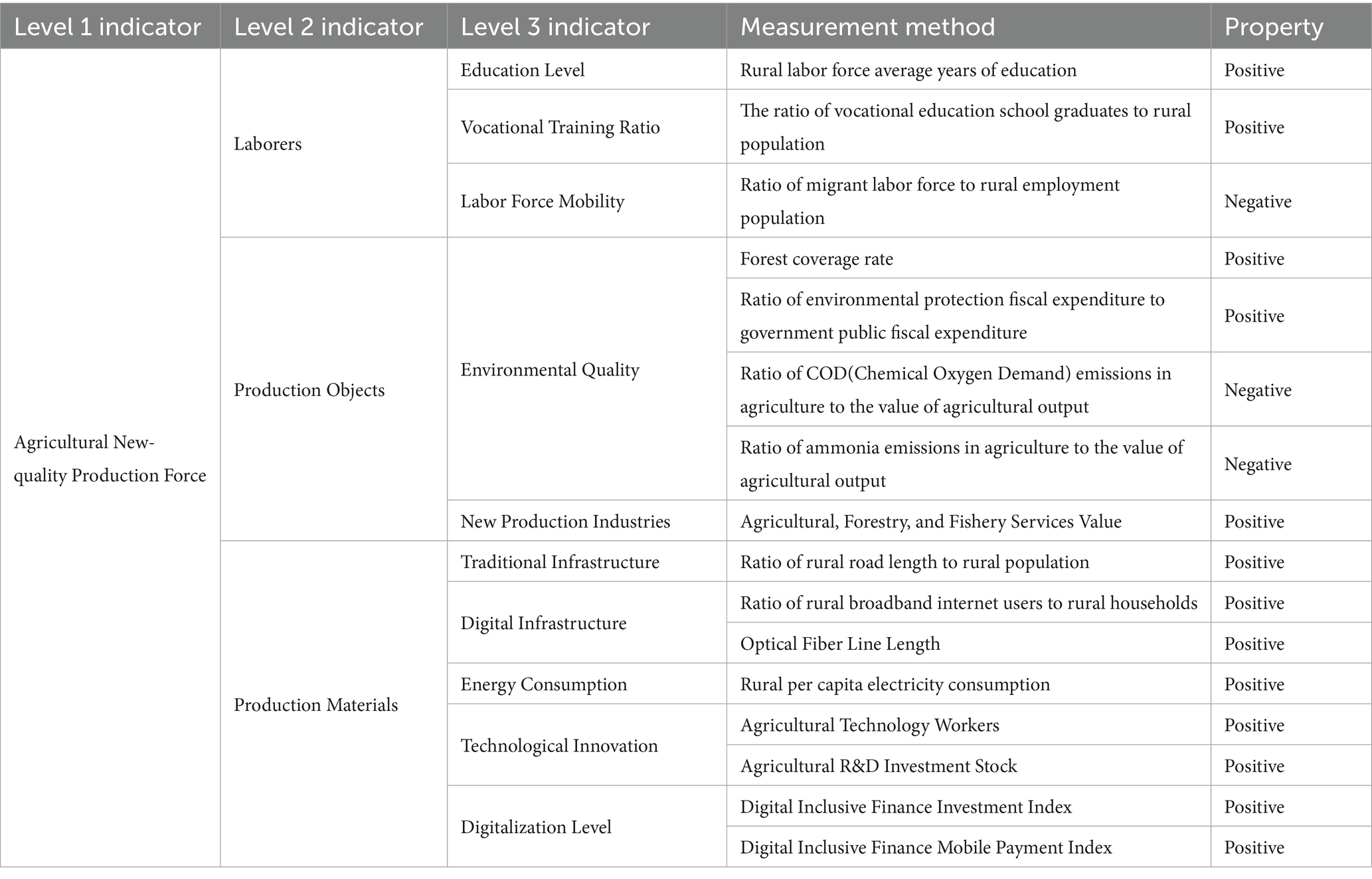
The deep integration of new quality productivity (NQP) with the agricultural sector is an inevitable path to promoting high-quality agricultural development. This paper explores the role of NQP in enhancing the high-quality agricultural development using panel data from 30 provinces in China over the period 2012–2021. An evaluation index system was constructed to measure both NQP and the level of high-quality development of agriculture. Empirical analysis was conducted using fixed effect and threshold effect models to test the promotion effect of NQP on agricultural development. The results indicate that NQP significantly promotes high-quality agricultural development, a conclusion that remains robust after undergoing robustness tests. Heterogeneity analysis reveals regional differences, with the eastern region showing the strongest effect, followed by the central region, and the western region showing the weakest effect. Additionally, in areas with higher levels of marketization, the promoting effect of NQP is more pronounced. Further research shows a non-linear relationship between NQP and agricultural development, characterized by increasing marginal effects. The findings provide robust support for the practical application of NQP in agriculture to achieve high-quality development and offer significant theoretical foundations for policy-making.

Fintech, or financial technology, is transforming the agriculture sector by enhancing access to capital, optimizing the utilization of resources, and promoting sustainable agriculture practices. This research assesses how fintech can promote sustainable agriculture in Tamil Nadu, India, through an analysis of how it influences climatic resilience, environmental sustainability, and financial inclusion. The research examines the impacts of fintech, mobile market access platforms, and precision farming technologies on agricultural sustainability and production by surveying farmers across the region. The findings indicate that farmers can embrace green farming methods, access broader markets, and acquire loans with greater ease using fintech, reducing resource wastage and enhancing economic stability. The effectiveness of fintech solutions is, nonetheless, significantly influenced by factors such as legislative support, infrastructural availability, and digital literacy. The research stresses that for the maximum benefit to small and marginal farmers, targeted digital literacy programs and increased fintech access are needed. For policymakers, financial institutions, and stakeholders in the agricultural sector, the findings of the research make valuable recommendations on the appropriate utilization of fintech technologies to address sustainability challenges and enhance rural economic development.