Bispecific Antibodies and their Conjugates in Solid Tumors and Hematological Malignancies

90kviews
Editorial09 December 2025
Editorial: Bispecific antibodies and their conjugates in solid tumors and hematological malignancies

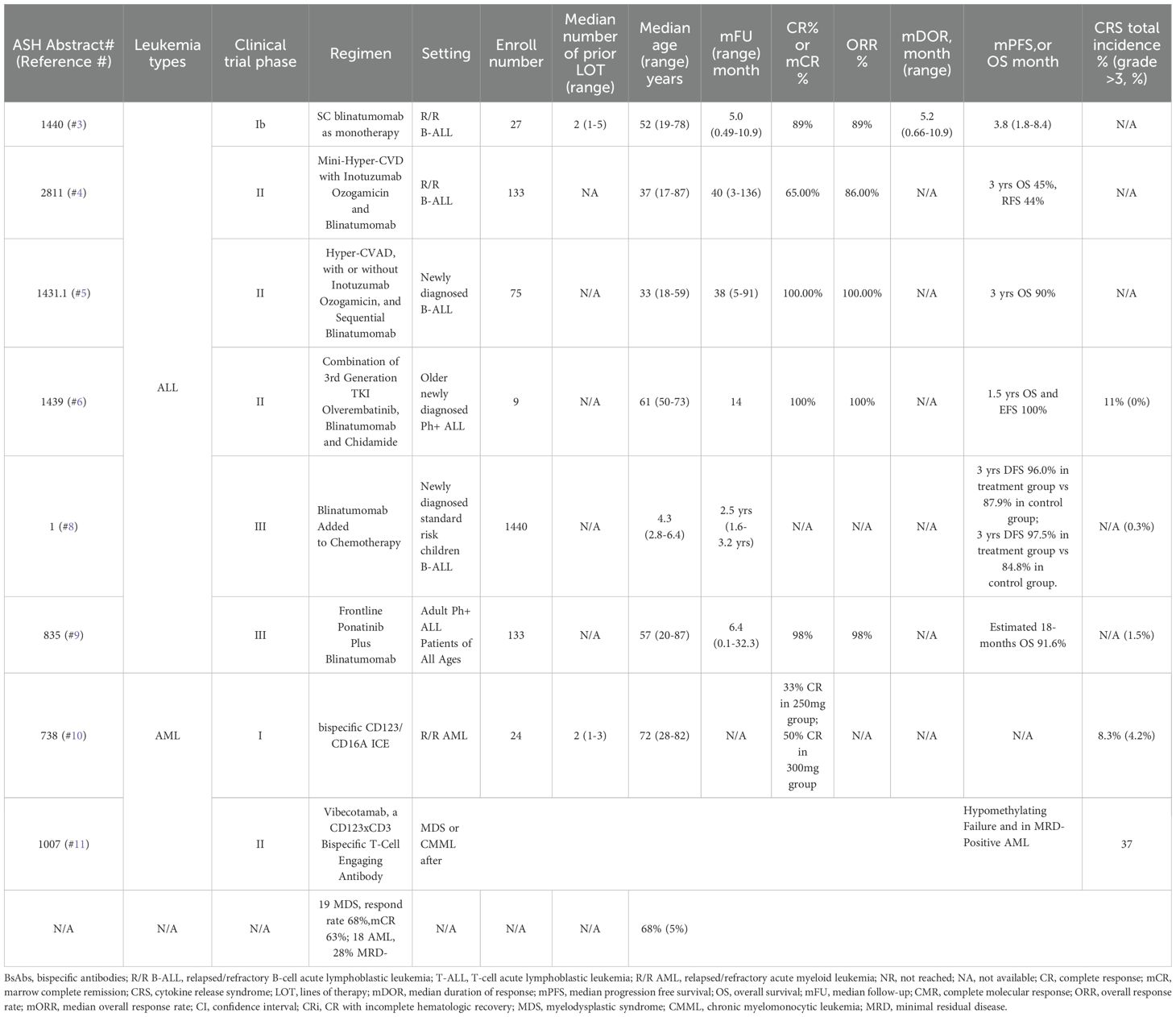
illustrate how rapidly the field is evolving, but also how heterogeneous the underlying biology, clinical development strategies and toxicity profiles remain.Several contributions focus on acute leukemia, where bispecific T cell engagers were first clinically established. Cao et al. summarize the most recent bispecific antibody data presented at the 66th American Society of Hematology meeting, encompassing both acute lymphoblastic leukemia (ALL) and acute myeloid leukemia, as well as combinations with chemotherapy and other targeted agents. Their conference-based overview highlights not only consistently high measurable residual disease (MRD) negativity rates in relapsed/refractory B-ALL but also the diversification of targets and platforms entering clinical testing, as well as the operational challenges of delivering these agents outside highly specialized centers. This Research Topic shows bispecific and other multispecific antibodies that move from hematologic malignancies into lung and other solid tumors, including heavily pretreated, high-risk patients. They enable MRD-focused strategies, options for such disease and precision use guided by immunophenotype and genetics, but at the price of immune toxicities, serious infections and infusions that require close monitoring (4,5). Translational work on cytokine-fusion, trispecific and other advanced formats shows how they remodel the tumor microenvironment, mobilize effector cells and counter immune escape and other resistance. Meta-analyses, real-world cohorts and smaller clinical series define priorities: biomarker-based target selection, integration with cellular therapies and radiation therapy, and long-term safety, sequencing, and survivorship study.Built to bridge diseases and disciplines, this 2024-2025 snapshot spans diverse cancers and study stages and aims to inform the next generation of bispecific and multispecific therapies.

1,454 views

REVIEW
23 July 2025
Blinatumomab in pediatric B-acute lymphoblastic leukemia
Yifang Chengand Aiguo Liu
Blinatumomab, a bispecific T-cell engager, has demonstrated substantial clinical benefits in treating pediatric patients with relapsed or refractory B-cell acute lymphoblastic leukemia (R/R B-ALL). Approved by FDA for several indications, blinatumomab is now integral to therapeutic protocols for specific pediatric cohorts, with real-world applications steadily increasing. As one of the representatives of cutting-edge immunotherapy for pediatric ALL, blinatumomab plays a crucial role in precision medicine against the backdrop of current genetic testing. Clinical efficacy is influenced by factors such as tumor burden, endogenous T-cell function, CD19 antigen loss, and lineage switch. Treatment-related complications, such as cytokine release syndrome (CRS), neurotoxicity (ICANS), and infections, necessitate vigilant monitoring. Administration involves continuous intravenous infusion, with consideration for drug interactions. Despite proven short-term efficacy and tolerability, long-term impacts on pediatric patients warrant further investigation. Current studies refine dosing strategies and combinational approaches to enhance therapeutic precision for pediatric patients. This review synthesizes selected literature related to clinical trials of blinatumomab, emphasizing determinants of clinical efficacy and adverse events associated with treatment.

8,704 views

10 citations

ORIGINAL RESEARCH
27 August 2025
Trispecific eFab-eIg T-cell engagers targeting HER2 and HER3
Ann-Kathrin Löffler, 3 more and Oliver Seifert

5,671 views

2 citations

ORIGINAL RESEARCH
18 September 2025
Blinatumomab demonstrates MRD eradication in MRD-positive/chemotherapy-delayed pediatric B-ALL and high response in relapsed/refractory cases: a multicenter cohort study
Na Zhang, 8 more and Hui Jiang

4,597 views

2 citations

IntroductionCancer immunotherapy has been revolutionized by targeting PD-1 to restore antitumor T-cell activity and blocking VEGF to attenuate immunosuppressive tumor angiogenesis. While combining PD-1 and VEGF inhibition has shown promise in enhancing antitumor responses, co-administration of two or more monoclonal antibodies face several challenges, including distinct pharmacokinetics, complex dosing, and toxicity. A bispecific antibody (BsAb) targeting both PD-1 and VEGF pathways could overcome these limitations by enabling simultaneous, localized blockades of PD-1 and VEGF signaling within the tumor microenvironment (TME) as both PD-1 and VEGF are usually co-expressed in the TME.MethodsHere, we describe the in vitro characterization, functional and preclinical evaluation of JS207, a novel BsAb targeting PD-1 and VEGFA with high antigen binding affinity. JS207 matched or surpassed the activity of benchmarks antibodies in several in vitro binding assessments, T cell activation, VEGF signaling inhibition, cytokines (IL-2 and IFN-γ) release.ResultsJS207 showed significant anti-tumor efficacy in mouse MC38 colon cancer model and A375 melanoma tumor model. Investigation into the mechanism of action revealed that VEGFA could significantly promote JS207’s antigen binding activity, T cell activation potency, and internalization of cell surface PD-1. In vivo results demonstrated that JS207 was well-tolerated and presented remarkable anti-tumor efficacy. In addition, JS207 showed enhanced thermal stability as evidenced by retained potency under heat stress, a critical factor for CMC (Chemistry, manufacturing and control) manufacture, storage and drug shelf life.ConclusionJS207 is a promising therapeutic candidate that may address unmet clinical needs in cancer immunotherapy.

13,254 views

13 citations

Bispecific antibody for lung cancer: mechanisms and clinical insights
REVIEW
29 May 2025

13,796 views

11 citations

BackgroundMultiple myeloma (MM) is a hematological malignancy with limited treatment options for patients with relapsed/refractory MM (RRMM). Teclistamab, a B-cell maturation antigen (BCMA) × CD3 bispecific antibody, has shown promising results in clinical trials and real-world studies.MethodsPubMed/MEDLINE, Web of Science, EMBASE, Cochrane Library, ClinicalTrials.gov, and meeting libraries were searched from inception to 14 November 2024. The assessed outcomes included overall survival (OS), progression-free survival, time to next treatment, duration of response, overall response rate (ORR), ≥complete response (≥CR), ≥very good partial response (≥VGPR), VGPR, partial response, and adverse events.ResultsIn total, 34 studies involving 4,064 patients were included. In pairwise meta-analysis, teclistamab demonstrated superior OS [hazard ratio (HR) = 0.69, 95% confidence interval (CI): 0.54–0.89; p = 0.037] compared to existing RRMM treatments. Real-world studies showed comparable ORR (62%, 95% CI: 58%–66%) but slightly lower survival outcomes, possibly because of shorter follow-up times and higher-risk populations. Subgroup analyses revealed enhanced efficacy with combination therapies (ORR: 85% vs 62%, p < 0.0001) and notable clinical benefits in the China cohort (≥VGPR: 77%, ≥CR: 58%). Safety profiles indicated manageable cytokine release syndrome and immune effector cell-associated neurotoxicity syndrome, though infection risks required vigilant management.ConclusionsTeclistamab continues to be a promising and effective treatment option for RRMM patients, including those previously exposed to BCMA-targeted therapies, and offers new hope for overcoming resistance and achieving better early disease control. Further research is needed to optimize its application in diverse populations, particularly in Asian cohorts.Systematic Review Registrationhttps://www.crd.york.ac.uk/prospero/#myprospero, identifier CRD42025633838.

9,153 views

12 citations

Bispecific antibodies (BsAbs) are cutting-edge immunotherapy agents that can bind two distinct antigens or epitopes simultaneously. They hold significant potential in targeting leukemic cell markers and activating immune cells like T cells or NK cells to eliminate malignant cells. BsAb treatments showed encouraging outcomes for both acute myeloid leukemia (AML) and acute lymphoblastic leukemia (ALL). In relapsed/refractory (R/R) ALL, BsAbs improved overall survival (OS) and achieved measurable residual disease (MRD) negativity in most patients. Blinatumomab plus standard chemotherapy or in combination with other treatments, such as Mini-Hyper-CVD and Inotuzumab Ozogamicin, improved disease-free survival (DFS) in B-ALL. In AML and related conditions, novel BsAbs like AFM28 (CD123xCD16A) and Vibecotamab (CD123xCD3) showed promising efficacy in heavily pretreated R/R AML and in MDS/CMML following the failure of treatment with hypomethylating agents (HMA). The meeting underscored the transformative potential of BsAbs, especially in ALL-focused trials, with ongoing research aiming to evaluate their safety and efficacy in broader patient populations and combination regimens. This summary highlights the latest progress in BsAb-based immunotherapy presented at the ASH 2024 meeting, held from December 7–10 in San Diego, California.

5,800 views

9 citations

CASE REPORT
31 March 2025
Successful treatment of primary refractory DLBCL/HGBL - MYC/BCL2 transformed from FL using glofitamab: a case report
Ming-qiang Chu, 5 more and Jing-dong Zhou

5,090 views

3 citations