Childhood myopia is no longer just a routine refractive error; it is increasingly being treated as a public health problem, with projections suggesting that by 2050 as many as half of the world's population could be affected if current trends continue. 1 The burden is especially visible in East and Southeast Asia, but rising prevalence is also being reported in low-and middle-income countries, where health systems are facing challenges. What once seemed like "simple" childhood myopia is now linked to later complications such as myopic macular degeneration, retinal detachment, glaucoma, and cataract, which makes early and structured control harder to ignore. 2 This Frontiers research topic focusses the spotlight on a very essential and practical question: how to prevent myopia onset and slow progression in real-world settings. Across all its articles, it covers epidemiologic risk modelling, digital screening and implementation science, pharmacologic and optical therapies, and opinions that push the field beyond refractive correction and toward active myopia management. The overall message is not that there is one answer, but that several complementary approaches need to work together across the course of a child's visual development.One stream of work in the collection focuses on identifying which children are most likely to become fast progressors, using multivariable models that incorporate age, baseline refraction, parental myopia, near-work intensity, outdoor time and school environment. Prediction models developed in Asian cohorts show that simple clinical variables can stratify risk with reasonable accuracy, offering a basis for targeted surveillance rather than uniform annual refractions. Multiple articles emphasize that recognition should be early and systematic such as school-based screening, cycloplegic refraction and, where feasible, axial length measurement; so that interventional decisions are made before high myopia and structural damage emerge.Another thread in the issue explores how digital technologies and novel screening pathways can operationalize myopia control at scale. Stakeholder work around digital myopia screening programmes reveals both enthusiasm and caution: parents, teachers and clinicians appreciate the potential for reach, but raise concerns about data privacy, equity of access and integration with existing school health systems. These perspectives remind us that even the best interventional modalities may not deliver adequate results in practice if they are not embedded within socially acceptable, sustainable delivery models. 3 This issue included review of pharmacologic and optical approaches, discussed considering current randomized trials and meta-analyses. Low-dose atropine, especially 0.01% and 0.05%, emerges as one of the main treatment options, [4][5] with evidence showing meaningful slowing of both refractive progression and axial elongation, even if results vary across ethnic groups and dosing schedules. The optical approaches covered include peripheral-defocus spectacle lenses such as DIMS designs, dual-focus soft contact lenses, and orthokeratology, all of which have shown clinically meaningful effects on slowing axial growth in controlled studies. Repeated low-level red-light therapy have shown effects on preventing axial elongation, though questions remain about long-term safety and optimal treatment windows. 6 Additionally novel spectacle designs with diffusion optics or contrast modulation shown promising shortterm effect on axial length but their long-term efficacy and rebound effect, if any, yet to be accessed. [7][8] The Topic also touches on combination therapy of pharmacologic plus optical intervention where additive/synergistic benefits appear in children who are inadequately controlled by monotherapy, reflecting a shift towards individualized, multi-modal regimens.A distinctive feature of this collection is consideration of primary prevention by intervening before myopia onset in high-risk, pre-myopic children. Opinion and perspective argue that delaying the onset of myopia by one or two years may translate into substantial lifetime reductions in axial length, potentially halving the risk of sight-threatening complications. At the same time, they also raise concern that prophylactic use of atropine or myopia-control lenses in children with no myopic refractive error raises ethical, adherence and cost concerns, and must be guided by robust risk stratification and careful counselling.The issue also highlights realities of clinical practice by emphasizing that discomfort, visual disturbances and behaviour can quickly erode the real-world impact of otherwise efficacious interventions. Reports on experience with peripheral defocus spectacle lenses, digital programmes and pharmacologic treatments shown that central acuity and trial outcomes are only part of the story; child and family acceptance, frame fit, centration, adaptation and day-to-day usability are equally critical to sustained success. Many authors call for structured troubleshooting and communication protocols, moving beyond ad-hoc advice to systematic support that keeps children engaged with their treatment over years rather than months.Taken together, this issue present childhood myopia care as a continuing management: it begins with behavioural and environmental measures, moves through risk-based screening and early recognition, and extends to tailored pharmacologic and optical treatment with regular followup. For clinicians, the takeaway is straightforward: myopia management can no longer stop at prescribing single-vision lenses. It calls for proactive, individualized care that is evidencebased but also realistic about local health-system constraints. For researchers and policymakers, the Topic highlights persistent gaps: data in non-isolated and syndromic myopia, long-term outcomes of emerging modalities, cost-effectiveness in low-resource settings, and scalable models that integrate digital tools, school health programmes and specialty clinics. This Frontiers collection shows that childhood myopia care now includes a wider range of interventions than it did even a few years ago, but having more options is only part of the story. Their value depends on whether they can be used in ways that fit local, clinical and publichealth realities. As prevalence continues to rise, , the task for clinicians, researchers, and publichealth leaders is to turn these options into workable prevention and management strategies. The real goal is to ensure that fewer children progress to high myopia and fewer adults face avoidable sight-threatening complications later in life.
Editorial07 September 2026
Editorial: Interventional modalities for the prevention and management of childhood myopia

REVIEW
6 January 2026
Mariam M. AlEissa, 1 more and Deepak P. Edward
3 Authors
- MM
Mariam M. AlEissa
Department of Research, King Khaled Eye Specialist Hospital (KKESH) Research Center, Saudi Arabia
- MA
Malak Abedalthagafi
Department of Pathology and Laboratory Medicine, Tufts University School of Medicine, United States
- DP
Deepak P. Edward
Department of Research, King Khaled Eye Specialist Hospital (KKESH) Research Center, Saudi Arabia
Consanguineous marriages are common, particularly in Saudi Arabia, where approximately half of all marriages are consanguineous. The likelihood of autosomal recessive (AR) genetic abnormalities, especially rare diseases (RDs) that present long-term health issues, is significantly increased by this trend, making Inherited Ocular Diseases (IODs) a public health concern in Saudi Arabia. The common IODs include Primary Congenital Glaucoma (PCG), Retinitis Pigmentosa (RP), and Leber Congenital Amaurosis (LCA). To date, there are no national initiatives for screening programs to detect, prevent, and manage IOD. This review aims to evaluate the public health landscape of IOD in Saudi Arabia, including epidemiology and genetic factors. It highlights the need for a national framework to facilitate screening, prevention, and early intervention. Cost-effectiveness evaluation, early genetic screening, and counseling can drastically lower the long-term medical expenses related to IOD management. Outreach programs can be used to address issues, including cultural acceptance and equitable access to screening services, which are needed. Further carrier screening for at-risk families accompanied by genetic counseling decreases new IOD cases and provides better family planning for impacted populations. These are among the expected results, which will eventually enhance health outcomes and ensure the long-term viability of Saudi Arabia’s healthcare system. In alignment with Vision 2030’s futuristic pipeline for screening, introducing telemedicine and AI-driven predictive tools can enhance accessibility and precision in screening programs.
ORIGINAL RESEARCH
21 October 2025
Jiajia Liao, 1 more and Wanqing Jin
3 Authors
- JL
Jiajia Liao
National Clinical Research Center for Ocular Diseases, Eye Hospital, Wenzhou Medical University, China
- ZC
Zhijie Chen
Key Laboratory of Surface Modification of Polymer Materials, Wenzhou Polytechnic, China
- WJ
Wanqing Jin
National Clinical Research Center for Ocular Diseases, Eye Hospital, Wenzhou Medical University, China
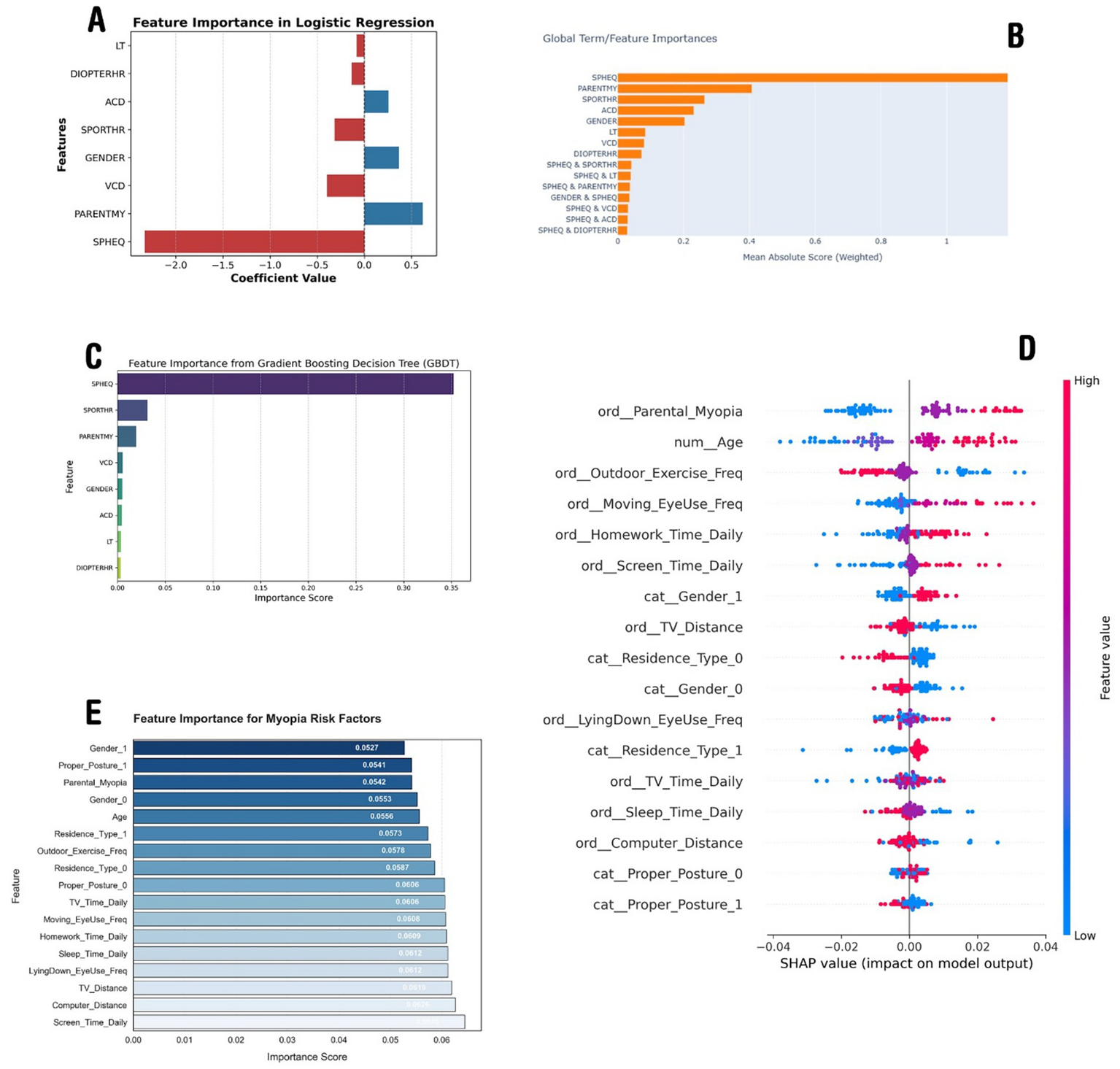
IntroductionMyopia is a multifactorial condition driven by an interplay of genetic predisposition and environmental triggers. This study aims to harmonize and analyze risk predictors from two distinct datasetsone historical and clinical, the other contemporary and behavioralto develop an integrated framework for myopia risk prediction.MethodsWe analyzed two datasets: the Orinda Longitudinal Study of Myopia (OLSM), a 1995 US cohort (n≈500) with detailed ocular biometrics (e.g., spherical equivalent refraction, axial length) and lifestyle factors, and a 2022-2023 Chinese cross-sectional study (n=100,000) highlighting modern behaviors (e.g., screen time, posture). We employed multiple machine learning modelsincluding logistic regression, Explainable Boosting Machine (EBM), gradient boosting decision trees (GBDT) on OLSM, and deep neural networks (DNN) and XGBoost on the Chinese datasetto identify key predictors. Model interpretability was assessed using SHapley Additive exPlanations (SHAP). We also tested three ensemble strategies (sequential, averaging, transfer learning) to merge insights across the structurally divergent datasets.ResultsBoth datasets confirmed parental myopia as a universal risk factor and time spent outdoors as a protective factor. In the OLSM dataset, spherical equivalent refraction and parental myopia were the top predictors, with models achieving an AUC of up to 0.92. In the Chinese dataset, the DNN model achieved 71% accuracy, identifying screen time, posture, and parental history as major risk factors. Cross-dataset integration via transfer learning proved most effective, successfully amplifying features like outdoor activity and posture while retaining core behavioral predictors like screen time. This approach bridged the clinical depth of OLSM with the granular, modern lifestyle insights from the Chinese dataset.DiscussionOur analysis confirms the multifactorial nature of myopia, blending historical biological mechanisms with contemporary behavioral drivers. The study demonstrates a scalable strategy for global myopia risk prediction by adaptively integrating diverse datasets. While not yet a turnkey clinical tool, this work lays the groundwork for future multimodal risk-prediction frameworks that can bridge era-specific biases and harness machine learning to capture the evolving profile of myopia risk.