Education systems worldwide remain marked by persistent, patterned inequities rooted in historical injustices, socioeconomic structures, policy regimes, and dominant assumptions about whose knowledge counts. These disparities vary across regions, as do the conceptions of equity used to name and address them. Across varied contexts, researchers, educators, policymakers, families, and community partners everywhere have increasingly turned to collaborative research to confront these inequities.Collaborative approaches to educational research take many forms, including research-practice partnerships (RPPs), community-engaged research, participatory action research, and designbased implementation research. Across their differences, these approaches reposition how research and practice relate, beginning from the premise that educational knowledge is strongest when produced together with schools and communities, as partners in inquiry. Such an endeavour is particularly crucial at a time when practitioners may be increasingly skeptical of scientific evidence (Rosman & Merk, 2021). The 2020 "Principles of Collaborative Education Research with Stakeholders" gave this commitment concrete form, calling for collaborations that give marginalized voices genuine influence, address community-defined problems, and remain answerable to the communities they serve. Further, such collaborations need to grapple with the aims of improvement, particularly with respect to how research supports aims for promoting equity (Farrell et al., 2023).Making this commitment a reality depends on the conditions in which partnerships operate. Power, funding, governance, and histories of exclusion shape every collaboration, and these same forces can steer partnerships towards reproducing they set out to transform (Diamond, 2021). How fully collaborations have realized these principles, and whether they are sufficient, remain open questions.This Research Topic was convened to take up these questions, critically exploring equity in and through educational collaboration across diverse contexts, attending to both promising strategies and instructive setbacks in processes and outcomes. The ten contributions gathered here, spanning the United States, the Netherlands, Singapore, and Chile, examine how equity is conceptualized, enacted, constrained, and repaired in collaboration. We organize them into three themes.
A first cluster of articles advances frameworks that make equity more explicit and actionable, offering the field clearer ways to define, operationalize, and evaluate a commitment that is often expressed in broad terms.Shewchuk and Vilceus, in a scoping review, show that explicit definitions of equity remain rare, even when equity is central to a collaboration's goals. They propose the Equity-Centred Collaboration Framework, which locates equity across three interdependent domains: goals, processes, and outcomes, to make it observable and accountable.Farrell et al. shift from defining equity to designing for it. Their framework for equity-centred boundary infrastructure addresses the tools, routines, and roles that support learning across research and practice. By reimagining the research brief as a boundary object, they show how ordinary tools can either reproduce hierarchies or enable transformational learning.Oyewole and colleagues ask what it would take to move collaborative research from niche to norm. Their framework identifies institutional action areas: egalitarian funding, power-levelling design, deliberate learning, expansive communication, and justice-aligned incentives, showing that individual commitment is insufficient without organizational change.
A second cluster examines partnerships in the day-to-day work of enacting equity. This work is iterative and often demanding, and equity is advanced through tension, renegotiation, and sustained attention to the "how" of partnership work.Hadad et al. examine an RPP in computer science education in California. Drawing on Freire's concepts of praxis and dialogue, they show that defining equity cannot just be a preliminary step but an ongoing practice: over four years, their partnership repeatedly revised its definition. Resistance to equity conversations proved generative, revealing assumptions about the field's supposed neutrality.Weddle et al. examine how a national RPP across 28 state education agencies sustained collaboration amid political shifts, turnover, and growth, highlighting boundary practices, a shared vision, small-group work, adaptable resources, and protected spaces for political sensemaking, all of which depend on deliberate facilitation, not simply shared goals.Gaikhorst et al., writing from the Educational Research Lab Amsterdam, find that equitable collaboration does not require erasing differences in expertise; collective agency in their partnership emerged when partners acknowledged distinct roles and actively revisited a shared vision.Gómez Zaccarelli et al. present a Latin American case from Chile, tracing an RPP's movement from trust-building to co-designed inquiry and revealing vulnerabilities common across partnerships: difficulties in trust among partners, dependence on individual champions and limited formal infrastructure.
A third cluster shifts the equity question from partnerships to the systems that surround them, including funding geographies, governance arrangements, and colonial histories.
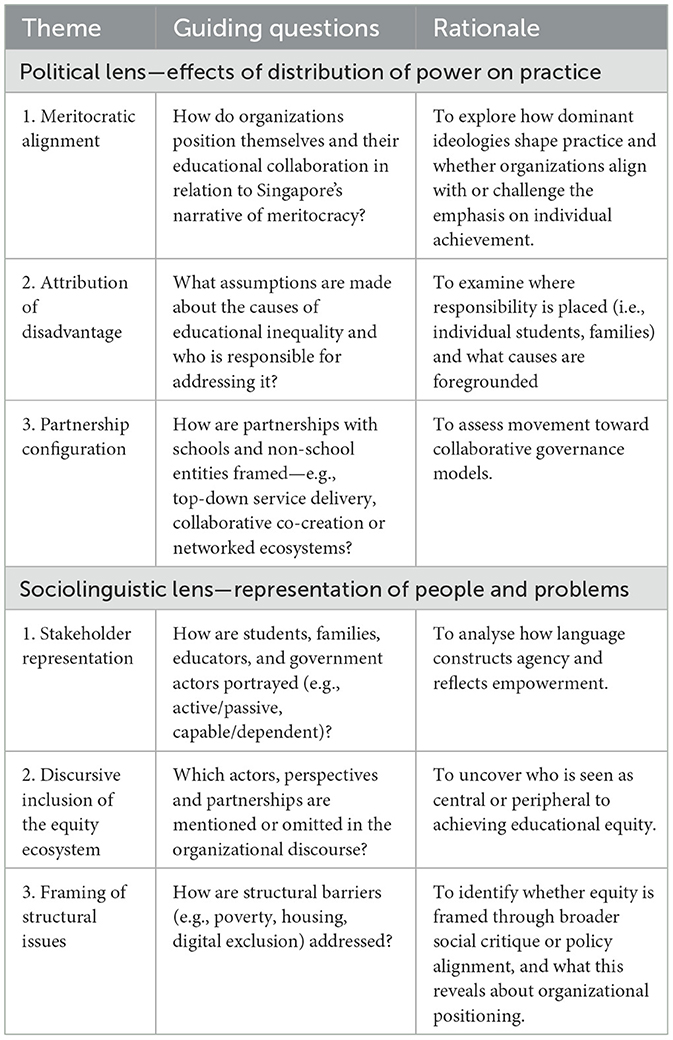
California research-practice partnerships funded by national sources, which fueled their growth and focus on equity. However, these partnerships were mainly in coastal, urban, and suburban areas, centred around research universities and districts, with grants primarily going to research institutions. They argue that this shows funders greatly influence who can create and sustain partnerships, making access to RPP infrastructure a matter of equity.Teng et al. offer a Singaporean perspective on partnerships within a centralized, outcomesdriven system. Through a critical discourse analysis of community-based organizations, they show how partnerships support marginalized youth while remaining constrained by compensatory, technocratic frames. They call for collaborative governance that centres community ownership rather than treating educational gaps as technical deficits.
, where contradictions between punitive school discipline and Indigenous kinship values became resources for expansive learning and decolonizing agency. Centring Anishinaabe lifeways and kin-making, the partnership reframed disengagement as a cultural disconnection produced by schooling. Here, equity is not remediation within existing systems but the collective work of reclaiming epistemic authorship and designing educational futures rooted in sovereignty.
The contributions gathered here examine equity as something to specify, to enact, and to situate within larger structures. Read together, they advance three propositions. First, equity must be made explicit: it becomes actionable when partners define it, revisit it, and examine how it appears across goals, processes, and outcomes. Second, equity is structural as well as relational: alongside trust and shared decision-making, it depends on redistributing funding, redesigning incentives, and transforming governance. Third, tension can strengthen equitable collaboration, as resistance, contradiction, and role negotiation can become resources for deeper learning.The collection also reveals a shared vulnerability: many partnerships depend on temporary grants, individual champions, and goodwill, a fragility that becomes consequential as research funding and equity commitments face political pressure or are not yet well developed. Strengthening equity, therefore, requires both stronger partnership practices and a transformed research enterprise.Several avenues for future work include longitudinal study of how partnerships are sustained or end after initial grants; research on the political economy of collaboration; building partnership capacity in rural and historically marginalized regions; broader definitions of impact that recognize community-held knowledge; and scholarship that includes students, families, and communities as co-theorists.Ultimately, this work is about the students, families, and communities that education systems exist to serve. Strengthening equity in and through research collaboration is a long and collective undertaking, and the articles in this Research Topic offer the field both the grounding and the momentum to carry it forward.