From Adolescence to Adulthood: The Role of Diet in Preventing Metabolic and Mental Health Disorders

Cover image for Research Topic "From Adolescence to Adulthood: The Role of Diet in Preventing Metabolic and Mental Health Disorders"
53kviews
Editorial09 February 2026
Editorial: From adolescence to adulthood: the role of diet in preventing metabolic and mental health disorders

Editorial on the Research Topic: From Adolescence to Adulthood: The Role of Diet in the 9

Adolescence is a pivotal developmental window during which dietary habits, psychosocial 11 trajectories, and biological maturation converge to shape lifelong health. These years are marked by 12 increasing autonomy over food choices alongside profound metabolic, neuroendocrine, and 13 emotional changes, positioning adolescence as both a period of vulnerability and a powerful 14 opportunity for prevention.

1,753 views

IntroductionOver the last years, adolescents have exhibited high consumption of sugar-sweetened beverages (SSBs). During this developmental stage, characterized by profound biological and psychosocial changes, individuals are more susceptible to sleep disturbances, as well as psychological, behavioral, and emotional difficulties. The present scoping review aims to offer insights into how SSBs consumption relates to sleep and mental health outcomes in adolescents.MethodsA systematic search and selection process was conducted across four electronic databases. Studies, published in peer-reviewed international scientific journals up to April 2025, in English, and examining the relation between SSBs, sleep, and mental health in adolescents were considered eligible.ResultsThe search identified 288 references after duplicate removal. Based on PCC framework, 57 studies were included. Slightly fewer studies investigated the association between SSBs consumption and sleep outcomes (n = 25), compared with those focusing on mental health outcomes (n = 32). Evidence suggests a potential link between SSBs consumption, sleep, and mental health, indicating that higher intake may be associated with increased sleep disturbances and mental health problems.DiscussionOverall, the results of this review advance the hypothesis of a possible bidirectional relationship between SSBs consumption and both adverse sleep and mental health outcomes. These findings should be interpreted with caution, due to the main gaps identified. The current evidence calls for future studies that use interventional and longitudinal designs, focus on adolescence, target regions with rising SSBs consumption and sleep or mental health issues, analyze SSBs subgroups separately, and address all sleep dimensions. This review also highlights the need for tailored public health intervention strategies that address all lifestyle domains relevant to adolescent health.Scoping review registrationhttps://osf.io/kzu7y/overviewn, DOI: 10.17605/OSF.IO/KZU7Y.

4,470 views

5 citations

The effect of dietary carbohydrate quality on depression and anxiety levels in adolescents
ORIGINAL RESEARCH
19 November 2025
The effect of dietary carbohydrate quality on depression and anxiety levels in adolescents
Taha Gökmen Ülger, 4 more and Berre İncekara

5,286 views

2 citations

ORIGINAL RESEARCH
5 January 2026
Parents’ nutrition knowledge, perceived barriers and enablers, and healthy-eating attitudes associated with children’s adherence to the Mediterranean diet: the DELICIOUS project
Sabrina Castellano, 18 more and Giuseppe Grosso

2,910 views

2 citations

ORIGINAL RESEARCH
10 November 2025
Diet quality and its associated factors among adolescents in high schools of Rawalpindi and Islamabad
Fatima Falak, 5 more and Maryam Irfan
Diet quality and its associated factors among adolescents in high schools of Rawalpindi and Islamabad
IntroductionAdolescence is a critical developmental stage during which dietary behaviors have profound impacts on physical health, mental well-being, and academic performance.ObjectiveThe objective of this study was to examine the associations between diet quality and academic performance, body image perceptions, and demographic factors.Methodsn = 281 adolescents aged 15–18 years from public and private high schools in Rawalpindi and Islamabad were selected for the study. A cross-sectional study design was incorporated and the data were gathered through the Diet Quality Questionnaire (DQQ), Kuppuswamy Socioeconomic Scale and Body Satisfaction and Image Questionnaire.ResultsThe analysis showed that 42.7 of % students possess a moderate diet and 57.3% possessed a poor diet. Diet quality was significantly associated with class grade, age, gender, socioeconomic status, body image and academic performance (p < 0.001). Students with a lower socioeconomic status, girls, senior grade students, and younger students were more likely to have poor eating habits.ConclusionThe findings present an urgent need for specific nutritional education and interventions in schools, in particular, among high-risk and vulnerable groups. Enhancing teenage diets can impact their psychological conditions, intellectual growth, and overall school performance.

6,188 views

5 citations

ORIGINAL RESEARCH
24 October 2025
Parents of children and adolescents knowledge, attitude, and practice toward metabolically healthy obesity: a cross-sectional survey
Fengyu Zhong, 6 more and Youfang Hu

2,803 views

2 citations

ORIGINAL RESEARCH
1 October 2025
Dietary inflammation and socioeconomic status mediate depression–constipation link: a cross-sectional analysis of NHANES 2005–2010
Qiulu Huang, 3 more and Lina Wang

3,437 views

1 citations

ORIGINAL RESEARCH
25 August 2025
Trends in the prevalence of anorexia nervosa among individuals under 45 years in China, 1992–2021: an age-period-cohort analysis
Jun Tian, 3 more and Yongzhao Zhou

5,407 views

2 citations

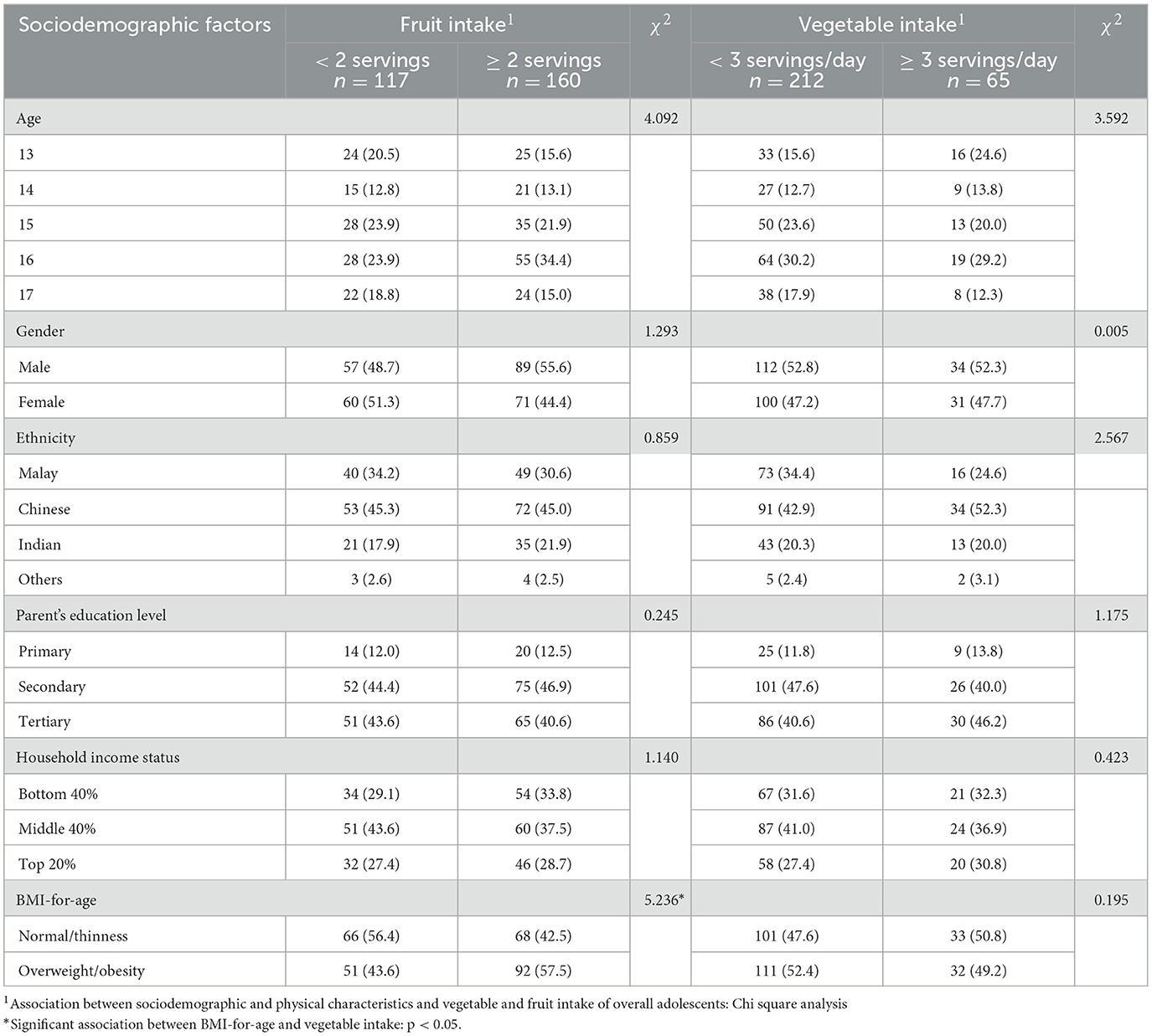
BackgroundSubstantial scientific evidence firmly advocates consumption of vegetables and fruits for maintenance of overall health and protection against chronic diseases, such as obesity. However, prevalence of fruit and vegetable intake among adolescents in Malaysia remains low, whereas the data on factors associated with vegetable and fruit intake among adolescents were limited.ObjectiveThis study aims to determine the prevalence of fruit and vegetable intake and the factors that influence the Malaysian adolescents' consumption of fruits and vegetables.MethodsA cross-sectional study was conducted from November 2021 to August 2022 by distribution of an online validated questionnaire on various platforms to recruit school-going adolescents aged 13 to 17 years old (Form 1–5) in Selangor. Respondents were screened and data of eligible participants were included as subjects. Descriptive statistics, chi square analysis, and generalized linear model with Poisson-loglinear distribution and the robust estimator were employed for data analysis.ResultsA total of 277 adolescents participated in this study. Overall, low prevalence of adequate vegetable consumption was observed (23.5%). Of the participants surveyed, 14.8% of adolescents with thinness, 25.2% and 15.0% of adolescents with overweight and obesity, and 27.1% of normal-weight adolescents met the recommended daily intake (>3 servings), whereas 64.1% of adolescents with overweight and obesity and 65% of normal-weight participants consumed at least two servings of fruits a day. The findings revealed significant association between BMI-for-age (X2(1, N = 277) = 5.236, p = 0.022) and adolescent fruit intake. On the other hand, overweight and obese adolescents reporting positive intention (PR: 1.146, 95% CI: 1.002, 1.310, p = 0.047) and parental allowance (PR: 1.125, 95% CI: 1.011, 1.252, p = 0.030) were observed to have 14.6% and 12.5% higher prevalence of fruit consumption, respectively, while availability at home (PR: 0.849, 95% CI: 0.731, 0.987, p = 0.033) showed significantly lower prevalence of fruit intake with more reports of home availability.ConclusionThe study suggests that personal, social-environmental, and physical-environmental factors influence vegetable and fruit intake among adolescents, particularly fruit intake consumption behaviors among overweight and obese adolescent population in Selangor. The enunciation of these intake correlates could potentially be incorporated in future development of intervention strategies to effectively promote fruit and vegetable intake.

3,868 views

3 citations