Advanced Machine Learning Techniques for Single or Multi-Modal Information Processing

41kviews
ORIGINAL RESEARCH
9 February 2026
Multimodal AI fusion for infrastructure resilience: real-time urban analytics framework aligned with SDG-9
N. S. Kalyan Chakravarthi, 4 more and G. Sivaprasad

2,635 views

1 citations

6,285 views

6 citations

Intelligent leak monitoring of oil pipeline based on distributed temperature and vibration fiber signals
ORIGINAL RESEARCH
20 November 2025
Intelligent leak monitoring of oil pipeline based on distributed temperature and vibration fiber signals
Xiaobin Liang, 9 more and Wei Wu
Due to long-term usage, natural disasters and human factors, pipeline leaks or ruptures may occur, resulting in serious consequences. Therefore, it is of great significance to monitor and conduct real-time detection of pipeline leaks. Currently, the mainstream methods for pipeline leak monitoring mostly rely on a single signal, which have significant limitations such as single temperature being susceptible to environmental temperature interference leading to misjudgment, and single vibration signal being affected by pipeline operation noise. Based on this phenomenon, this research has built a distributed optical fiber system as an experimental platform for temperature and vibration monitoring, obtaining 3,530 sets of real-time synchronized spatial-temporal temperature and vibration signals. A dual-parameter fusion residual neural network structure has been constructed, which can extract characteristic signals from the original spatial-temporal temperature and vibration signals obtained from the above monitoring system, thereby achieving a classification accuracy of 92.16% for pipeline leak status and a leakage location accuracy of 1 m. This solves the problem of insufficient feature extraction and weak anti-interference ability in single signal monitoring. By fusing the original temperature and vibration signals, more leakage features can be extracted. Therefore, compared with single signal monitoring, this study has improved the accuracy of leakage identification and location, bridging the gap of misjudgment caused by single signal interference, and providing a basis for pipeline leakage monitoring and real-time warning in the oil industry.

3,912 views

5 citations

ORIGINAL RESEARCH
4 August 2025
Basrah Score: a novel machine learning-based score for differentiating iron deficiency anemia and beta thalassemia trait using RBC indices
Salma A. Mahmood, 1 more and Saad S. Hamadi
Basrah Score: a novel machine learning-based score for differentiating iron deficiency anemia and beta thalassemia trait using RBC indices
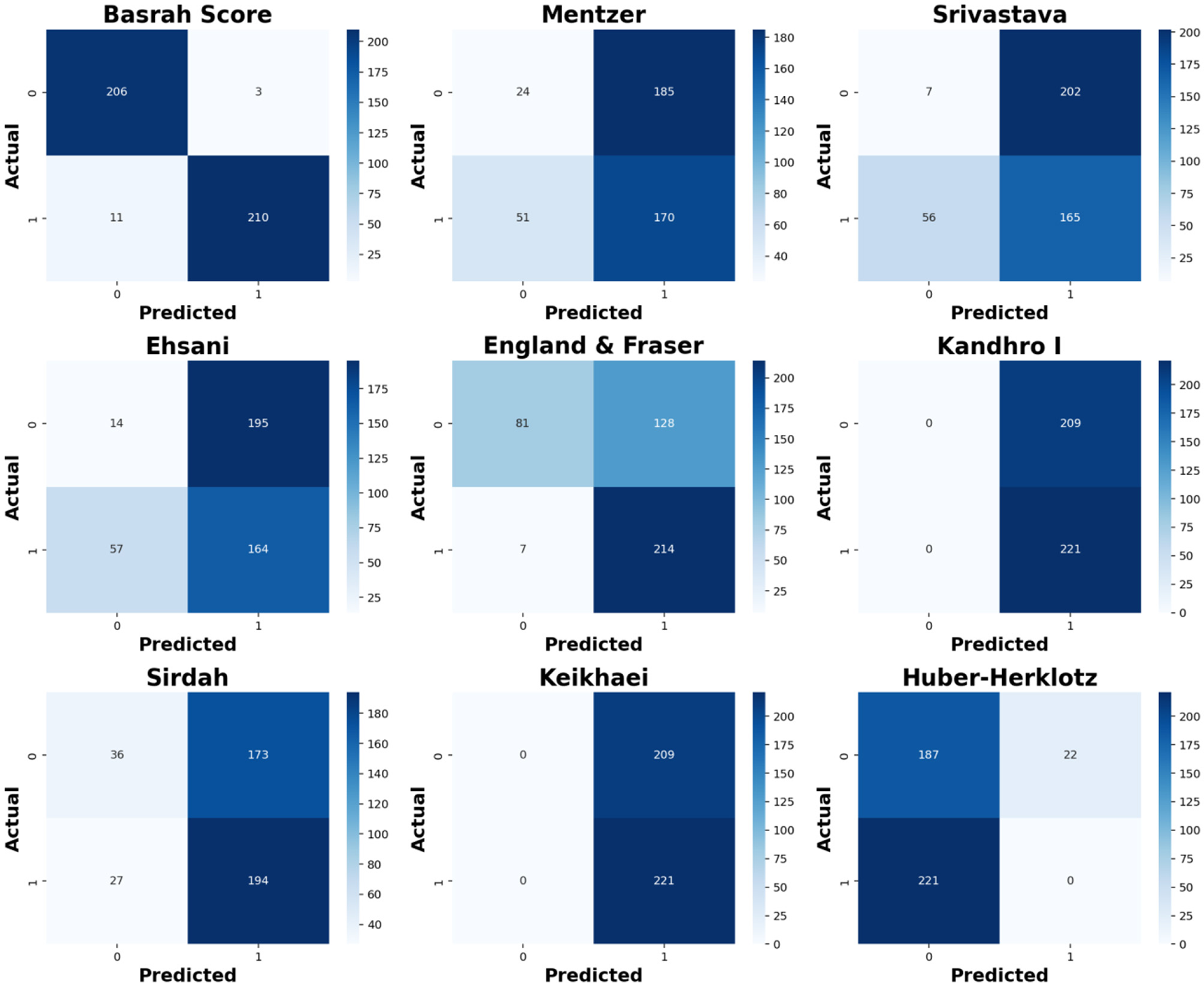
Iron deficiency anemia (IDA) and beta-thalassemia trait (BTT) are prevalent causes of microcytic anemia, often presenting overlapping hematological features that pose diagnostic challenges and necessitate prompt and precise management. Traditional discrimination indices—such as the Mentzer Index, Ihsan's formula, and the England and Fraser criteria—have been extensively applied in both research and clinical settings; however, their diagnostic performance varies considerably across different populations and datasets. This study proposes a novel and interpretable diagnostic model, the Basrah Score, developed using Elastic Net Logistic Regression (ENLR). This machine learning–based approach yields a flexible discrimination function that adapts to variations in clinical and environmental factors. The model was trained and validated on a local dataset of 2,120 individuals (1,080 with IDA and 1,040 with BTT), and was benchmarked against eight conventional indices. The Basrah Score demonstrated superior diagnostic performance, with an accuracy of 96.7%, a sensitivity of 95.0%, and a specificity of 98.6%. These results underscore the importance of incorporating advanced pre-processing techniques, class balancing, hyperparameter optimization, and rigorous cross-validation to ensure the robustness of diagnostic models. Overall, this research highlights the potential of integrating interpretable machine learning models with established clinical parameters to improve diagnostic accuracy in hematological disorders, particularly in resource-constrained settings.

4,373 views

9 citations