Similarities and Differences Between Substance-Related and Non-Substance-Related Addictive Behaviors

Cover image for Research Topic "Similarities and Differences Between Substance-Related and Non-Substance-Related Addictive Behaviors"
50kviews
Editorial07 May 2026
Editorial: Similarities and differences between substance-related and non-substance-related addictive behaviors

Editorial on the Research Topic Similarities and Differences Between Substance-Related and Non-16Substance-Related Addictive Behaviors. 17An altered inhibitory skill, combined with an increased salience of addiction-related cues, are 18 the two main disturbed cognitive and emotive mechanisms related to addictive behaviors. Indeed, 19 addictive stimuli were associated through classical conditioning stimuli to rewarding and highly 20 motivational responses (such as excessive alcohol consumption or gambling

966 views

ORIGINAL RESEARCH
14 May 2026
Relationship between peer victimization and adolescent internet addiction: self-esteem as a mediator and teacher-student relationship as a moderator
Yujie Wang, 7 more and Chenchen Xu

1,588 views

1 citations

ORIGINAL RESEARCH
7 May 2026
Screen time, smartphone addiction, and executive-motor function in Tunisian middle school students
Mohamed Yaakoubi, 10 more and Adnene Gharbi

3,616 views

1,501 views

2 citations

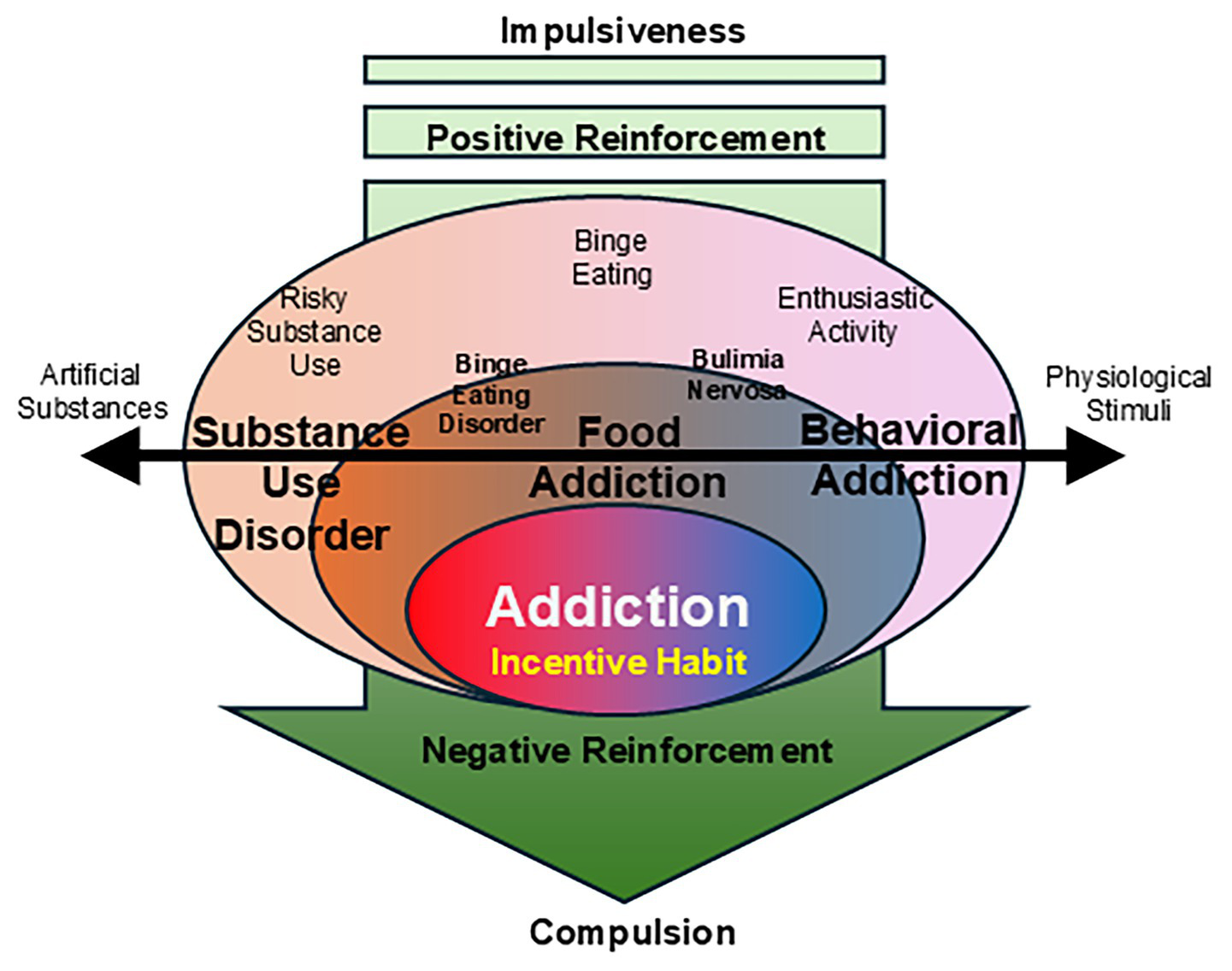
The term addiction or addictive disorder refers to a psychiatric condition that is characterized impulsive and compulsive seeking targets or action executions despite negative consequences are expected to occur. However, it has been used to lump widely heterogeneous conditions, such as substance use disorders, behavioral addictions, and food addiction, together, which has been causing a serious problem in understanding and defining the addictive disorder. Here we deliberate a framework toward comprehensive understanding of addictive disorders that overcome the heterogeneities of substance use disorders, behavioral addictions, and a food addiction, by considering that addictive disorders could form a spectrum of disorders, consisting of three imperative components, specifically negative reinforcements in relation to compulsive seeking, cue-induced responses in relation to associative learning, and a food addiction as an intermediate phenotype between substance use disorders and behavioral addictions.

5,241 views

4 citations

ORIGINAL RESEARCH
16 January 2026
Adaptation and validation of the Turkish version of The Brief Screener for Substance and Behavioral Addiction (SSBA)
Ardil Bayram Şahin, 5 more and Hale Yapici Eser

2,828 views

1 citations

BRIEF RESEARCH REPORT
13 November 2025
Verbal memory dysfunction in substance use and gambling addictive disorders: a comparative analysis of performance accuracy and error typologies
Davide Crivelli, 4 more and Michela Balconi

2,580 views

ORIGINAL RESEARCH
3 November 2025
IntroductionAlcohol consumption is a major public health concern, linked to numerous diseases, including neurological disorders. Building on research into the interaction between emotion and motor processes, posturography has proven useful for studying how socioaffective information influences body sway. Few studies have explored this under motivational conditions, with limited work on food or alcohol cues.MethodsFifty-five healthy participants viewed visual stimuli in four conditions (neutral–alcohol, alcohol, neutral–food, food) while their postural responses were recorded. After the experiment, participants rated each stimulus on pleasantness, unpleasantness, consumption, approach, avoidance, and intensity.ResultsSubjective ratings differed significantly between conditions. Postural variability and movement amplitude were modulated by both incentive type (food vs. alcohol) and valence (incentive vs. neutral). Notably, food cues increased postural movement, whereas alcohol cues decreased it.DiscussionThese findings highlight distinct motor signatures for different appetitive cues and contribute to understanding how emotions and motivation shape embodied responses to environmental stimuli.
Postural correlates of visual incentives: application to food and alcohol stimuli

4,500 views

1 citations