
Physical AI and Robotics – Outputs from IS-PAIR 2025 and Beyond

38kviews
Editorial04 June 2026
Editorial: Physical AI and robotics – outputs from IS-PAIR 2025 and beyond

decision-making and continuous learning, enabling (physical) systems to adjust their behavior and decisions 25 based on environmental changes. 2. To encourage creativity in designing flexible, durable robotic structures 26 using biomimetic materials that can withstand unpredictable conditions, ensuring consistent performance 27 in diverse settings. 3. To examine the role of creating sensory systems and actuators that allow robots to 28 perceive their environment accurately and respond with adaptive, proactive, precise actions. This Research 29 Topic comprises seven articles, covering a broad spectrum of Physical AI research from material and 30 structural design to control and machine learning theories, as well as the practical application of these 31 results in robot locomotion and manipulation. Among these, one study proposes a novel technique for 32 obtaining the adaptive behavioral data of insects to serve as a resource for future Physical AI development.

In the domain of machine learning for Physical AI, one study (Kobayashi, 2026) proposes two novel 34 methods to balance memory consolidation and plasticity (weight adaptation) within continual learning (CL) 35 frameworks. The first method, called A2ER, incorporates three sub-strategies: 1) the adaptation strategy for 36 auto-tuning of the weights and balancing the learning from new and past data, as well as the preservation 37 of past outputs; 2) the block strategy for preventing memory consolidation of incorrect skills; and 3) 38 the correction strategy for updating past outputs to make them consistent with the current situation and 39 enhance plasticity. The second method, called O2S, consists of three other mechanisms: 1) the q-logarithm 40 strategy for facilitating the specification of the balance between consolidation and plasticity; 2) the plural 41 strategy for shifting from high plasticity to consolidated processes; and 3) the omission strategy for filtering 42 out inconsistent past data and preserving important data for long-term memory. These improvements

2,226 views

1 citations

1,976 views

ORIGINAL RESEARCH
18 February 2026
Simulating the integration and regulation of human Ia and Ib reflexes on a musculoskeletal robot driven by pneumatic artificial muscles
Junqi Wang, 3 more and Koh Hosoda

1,565 views

ORIGINAL RESEARCH
25 September 2025
Weber–Fechner law in temporal difference learning derived from control as inference
Keiichiro Takahashi, 2 more and Takamitsu Matsubara
Weber–Fechner law in temporal difference learning derived from control as inference
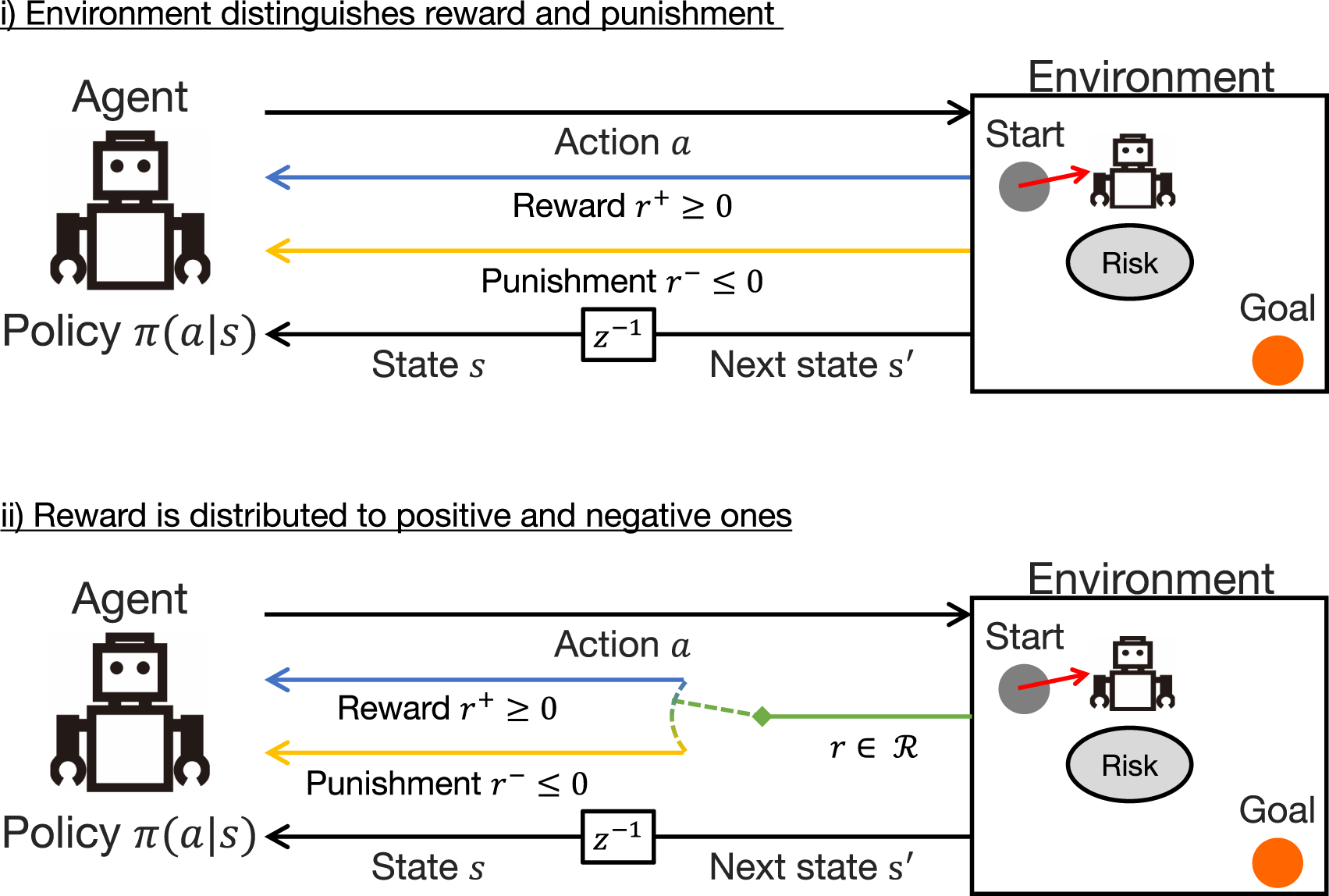
This study investigates a novel nonlinear update rule for value and policy functions based on temporal difference (TD) errors in reinforcement learning (RL). The update rule in standard RL states that the TD error is linearly proportional to the degree of updates, treating all rewards equally without any bias. On the other hand, recent biological studies have revealed that there are nonlinearities in the TD error and the degree of updates, biasing policies towards being either optimistic or pessimistic. Such biases in learning due to nonlinearities are expected to be useful and intentionally leftover features in biological learning. Therefore, this research explores a theoretical framework that can leverage the nonlinearity between the degree of the update and TD errors. To this end, we focus on a control as inference framework utilized in the previous work, in which the uncomputable nonlinear term needed to be approximately excluded from the derivation of the standard RL. By analyzing it, the Weber–Fechner law (WFL) is found, in which perception (i.e., the degree of updates) in response to a change in stimulus (i.e., TD error) is attenuated as the stimulus intensity (i.e., the value function) increases. To numerically demonstrate the utilities of WFL on RL, we propose a practical implementation using a reward–punishment framework and modify the definition of optimality. Further analysis of this implementation reveals that two utilities can be expected: i) to accelerate escaping from the situations with small rewards and ii) to pursue the minimum punishment as much as possible. We finally investigate and discuss the expected utilities through simulations and robot experiments. As a result, the proposed RL algorithm with WFL shows the expected utilities that accelerate the reward-maximizing startup and continue to suppress punishments during learning.

3,612 views

2 citations