
Nutrients and Bioactive Compounds: Preventing and Treating Neurodegenerative Diseases and Disorders

Cover image for Research Topic "Nutrients and Bioactive Compounds: Preventing and Treating Neurodegenerative Diseases and Disorders"
49kviews
Editorial: Nutrients and bioactive compounds: preventing and treating neurodegenerative diseases and disorders
Editorial24 July 2026
Editorial: Nutrients and bioactive compounds: preventing and treating neurodegenerative diseases and disorders

neuroscience with nutritional strategies, it provides a timely platform for exploring prevention and adjunctive care. This collection of contributions -including original mechanistic studies, pilot trials, systematic reviews, meta-analyses, and opinion pieces -offers a coherent framework that underscores the relevance of plant-derived polyphenols, organosulfur compounds, spices, and whole-diet Anti-inflammatory and immunomodulatory actions further strengthen neuroprotection and underscore immunomodulation as a key neuroprotective mechanism (Park et al., 2025;Godos et al., 2025) Supporting these mechanistic insights, major epidemiological and clinical syntheses confirm that adherence to polyphenol-rich, plant-forward dietary patterns is associated with a 17-30% lower risk of dementia and slower cognitive decline, while emphasizing the need for improved bioavailable formulations and longer-term trials (Fekete et al., 2025;Liu et al., 2025).The articles in this Research Topic converge on several key conclusions (Figure 1). First, multi-target bioactives, particularly bound or formulated polyphenols (Li et al., Kara et al., Alam et al.) Collectively, this Research Topic advances nutritional neuroscience by providing rigorous, evidence-based demonstrations that nutrients and bioactive compounds can meaningfully modify neurodegenerative trajectories. While not a substitute for pharmacological innovation, these findings strongly support integrating targeted dietary strategies, leveraging enhanced formulations, synergistic combinations, and precision approaches, into prevention paradigms from midlife onward and as adjunctive therapies. Future efforts should prioritize in vivo validation, sex-specific responses, gut-brain-microbiome interactions, and pragmatic clinical trials to translate these molecular insights into tangible public-health impact. By illuminating both the promise and the remaining challenges, the contributions in this issue chart a clear path toward nutrition-informed strategies that may meaningfully help alleviate the growing burden of NDs.

Neurodegenerative Diseases and Disorders. Neurodegenerative diseases are driven by multiple interconnected pathological processes, including oxidative stress, chronic neuroinflammation, mitochondrial dysfunction, impaired proteostasis, synaptic loss, and epigenetic dysregulation (left side). Dietary nutrients and bioactive compounds -such as polyphenols, anthocyanins, organosulfur metabolites, spice-derived actives, and Mediterranean/MIND diet components -act as multi-target modulators that simultaneously restore redox balance, suppress inflammation, preserve mitochondrial and synaptic function, and regulate epigenetic mechanisms (right side), thereby shifting disease trajectories toward neuroprotection, prevention from midlife, and adjunctive therapeutic strategies.

2,467 views

ORIGINAL RESEARCH
3 February 2026
Nutrigenomic influence of a curcumin-supplemented high glycemic diet on hippocampal microvasculature in male C57BL/6J mice
Emilio Balbuena, 3 more and Dragan Milenkovic

2,813 views

Curcumin-piperine nanoparticles mitigate cuprizone-induced cognitive impairment via antioxidant and anti-inflammatory mechanisms
ORIGINAL RESEARCH
14 October 2025
Curcumin-piperine nanoparticles mitigate cuprizone-induced cognitive impairment via antioxidant and anti-inflammatory mechanisms
Mohammad Zubair Alam, 14 more and Ghulam Md Ashraf
ObjectiveNeuroinflammation is a key contributor to many neurodegenerative diseases. Cuprizone, a copper-chelating agent, is widely used in research to induce neurotoxicity and demyelination, mimicking the pathology of multiple sclerosis. This study investigates the protective and therapeutic effects of curcumin and piperine nanoformulations prepared in Zanthoxylum rhetsa seed oil against cuprizone-induced neurotoxicity in mice.MethodsSeventy-five Swiss albino mice were divided into five groups: control, cuprizone-treated, blank formulation-treated, curcumin-treated, and curcumin with piperine-treated groups. Behavioral assessments, along with biochemical and histological analyses of the hippocampus, were conducted to evaluate learning and memory, antioxidant enzyme activity, neuroinflammatory markers, and cellular integrity.ResultsCuprizone exposure significantly impaired cognitive function and induced oxidative stress, as evidenced by decreased levels of key antioxidant enzymes like catalase, superoxide dismutase, glutathione and glutathione peroxidases. Additionally, increased levels of neuroinflammatory markers such as GFAP, MCP-1, MIP-1, and CCL-5 were observed. Treatment with curcumin and piperine nanoformulations mitigated these effects by restoring antioxidant defenses and modulating inflammatory responses. The curcumin-piperine combination exhibited superior neuroprotection compared to curcumin alone, enhancing memory performance and reducing neuroinflammation more effectively. The results highlight the potential of curcumin and piperine nanoformulations in alleviating neurotoxicity and cognitive impairments associated with neurodegenerative disorders.ConclusionThese findings suggest that curcumin-based nanoformulations could serve as promising therapeutic agents for treating neuroinflammatory diseases, warranting further studies to explore their precise mechanisms and optimize their clinical applications.

4,713 views

4 citations

ORIGINAL RESEARCH
31 July 2025
In vitro mechanistic studies and potential health benefits of a standardized bilberry extract in low mood and cognitive enhancement
Mehtap Kara, 18 more and Amjad Khan
In vitro mechanistic studies and potential health benefits of a standardized bilberry extract in low mood and cognitive enhancement
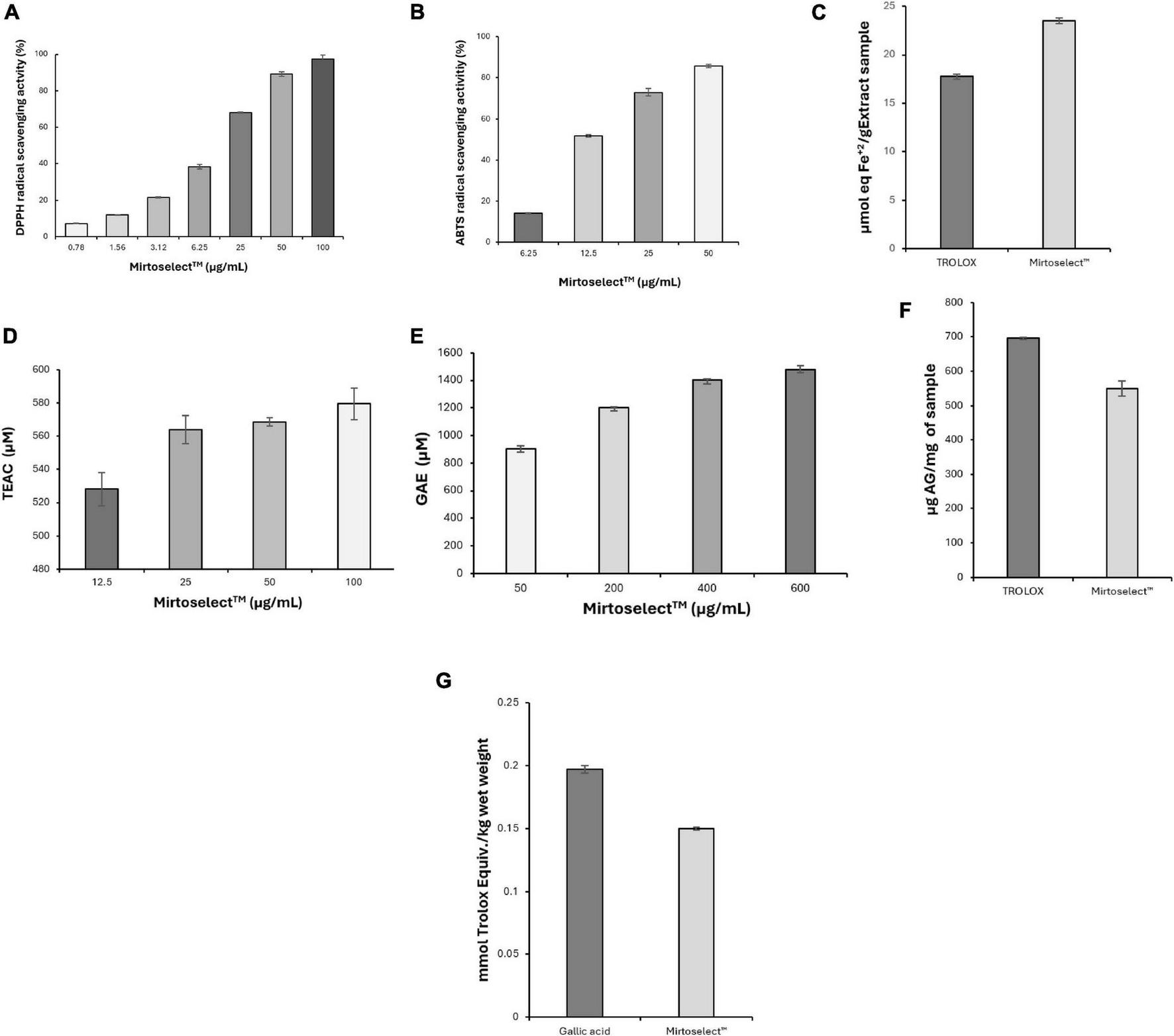
BackgroundLow mood and cognitive impairments are multifactorial conditions often linked to oxidative stress, neurotransmitter imbalances, and neuroinflammation. Bilberry (Vaccinium myrtillus L.) extract, particularly rich in anthocyanins, has shown promising neuropharmacological properties in recent studies.Aims of the studyThis study aimed to comprehensively evaluate the biochemical, antioxidant, and neuroprotective properties of a standardized bilberry extract (Mirtoselect™), alongside assessing its potential health benefits on mood and cognitive enhancement in a clinical setting.MethodsIn vitro assays were conducted to explore the neuromodulatory, antioxidant, and cytoprotective properties of Bilberry extract. Enzyme inhibition assays targeted γ-Aminobutyric acid transaminase (GABA-T), monoamine oxidase A (MAO-A), and acetylcholinesterase (AChE), while GABAA receptor binding was also evaluated. Antioxidant capacity was assessed using DPPH, ABTS, FRAP, ORAC, HORAC, and TAS assays. Neuroprotection was investigated using SH-SY5Y cells exposed to H2O2, assessing cell viability (MTT), membrane integrity (LDH release), and BDNF expression. Cytotoxicity was determined through the MTT assay in SH-SY5Y cells. A randomized, double-blind, placebo-controlled pilot clinical study was conducted on healthy adult subjects (n = 33) (aged 25–55 years) to evaluate the effects of Bilberry extract on mood (POMS) and cognitive function.ResultsBilberry extract demonstrated significant inhibition of GABA-T, MAO-A, and AChE, alongside moderate GABAA receptor binding. It exhibited robust antioxidant activity in DPPH (EC50: 9.24 ± 0.22 μg/mL), ABTS (EC50: 12.70 ± 0.11 μg/mL), FRAP, ORAC, HORAC, and TAS assays. Neuroprotective effects included enhanced cell viability, reduced LDH release, and upregulation of BDNF in SH-SY5Y cells under oxidative stress. Cytotoxicity tests confirmed a favorable safety profile. In the pilot study, Bilberry extract supplementation significantly improved mood parameters, including reduced tension, depression, and confusion scores (p < 0.05) compared to placebo, with minimal adverse effects.ConclusionBilberry extract exhibits potent antioxidant, neuromodulatory, and neuroprotective properties, supporting its potential as a natural intervention for managing low mood and cognitive health. The favorable safety profile and preliminary clinical benefits warrant further research.

5,240 views

2 citations

ORIGINAL RESEARCH
29 August 2025
Intrathecal silymarin administration improves recovery after compression spinal cord injury: evidence for neuroprotection, antioxidant, and anti-inflammatory action
Omar Bahmani, 4 more and Javier Echeverría

2,949 views

2 citations

Antioxidant action and potential neuroprotection of polyphenolics extracted from Astragalus membranaceus residue
ORIGINAL RESEARCH
23 July 2025
Antioxidant action and potential neuroprotection of polyphenolics extracted from Astragalus membranaceus residue
Lu Li, 7 more and Su Liu

3,528 views

4 citations