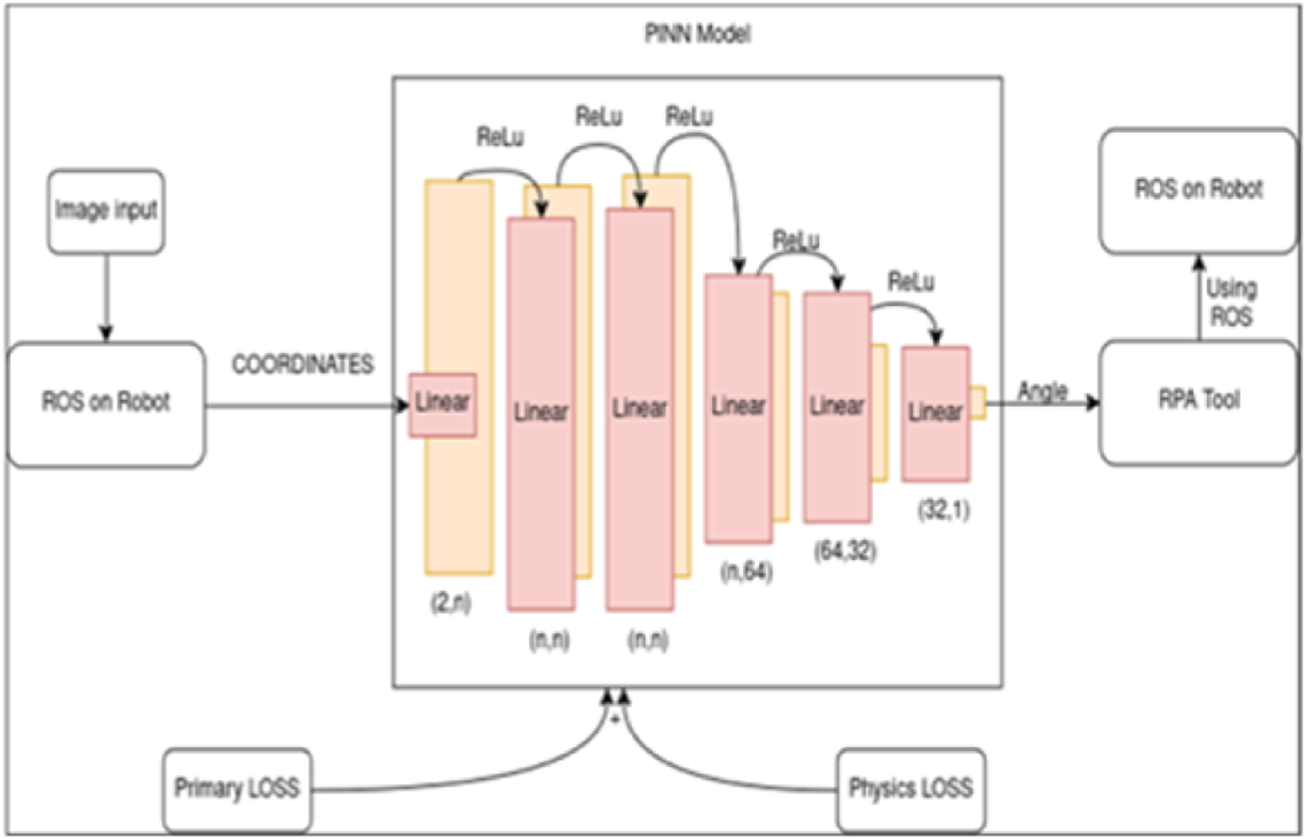
The application of explainable machine learning to robotic systems requires methods that connect high-level decisions with observable actions. Ding et al. (2026) develop PFEA, a closed-loop vision-language framework for tabletop robotic manipulation. The framework employs Chain-of-Objects Reasoning to translate natural-language instructions into executable actions and uses execution feedback to support replanning. Experimental results show an approximately 20% improvement in average task success rate over the evaluated baselines.For autonomous driving, Wang et al. (2026) examine braking behavior in CARLA using reference and distilled policies, XGBoost surrogate models, and SHAP analysis. Their findings identify key traffic-state variables influencing braking decisions and reveal how environmental conditions and safety fallbacks affect policy interpretation. In robotic kinematics, Agrawal et al. (2026) explore the integration of physics-informed neural networks with robotic process automation tools for modeling joint motion and solving forward and inverse kinematic problems. These studies address different aspects of robotic intelligence, from task planning and control interpretation to the incorporation of physical constraints into learning-based models.
Interpretable representations are particularly important in applications where users need to understand the basis of machine learning predictions. Ji et al. ( 2026) develop an end-to-end Concept Bottleneck Model for colonoscopic polyp classification. The model incorporates 62 clinically defined concepts and uses vision-language alignment to generate pseudo concept labels. It achieves a macro F1-score of 95.20%, with no statistically significant difference from the black-box baseline. The authors also acknowledge the need for further validation of concept interpretability. Videla and Mukamalla (2026) investigate explainable facial expression recognition by combining image preprocessing, gradient convolutional vector fuzzy pattern recognition, and ensemble machine learning. Their method achieves 97% accuracy and a 97% F1-score in the reported evaluation. Both studies incorporate interpretable representations into visual classification, although the practical value of the explanations requires evaluation in their respective application contexts.
Trustworthy intelligent systems must also address risks associated with sensitive information and software vulnerabilities. Aroua et al. (2026) review privacy attacks and defense mechanisms for healthcare large language models, organizing vulnerabilities across the data, model, application, and infrastructure layers. Their review emphasizes the trade-off between privacy protection and clinical utility, particularly when stronger safeguards affect the performance of medical AI applications. Radanliev et al. (2026) propose an execution-grounded vulnerability assessment framework for agentic AI systems. The framework integrates software and AI bills of materials with runtime telemetry to generate reproducible CSAF-VEX security advisories. Under controlled experimental conditions, it achieves an F1-score of 0.93 and reduces false positives by up to 42% compared with static matching. These contributions address complementary security concerns, highlighting the importance of evaluating privacy and vulnerability risks within their operational contexts.
The contributions in this Research Topic also identify several challenges requiring further investigation. For explainable models, an important question is whether the generated explanations faithfully reflect model behavior and provide useful information to human users. The reliability of robotic and intelligent systems also requires evaluation beyond specific datasets and controlled experimental environments, particularly when operating conditions change. In addition, privacy and security mechanisms must be examined in relation to practical requirements, including clinical utility, computational performance, and operational constraints.Addressing these challenges will require evaluation methods that consider explanation quality, robustness, and human oversight together with task performance. Closer integration of interpretable learning, feedback mechanisms, and operational risk assessment may provide a useful direction for future research.
The seven articles in this Research Topic present advances in explainable robotic control, interpretable perception, and intelligent system security. These contributions offer complementary perspectives on making learning-based systems more interpretable, reliable, and secure. Further research connecting model interpretability with system reliability, human oversight, and practical deployment will be important for developing trustworthy and humancentered intelligent systems.