Multidrug-resistant (MDR) organs infection for critically ill patients is a big challenge in clinical practice and is associated with greatly increased mortality (1). In this Research Topic, three articles explored the clinical and microbiological characteristics of MDR pathogens infection for patients admitted to intensive care units (ICU) negative bacteria leaded the most frequently isolated microorganisms and was associated with higher percentage of complications such as brain dysfunction, acute kidney injury and thrombocytopenia. Whilst PCT was a not good biomarker to distinguish bloodstream infections caused by various pathogens or fungus. Given that the mortality for patients with carbapenem-resistant Klebsiella pneumoniae (CRKP) blood stream infection is reported to be as high as 30%-70%, Yu et al. assessed the association between the neutrophil-to-lymphocyte ratio (NLR) on the 4 th day and 28-day mortality by using a logistic analysis. After balanced the confounders, NLR on the 4th day was associated with the 28-day mortality while the appropriate initial therapy was an independent protective factor. Moreover, they suggested the trend of NLR during the therapy may Organizing pneumonia is a pattern of lung-tissue repair after injury and it can be cryptogenic or a response to a specific lung injury in many diverse clinical con texts. Given the therapy for organizing pneumonia is empirical and few therapy was confirmed beside systemic glucocorticoid therapy (4), they demonstrated that delayed MSC therapy enhanced resolution of lung injury induced by CRKP infection and favorably modulated immune cell profile, which provide the potential role of MSC to facilitate the resolution of pulmonary organization after MDR pathogen infection.
Editorial15 September 2023
Editorial: Antimicrobial resistance and therapy in critically ill patients
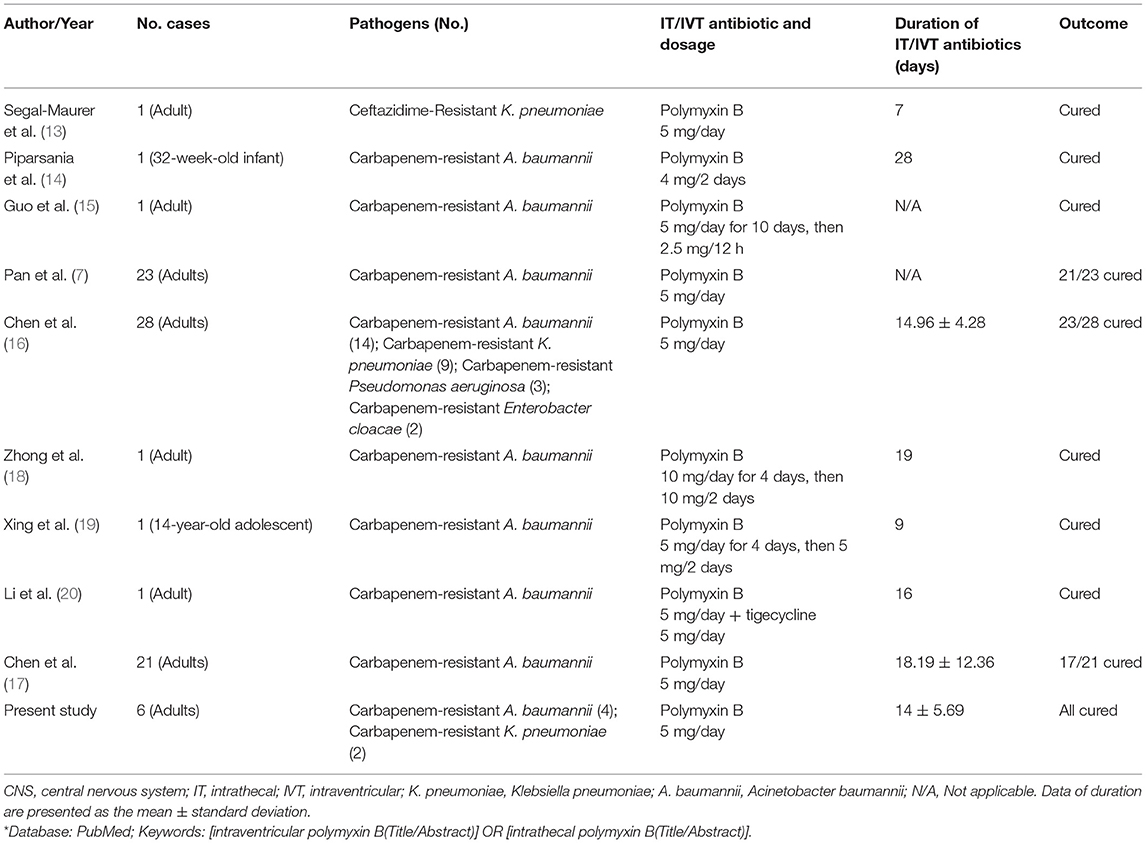
Introduction: Post-neurosurgical central nervous system (CNS) infection caused by multidrug-resistant (MDR)/extensively drug-resistant (XDR) Gram-negative bacteria remains a major clinical challenge. This study describes our experience of treating such patients with combined intraventricular (IVT) and intravenous (IV) polymyxin B administration.
Methods: This retrospective study included six patients with post-neurosurgical CNS infections of carbapenem-resistant Acinetobacter baumannii (CRAB) or carbapenem-resistant Klebsiella pneumoniae (CRKP). All patients were treated in the intensive care unit (ICU) of First Affiliated Hospital, Zhejiang University School of Medicine (Hangzhou, China) between November 2020 and November 2021, and all received IVT plus IV polymyxin B. Data including patients’ characteristics, therapeutic process, symptoms, cerebrospinal fluid (CSF) examination, laboratory tests, and complications were collected.
Results: Six patients with post-neurosurgical CNS infection were enrolled in the study. The patients comprised five males and one female, and the average age was 58 years (range, 38–73 years). Four out of the six cases were CRAB-positive in CSF culture, while two cases were CRKP-positive. The mean duration of polymyxin B administration was 14±5.69 days (range, 6–20 days). The average period of patients reaching CSF sterilization was 10.33±3.67 days (range, 5–14 days). All six cases were cured without acute kidney injury or epilepsy.
Conclusion: IVT plus IV polymyxin B is a safe and effective treatment for post-neurosurgical patients with intracranial infection caused by MDR/XDR Gram-negative bacteria.

ORIGINAL RESEARCH
28 April 2022
He-Ning Wu, 4 more and Ke-liang Xie
6 Authors
- HW
He-Ning Wu
Department of Critical Care Medicine, Tianjin Medical University General Hospital, China
- EY
Er-Yan Yuan
Department of Critical Care Medicine, Tianjin Medical University General Hospital, China
- WL
Wen-Bin Li
Department of Critical Care Medicine, Tianjin Medical University General Hospital, China
- MP
Min Peng
Department of Critical Care Medicine, Tianjin Medical University General Hospital, China
- QZ
Qing-Yu Zhang
Department of Critical Care Medicine, Tianjin Medical University General Hospital, China
- KX
Ke-liang Xie
Department of Critical Care Medicine, Tianjin Medical University General Hospital, China
Background: Bloodstream infections (BSI) are one of the common causes of morbidity and mortality in hospitals; however, the pathogenic spectrum and bacterial antibiotic resistance vary across the world. Therefore, identifying the pathogenic spectrum and changes in bacterial antibiotic resistance is critical in controlling BSI and preventing the irrational use of antibiotics.
Methods: This study retrospectively analyzed the distribution and antibiotic resistance of pathogens based on the clinical data of BSI patients presented in the ICU from 2018 to 2020. Test performance for the prediction of pathogen species was assessed by receiver operating characteristic (ROC) analysis.
Results: The analysis of the data of 382 BSI cases (10.40 cases per thousand patient day) revealed the most frequently isolated microorganisms to be Klebsiella pneumonia (11.52%), followed by Escherichia coli (9.95%), Staphylococccus epidermidis (9.95%), Candida parapsilosis (8.12%), and Enterococcus faecium (8.12%). Out of the isolated E. coli and K. pneumonia strains, 52.63% and 36.36%, respectively, were extended-spectrum β-lactamase (ESBL) positive. Among the isolated 55 fungal strains, C. parapsilosis was the most common one (30/55, 56.36%). Except for the cases with two or more strains in the same culture medium, compared with the patients with Gram-positive and fungal pathogens, patients with Gram-negative bacteria exhibited the highest sequential organ failure assessment (SOFA) score (P < 0.001), lowest Glasgow Coma Scale (GCS) (P = 0.010), lowest platelet (PLT) value (P <0.001), highest plasma creatinine (Cr) value (P = 0.016), and the highest procalcitonin (PCT) value (P <0.001). The area under the curve (AUC) in the ROC analysis for the differentiation of Gram-negative BSI from Gram-positive and fungal BSI by PCT was 0.7 (95% confidence interval [CI], 0.644–0.755), with a cutoff value of 16.62 ng/mL (sensitivity 57.5% and specificity 74%).
Conclusions: A wide range of pathogens was detected in BSI patients, especially the older ones, and varying antibiotic-resistance rates were observed for the isolated strains. Therefore, antibiotics should be used reasonably according to the distribution and antibiotic resistance of pathogens in different BSI patients. Moreover, PCT may be used as a test index to distinguish Gram-negative BSI from Gram-positive BSI and fungal BSI.