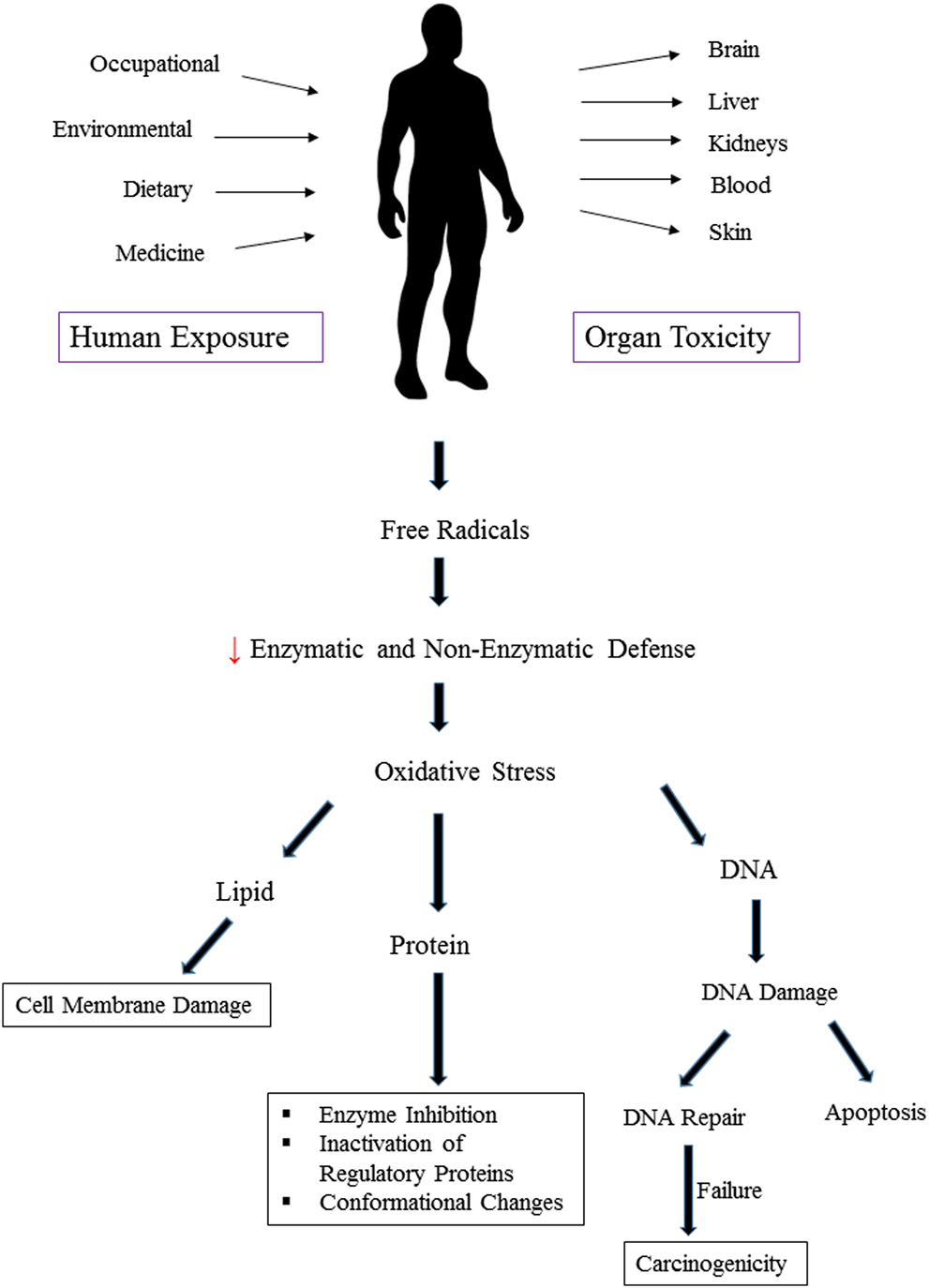
Toxicology is the science of poisons. Globally, exposures to toxic metals through water, food, and the environment pose a major health threat to humans and animals. In particular, environmental and occupational metals exposure underlie many human and animal diseases. More needs to be done to address the major health concerns associated with heavy metal exposures. The present special topic received 20 articles highlighting toxicity of various metals/metalloids, their toxicity, mechanism, and promising therapeutic agents including anti-oxidants.The work of Wang et al. finds that swainsonine (SW), an indolizidine alkaloid extracted from locoweeds, induces cell paraptosis through ER stress and MAPK signaling pathway, thus further laying a theoretical foundation for the study of SW toxicity mechanism. Guo et al. indicate that demonstration of ER stress is involved in the hepatotoxicity induced by monocrotaline (MCT), and CHOP plays an important role in this process. Alehaideb et al. found that furanocoumarin bioactive metabolism in humans would result in reactive metabolite(s) formation inactivating CYP1A2 isozyme and inhibiting caffeine metabolism. Once the CYP1A2 isozyme is deactivated, the enzymic activity can only be regained by isozyme re-synthesis which takes a long time. Deore et al. find that alpha-lipoic acid protects experimental rats against lead and ZnO NP-induced altered immunological, neurological, and reproductive characteristics. Alpha-lipoic acid's therapeutic impact can be due to its multiple actions, which include chelation, antioxidative, anti-inflammatory, and antiapoptotic effects. Kim et al. studies skin sensitization by NPs using two skin sensitization test methods and find that CuO and CoO NPs have sensitization potential. The effect is induced by the constituent elements of fast-dissolving NPs. Metal ion release is verified as the key "factor" for cutaneous sensitivity based on ion chelation studies. Ta et al. evaluated a variety of skin sensitization predictive models that can be employed in the biopharmaceuticals and cosmeceuticals industries, as well as their future prospects and highlighted problems. In vitro skin sensitization tests alone cannot replace human and animal tests because they only focus on one single pathway in adverse outcome pathways (AOP). In silico approach, conversely, has more advantages than in vitro tests since it can take into account more than one AOP key event by combining various in chemico, in vitro, and in vivo. In this special issue, knowledge and understanding of metals/metalloids with respect to their exposure dynamics, toxicokinetics, and mechanism of toxicity in humans and animals are critical for developing appropriate strategies to prevent, treat and manage metal/metalloid poisoning.
8 Authors
- SW
Shuai Wang
College of Veterinary Medicine, Northwest A&F University, China
- YG
Yazhou Guo
College of Veterinary Medicine, Northwest A&F University, China
- CY
Chen Yang
College of Veterinary Medicine, Northwest A&F University, China
- RH
Ruijie Huang
College of Veterinary Medicine, Northwest A&F University, China
- YW
Yuting Wen
College of Veterinary Medicine, Northwest A&F University, China
- CZ
Chunyan Zhang
College of Veterinary Medicine, Northwest A&F University, China
- CW
Chenchen Wu
College of Veterinary Medicine, Northwest A&F University, China
- BZ
Baoyu Zhao
College of Veterinary Medicine, Northwest A&F University, China
5,195 views
36 citations
4 Authors
- SC
Sandra Concepcion Das
Laboratory Animal Research Center, Qatar University, Qatar
- KV
Kavitha Varadharajan
Laboratory Animal Research Center, Qatar University, Qatar
- MS
Muralitharan Shanmugakonar
Laboratory Animal Research Center, Qatar University, Qatar
- HA
Hamda A. Al-Naemi
Laboratory Animal Research Center, Qatar University, Qatar
4,489 views
24 citations
9 Authors
- HW
Hansol Won
Republic of Korea
- DH
Da Hye Jeong
Republic of Korea
- HS
Hyo-Sook Shin
Republic of Korea
- JH
Jin Hee Lee
Republic of Korea
- JP
Jeong Pyo Lee
Republic of Korea
- JY
Jun-Young Yang
Republic of Korea
- KJ
Kikyung Jung
Republic of Korea
- JJ
Jayoung Jeong
Republic of Korea
- JH
Jae Ho Oh
Republic of Korea
7,307 views
8 citations
9 Authors
- SZ
Sheng Zhang
Tianjin University of Traditional Chinese Medicine, China
- CL
Chao Li
NMPA Key Laboratory for Quality Control of Traditional Chinese Medicine, Shanghai Institute for Food and Drug Control, China
- TF
Tingting Feng
NMPA Key Laboratory for Quality Control of Traditional Chinese Medicine, Shanghai Institute for Food and Drug Control, China
- SC
Shuai Cao
NMPA Key Laboratory for Quality Control of Traditional Chinese Medicine, Shanghai Institute for Food and Drug Control, China
- HZ
Heng Zhou
NMPA Key Laboratory for Quality Control of Traditional Chinese Medicine, Shanghai Institute for Food and Drug Control, China
- LL
Limin Li
NMPA Key Laboratory for Quality Control of Traditional Chinese Medicine, Shanghai Institute for Food and Drug Control, China
- QH
Qing Hu
NMPA Key Laboratory for Quality Control of Traditional Chinese Medicine, Shanghai Institute for Food and Drug Control, China
- XM
Xiuhong Mao
NMPA Key Laboratory for Quality Control of Traditional Chinese Medicine, Shanghai Institute for Food and Drug Control, China
- SJ
Shen Ji
Tianjin University of Traditional Chinese Medicine, China
3,349 views
19 citations
10 Authors
- TW
Tao Wang
College of Veterinary Medicine, Yangzhou University, China
- LW
Li Wang
College of Veterinary Medicine, Yangzhou University, China
- YZ
Yi Zhang
College of Veterinary Medicine, Yangzhou University, China
- JS
Jian Sun
College of Veterinary Medicine, Yangzhou University, China
- YX
Yilin Xie
College of Veterinary Medicine, Yangzhou University, China
- YY
Yan Yuan
College of Veterinary Medicine, Yangzhou University, China
- JG
Jianhong Gu
College of Veterinary Medicine, Yangzhou University, China
- JB
Jianchun Bian
College of Veterinary Medicine, Yangzhou University, China
- ZL
Zongping Liu
College of Veterinary Medicine, Yangzhou University, China
- HZ
Hui Zou
College of Veterinary Medicine, Yangzhou University, China
4,036 views
21 citations
9 Authors
- SK
Sung-Hyun Kim
Republic of Korea
- JH
Jin Hee Lee
Republic of Korea
- KJ
Kikyung Jung
Republic of Korea
- JY
Jun-Young Yang
Republic of Korea
- HS
Hyo-Sook Shin
Republic of Korea
- JP
Jeong Pyo Lee
Republic of Korea
- JJ
Jayoung Jeong
Republic of Korea
- JO
Jae-Ho Oh
Republic of Korea
- JK
Jong Kwon Lee
Republic of Korea
1,617 views
9 citations