Siglec-9, a cell surface transmembrane receptor mainly expressed on B cells, CD56+ NK cells, and CD4+ and CD8+ T cells, is strongly related to the tumor immune microenvironment. However, the expression pattern of Siglec-9 and its prognostic potential have not been investigated in a pan-cancer perspective. This study aimed to explore the association of Siglec-9 with prognosis, tumor stage, molecular subtype, and the immune microenvironment in pan-cancer. The mRNA expression of Siglec-9 was obtained from The Cancer Genome Atlas (TCGA), the Broad Institute Cancer Cell Line Encyclopedia (CCLE), and Genotype-Tissue Expression (GTEx). The relationship between Siglec-9 mRNA expression and prognosis was evaluated by the Kaplan-Meier analysis. The correlation between Siglec-9 and tumor-filtrating immune cells, immune subtype, and molecular subtype was evaluated on Tumor Immune Estimation Resource (TIMER) and Integrated Repository Portal for Tumor-Immune System Interactions (TISIDB). the correlation between Siglec-9 expression and immune checkpoint, mismatch-repair (MMR), DNA methyltransferase (DNMT), tumor mutation burden (TMB), and microsatellite instability (MSI), were also analyzed. It showed that Siglec-9 expression was significantly altered in most TCGA tumors. Siglec-9 expression was associated with the prognosis of patients with adrenocortical carcinoma (ACC), lung adenocarcinoma (LUSC), thymoma (THYM), colon adenocarcinoma (COAD), glioblastoma multiforme (GBM), prostate adenocarcinoma (PRAD), esophageal carcinoma (ESCA), and brain lower-grade glioma (LGG). Particularly, increased Siglec-9 expression was strongly correlated with poor prognosis in LGG. Correlation between Siglec-9 expression and tumor stage was also observed in various cancers. In addition, Siglec-9 was positively associated with infiltration of immune cells including neutrophils, dendritic cells (DCs), macrophage, CD4+ and CD8+ T cells. Moreover, a significant correlation between Siglec-9 and MSI, TMB, MMR, DNMT, immune checkpoint, immune subtype, molecular subtype, and immunomodulators were observed in multiple cancers. Specifically, poor prognostic value and strong correlation to immune cell infiltration were verified with the LGG dataset from the Chinese Glioma Genome Atlas (CGGA). These findings indicated that Siglec-9 can be a novel biomarker and a potential target for cancer immunotherapy.
Colorectal cancer (CRC) is the second most deadly cancer in the whole world, with the underlying mechanisms largely indistinct. Therefore, we aimed to identify significant pathways and genes involved in the initiation, formation and poor prognosis of CRC using bioinformatics methods. In this study, we compared gene expression profiles of CRC cases with those from normal colorectal tissues from three chip datasets (GSE33113, GSE23878 and GSE41328) to identify 105 differentially expressed genes (DEGs) that were common to the three datasets. Gene ontology and Kyoto Encyclopedia of Genes and Genomes pathway analyses showed that the highest proportion of up-regulated DEGs was involved in extracellular region and cytokine-cytokine receptor interaction pathways. Integral components of membrane and bile secretion pathways were identified as containing down-regulated DEGs. 13 hub DEGs were chosen and their expression were further validated by GEPIA. Only four DEGs (ADH1C, CLCA4, CXCL8 and GUCA2A) were associated with a significantly lower overall survival after the prognosis analysis. Lower ADH1C protein level and higher CXCL8 protein level were verified by immunohistochemical staining and western blot in clinical CRC and normal colorectal tissues. In conclusion, our study indicated that the extracellular tumor microenvironment and bile metabolism pathways play critical roles in the formation and progression of CRC. Furthermore, we confirmed ADH1C being down-regulated in CRC and reported ADH1C as a prognostic predictor for the first time.
Background: Cancer is considered one of the most lethal diseases worldwide. Venous thromboembolism (VTE) is the second leading cause of death in cancer patients. As one of the most reproducible predictors of thromboembolism, the D-dimer level is commonly considered by oncologists. Previous studies have demonstrated that the most correlated genes at the D-dimer level are F3, F5 and FGA.
Methods: Using data from TCGA and multiple webtools, including GEPIA2, UALCAN, TIMER2.0, Kaplan-Meier Plotter and CIBERSORTx, we analyzed the tumor mutation burden (TMB), microsatellite instability (MSI) and functions of D-dimer-related genes in cancer. Validation was conducted via quantitative real-time polymerase chain reaction (qRT-PCR) and independent GEO + GTEx cohort. All statistical analyses were performed in R software and GraphPad Prism 9.
Results: F3, F5 and FGA were expressed differently in multiple cancer types. TMB, MSI and anti-PD1/PDL1 therapy responses were correlated with D-dimer-related gene expression. D-Dimer-related genes expression affect the survival of cancer patients. F3 and F5 functioned in TGF-beta signaling. F3 and F5 were related to immunity and affected the fraction of CD8+ T cells by upregulating the TGF-beta signaling pathway, forming an F3, F5/TGF-beta signaling/CD8+ T cell axis.
Conclusion: F3, F5 and FGA serve as satisfactory GC multibiomarkers and potentially influence the immune microenvironment and survival of cancer patients by influencing TGF-beta signaling.
Accumulating evidence has implicated members of the procollagen-lysine, 2-oxoglutarate 5-dioxygenase (PLOD) gene family, PLOD1, PLOD2, and PLOD3, in cancer progression and metastasis. However, their expression, prognostic value, and mechanisms underlying their roles in lung adenocarcinoma (LUAD) have not yet been reported. We downloaded PLOD data for LUAD and normal tissues from The Cancer Genome Atlas (TCGA). PLOD1-3 protein expression was evaluated using the Clinical Proteomics Tumor Analysis Consortium and Human Protein Atlas (HPA). Survival analysis was performed using the Kaplan-Meier method. A protein-protein interaction network was constructed using STRING software. The ClusterProfiler" package was used for functional-enrichment analysis. The relationship between PLOD mRNA expression and immune infiltration was analyzed using the Tumor Immunity Assessment Resource and Tumor Immune System Interaction Database. The expression of PLODs in LUAD tissues was significantly upregulated compared to that in adjacent normal tissues. PLOD mRNA overexpression is associated with lymph node metastasis and high TNM staging. Receiver operating characteristic curve analysis showed that when the cutoff level was 6.073, the accuracy, sensitivity, and specificity of PLOD1 in distinguishing LUAD from adjacent controls were 84.4%, 79.7%, and 82.6%, respectively. The accuracy, sensitivity, and specificity of PLOD2 in distinguishing LUAD from adjacent controls were 81.0%, 98.3%, and 68.0%, respectively, at a cut-off value of 4.360. The accuracy, sensitivity, and specificity of PLOD3 in distinguishing LUAD from adjacent controls were 69.0%, 86.4%, and 52.0%, respectively, with a cut-off value of 5.499. Kaplan-Meier survival analysis demonstrated that LUAD patients with high PLODs had a worse prognosis than those with low PLODs. Correlation analysis showed that PLOD mRNA expression was related to immune infiltration and tumor purity. Upregulation of PLOD expression was significantly associated with poor survival and immune cell infiltration in LUAD. Our research shows that PLOD family members have potential as novel biomarkers for poor prognosis and as potential immunotherapy targets for LUAD.
Abstract
Lung cancer is the most common tumor with severe morbidity and high mortality. Increasing evidence has demonstrated that non-SMC condensin I complex subunit G (NCAPG) play crucial role in the progression of human cancer. However, the functions and mechanism of NCAPG in NSCLC are still barely known. Here, we utilized the diverse public databases analysis the expression of NCAPG in human varies cancer, the results shown that NCAPG was highly expression in diverse human cancer, especially in lung cancer. NCAPG level was significantly positive correlated with poor clinic-pathologic features, poor prognosis, TMB, MSI and immune cell infiltration in lung cancer. In addition, our results demonstrate that depletion of NCAPG significantly inhibits NSCLC cell proliferation, migration and self-renewal abilities, which could be reversed by miRNA-214-3p. Finally, we identified the upstream regulatory mechanism of NCAPG, namely FOXM1/THYMSOS/ miRNA-214-3p axis. Knock down of THYMSOS also inhibits the NSCLC cell proliferation, migration and self-renewal abilities. Collectively, our findings demonstrated the oncogenic roles of the FOXM1/lncRNA-TYMSOS/miRNA-214-3p /NCAPG axis in NSCLC, represent NCAPG have the potential of as an effective therapeutic target in future.
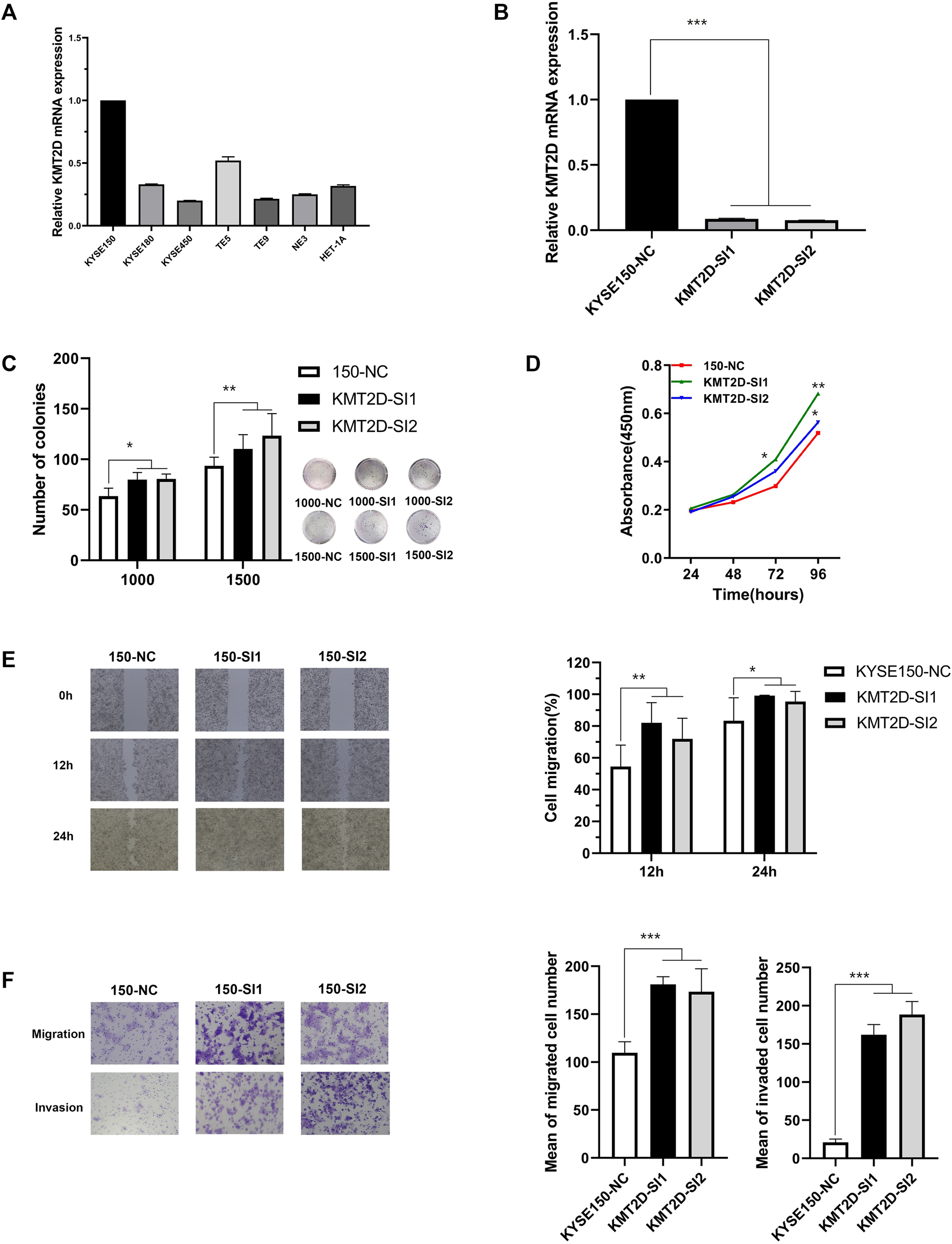
Due to the lack of effective diagnostic markers and therapeutic targets, esophageal squamous cell carcinoma (ESCC) shows a poor 5-year survival rate of less than 30%. To explore the potential therapeutic targets of ESCC, we integrated and reanalyzed the mutation data of WGS (whole genome sequencing) or WES (whole exome sequencing) from a total of 1145 samples in 7 large ESCC cohorts, including 270 ESCC gene expression data. Two new mutation signatures and 20 driver genes were identified in our study. Among them, AP3S1, MUC16, and RPS15 were reported for the first time. We also discovered that the KMT2D was associated with the multiple clinical characteristics of ESCC, and KMT2D knockdown cells showed enhanced cell migration and cell invasion. Furthermore, a few neoantigens were shared between ESCC patients. For ESCC, compared to TMB, neoantigen might be treated as a better immunotherapy biomarker. Our research expands the understanding of ESCC mutations and helps the identification of ESCC biomarkers, especially for immunotherapy biomarkers.
Both ferroptosis and lncRNAs are both significant for ovarian cancer (OC). Whereas, the study of ferroptosis-related lncRNAs (FRLs) still few in ovarian cancer. We first constructed an FRL-signature for patients with OC in the study. A total of 548 FRLs were identified for univariate Cox regression analysis, and 21 FRLs with significant prognosis were identified. The prognostic characteristics of nine FRLs was constructed and validated, showing opposite prognosis in two subgroups based on risk scores. The multivariate Cox regression analysis and nomogram further verified the prognostic value of the risk model. By calculating ferroptosis score through ssGSEA, we found that patients with higher risk scores exhibited higher ferroptosis scores, and high ferroptosis score was a risk factor. There were 40 microenvironment cells with significant differences in the two groups, and the difference of Stromal score between the two groups was statistically significant. Six immune checkpoint genes were expressed at different levels in the two groups. In addition, five m6A regulators (FMR1, HNRNPC, METTL16, METTL3, and METTL5) were higher expressed in the low-risk group. GSEA revealed that the risk model was associated with tumor-related pathways and immune-associated pathway. We compared the sensitivity of chemotherapy drugs between the two risk groups. We also explored the co-expression, ceRNA relation, cis and trans interaction of ferroptosis-related genes and lncRNAs, providing a new idea for the regulatory mechanisms of FRLs. Moreover, the nine FRLs were selected for detecting their expression levels in OC cells and tissues.