Background: German authorities reimburse migraine prevention with erenumab only in patients who previously did not have therapeutic success with at least five oral prophylactics or have contraindications to such. In this real-world analysis we assessed treatment response to erenumab in patients with chronic migraine (CM) who failed five oral prophylactics and, in addition, onabotulinumtoxinA (BoNTA).
Methods: We analyzed retrospective data of 139 CM patients with at least one injection of erenumab from two German headache centers. Patients previously did not respond sufficiently or had contraindications to β-blockers, flunarizine, topiramate, amitriptyline, valproate, and BoNTA. Primary endpoint of this analysis was the mean change in monthly headache days from the four-week baseline period over the course of a twelve-week erenumab therapy. Secondary endpoints were changes in monthly migraine days, days with severe headache, days with acute headache medication and triptan intake in the treatment period.
Results: Erenumab (starting dose 70 mg) led to a reduction of -3.7 (95% CI 2.4 – 5.1) monthly headache days after the first treatment and -4.7 (95% CI 2.9 – 6.5) after three treatment cycles (p<0.001 for both). All secondary endpoint parameters were reduced over time. Half of patients (51.11%) had a >30% reduction of monthly headache days in weeks 9-12. Only 4.3% of patients terminated erenumab treatment due to side effects.
Conclusion: In this treatment-refractory CM population, erenumab showed efficacy in a real-word setting similar to data from clinical trials in patients with fewer prior prophylactic treatment failures. Tolerability was good and no safety issues emerged. Erenumab is a treatment option for CM patients who failed all first-line preventives in addition to BoNTA.
Beijing Key Laboratory of Acupuncture Neuromodulation, Acupuncture and Moxibustion Department, Beijing Hospital of Traditional Chinese Medicine, Capital Medical University, China
ZX
Zi-Liang Xu
Engineering Research Center of Molecular and Neuro Imaging of Ministry of Education, School of Life Science and Technology, Xidian University, China
YZ
Ya-Jie Zhang
Beijing Key Laboratory of Acupuncture Neuromodulation, Acupuncture and Moxibustion Department, Beijing Hospital of Traditional Chinese Medicine, Capital Medical University, China
DL
Da-Peng Liu
Beijing Key Laboratory of Acupuncture Neuromodulation, Acupuncture and Moxibustion Department, Beijing Hospital of Traditional Chinese Medicine, Capital Medical University, China
MF
Marc Fishers
Department of Neurology, Beth Israel Deaconess Medical Centre and Harvard Medical School, United States
LZ
Lan Zhang
Engineering Research Center of Molecular and Neuro Imaging of Ministry of Education, School of Life Science and Technology, Xidian University, China
JS
Jin-Bo Sun
Engineering Research Center of Molecular and Neuro Imaging of Ministry of Education, School of Life Science and Technology, Xidian University, China
Background: The actions of caffeine as an antagonist of adenosine receptors have been extensively studied, and there is no doubt that both daily and sporadic dietary consumption of caffeine has substantial biological effects on the nervous system. Caffeine influences headaches, the migraine syndrome in particular, but how is unclear.
Material & Methods: This is a narrative review based on selected articles from an extensive literature search. The aim of this study is to elucidate and discuss how caffeine may affect the migraine syndrome and discuss the potential pathophysiological pathways involved.
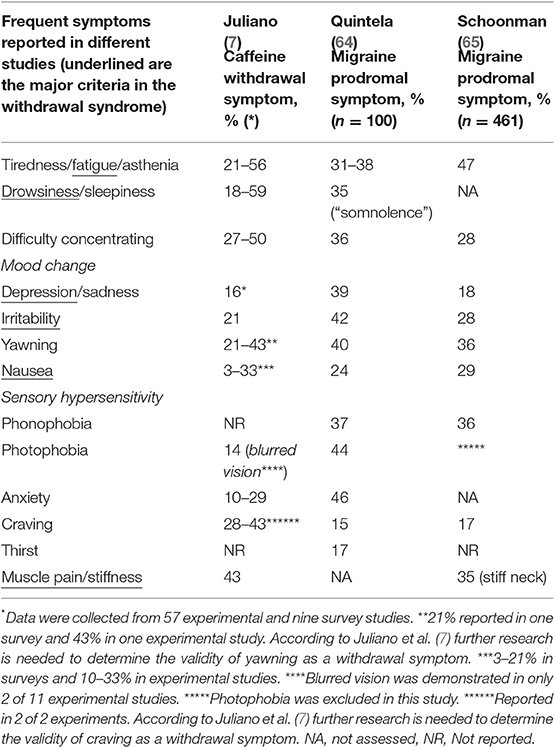
Results: Whether caffeine has any significant analgesic and/or prophylactic effect in migraine remains elusive. Neither is it clear whether caffeine withdrawal is an important trigger for migraine. However, withdrawal after chronic exposure of caffeine may cause migraine-like headache and a syndrome similar to that experienced in the prodromal phase of migraine. Sensory hypersensitivity however, does not seem to be a part of the caffeine withdrawal syndrome. Whether it is among migraineurs is unknown. From a modern viewpoint, the traditional vascular explanation of the withdrawal headache is too simplistic and partly not conceivable. Peripheral mechanisms can hardly explain prodromal symptoms and non-headache withdrawal symptoms. Several lines of evidence point at the hypothalamus as a locus where pivotal actions take place.
Conclusion: In general, chronic consumption of caffeine seems to increase the burden of migraine, but a protective effect as an acute treatment or in severely affected patients cannot be excluded. Future clinical trials should explore the relationship between caffeine withdrawal and migraine, and investigate the effects of long-term elimination.
Introduction
Cluster Headache (CH) is a very well characterized primary headache disorder. CH mostly affects men but an increasing percentage of women also suffers from this disease. Available data on gender-related differences in CH are very scarce and partly discordant. The aim of this manuscript is the careful definition of clinical profile of CH between the sexes.
Material and methods
Retrospective analysis of a clinical database of CH patients diagnosed and followed at the Pavia Headache Center between September 2016 and December 2018.
Results
We collected data from 250 CH patients, 163 males (mean age 41.46+10.37years) and 87 females (mean age 42.24+11.95 years). The mean age of CH onset was similar for both sexes but surprisingly the onset of disease often coincided with periods of abrupt fluctuations of sexual hormone levels (menarche, post-partum, menopause). Women had a longer mean attack duration (p=0.004) than men, without symptomatic treatment, and tended to have more attacks per day (p=0.053). Nausea and osmophobia were reported more frequently by women (p=0.048, p=0.037, respectively). Autonomic associated symptoms were almost equally prevalent in women and men, with the exception of ptosis (predominant in female) and enlarged temporal artery and nasal congestion (both more expressed in men). Concomitant thyroid diseases (23% vs 1.8%, p=0.001) and psychiatric disorders (17.2% vs 9.2%, p= 0.04) mostly occur in women than men. Snoring in sleep and smoking habit is more frequent in men: 53.4% vs 19.5% (p=0.00) and 67.5% vs 49.4% (p=0.005), respectively.
Conclusion
Despite an overall similar clinical presentation of cluster headache in both sexes, in women some features seem to overlap with migraine, as suggested by existing literature: the prevalence of “migrainous” associated symptoms during attacks, the more robust family history of migraine, the association of CH onset with hormonal changes, the longer duration of CH attacks and the more widespread distribution of pain.
These our findings may have a relevance in terms of a pathophysiological role of sexual hormones so far unexplored in CH. Further investigations along this line may lead to an improved global management of the disease, from the diagnosis to new gender-related therapeutic strategies.
Migraine is a frequent and very disabling disease pediatric age. Despite this, there is a lack of controlled studies on the pharmacological treatment of primary headaches in the developmental age.
Given that the recently introduced calcitonin gene-related peptide (CGRP) inhibitors (CGRP-r) are still limited to adulthood, there is no drug with exclusive indication for migraine treatment in pediatric age. This raises several limitations in terms of adherence and effectiveness of the therapy. Moreover, the scenario is complicated by placebo response, which is larger in children and adolescents than in adults and often leads to an improvement in the attack frequency even in absence of any active pharmacological treatment. Our goal was to investigate the real evidence concerning the prophylactic therapy of pediatric migraine by reviewing the clinical studies published between 2010 and 2019.
Department of Pediatric Neurology and Developmental Medicine, LMU Center for Children With Medical Complexity, Dr. von Hauner Children's Hospital, LMU–University Hospital, Ludwig-Maximilians-Universität, Germany
LA
Lucia Albers
Department of Pediatric Neurology and Developmental Medicine, LMU Center for Children With Medical Complexity, Dr. von Hauner Children's Hospital, LMU–University Hospital, Ludwig-Maximilians-Universität, Germany
NM
Nina M. Mathonia
Department of Pediatric Neurology and Developmental Medicine, LMU Center for Children With Medical Complexity, Dr. von Hauner Children's Hospital, LMU–University Hospital, Ludwig-Maximilians-Universität, Germany
MV
Michaela V. Bonfert
Department of Pediatric Neurology and Developmental Medicine, LMU Center for Children With Medical Complexity, Dr. von Hauner Children's Hospital, LMU–University Hospital, Ludwig-Maximilians-Universität, Germany
HK
Helene König
Department of Pediatric Neurology and Developmental Medicine, LMU Center for Children With Medical Complexity, Dr. von Hauner Children's Hospital, LMU–University Hospital, Ludwig-Maximilians-Universität, Germany
BK
Birgit Klose
Department of Pediatric Neurology and Developmental Medicine, LMU Center for Children With Medical Complexity, Dr. von Hauner Children's Hospital, LMU–University Hospital, Ludwig-Maximilians-Universität, Germany
LG
Lucia Gerstl
Department of Pediatric Neurology and Developmental Medicine, LMU Center for Children With Medical Complexity, Dr. von Hauner Children's Hospital, LMU–University Hospital, Ludwig-Maximilians-Universität, Germany
MN
Mirjam N. Landgraf
Department of Pediatric Neurology and Developmental Medicine, LMU Center for Children With Medical Complexity, Dr. von Hauner Children's Hospital, LMU–University Hospital, Ludwig-Maximilians-Universität, Germany