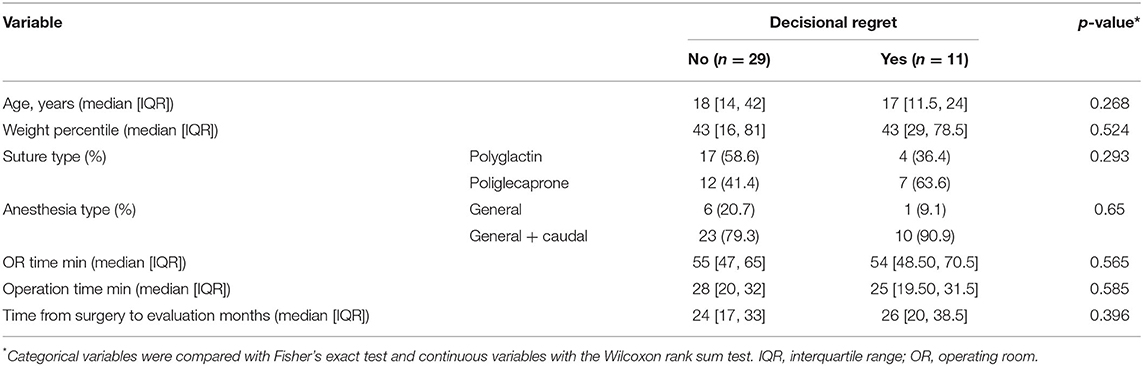
This Research Topic is intended to highlight the best research topic insights of Pediatric Urology in 2021.In this collection of articles published on this subject, we have a wide selection of studies that will contribute to the further progress of the field. In this issue, authors shared their experience with various urological anomalies and their management accompanied by a literature review. We thank the authors and reviewers for sharing their experiences and making these manuscripts better.Bar-Yaakov N., et showed that decisional regret was reported by 27.5% of parents of children who underwent revision of neonatal circumcision for excess foreskin. Parents were concerned about the appearance of a penis which may resemble an uncircumcised penis and most parents do not regret the surgery. (1) This study is well conducted and give us additional information to discussed with parents before indicating this surgery. However, since a non-therapeutic approach is employed most of the time, caregivers must be provided with sufficient information about the pros and cons of the surgery so that they can make the best decision and avoiding any regret in the future. (2) Authors from Spain (Ordóñez et al), described the long-term outcome of the patients with ureteropelvic junction obstruction (UPJO) treated by endoscopic retrograde balloon dilatation (ERBD). This is the largest reported cases treated endoscopically in pediatric patients with primary unilateral (92 cases being younger than 18 months). An additional procedure was needed in 21% of patients and an open pyeloplasty was needed in 6.25% (n = 7) cases of technical failure. Long-term success rate was 76.8% after one dilatation, and 86.6% in those who required up to 2 dilatations. Robotic and laparoscopic pyeloplasty are now frequently done in small children and, this data is very important and useful to discuss with parents before indicating surgery. (3) Benefits of minimal invasive surgery and success rate should be balance with chances of second surgery and additional anesthesia.Lu Xiaofei and Zhou Benzhang report a case of testicular torsion (TT) in patient with unilateral supernumerary testis (SNT). Since timing at presentation, the twisted gonad in the hemi-scrotum with SNT could not be saved but the remaining uninvolved testicle was preserved. The authors should be congratulated for the surgical criteria and the effort to preserve normal tissue. Intravaginal TT occurred in a clockwise direction in a left testicle, contrary what happens in most cases (inward rotation), probably because testicles are in different planes and there were no scrotal attachments. (4) Orchidopexy in the contralateral hemi-scrotum was a wise decision.The ideal technique for the correction of hypospadias would be one that allows for a good aesthetic and functional result, with a slit urethral meatus, correction of the penile curvature, obtaining an appropriately sized phallus and a low rate of complications. Unfortunately, so far, no technique has reached all these goals. (5) Xie et al, compared two surgical techniques for proximal hypospadias, the staged TIP urethroplasty (group 1), and the Byars' two-stage urethroplasty (group 2). The authors found significantly less complication rate in patients of group 1. As it was not a randomized clinical trial, the results of this study should be evaluated with caution, as less severe cases may have been selected to undergo TIP. Furthermore, follow-up is not long enough to detect complications that may occur later such as urethral strictures. (5) Authors from Italy, Paraboschi I. et al, reported an update on the current management of pediatric urolithiasis. This important review article describes novel technologies and devices to minimize surgical complications and improve patient outcomes. Small instruments and new technological developments have led to many innovations in the surgical management of pediatric urolithiasis. (6) The devices and technologies described in this review article are changing the way surgeons plan and treat urinary stones in children. Pediatric urologists need to be up to date with these technological advances that can decrease the morbidity of patients with urinary stones.Cryptorchidism is a common medical condition that pediatric urologist routinely treat. In the case of a non-palpable testis, in around half of the cases no intraabdominal testis will be found. In the presence of a vanishing testis-also known as testicular regression syndrome (TRS), there is a debate whether surgical excision of the remnant is necessary. (7) Depending on the presence of ectopic seminiferous tubules or germ cells in the remnant there is potential for malignancy. LEi Gao et al, form China made a research handling more than 300 patients with TRS in which they found very few germ cells in testicular remnants concluding an inguinal or scrotal exploration may not be necessary. They share good evidence in this paper which is worth reading for any surgeon dealing with this condition. Having this information handy would help in more grounded decision making for this condition.Bergel B. et al from Germany, analyze in their study if operating all patients with pediatric transplant exclusively in a pediatric environment had an impact on patients' safety and transplant outcome. In their Institution, pediatric renal transplants were performed over a long period in the general urology and high-volume transplant setting. In 2013, the decision was made to change this setting and pediatric transplantations were since then solely carried out in the pediatric hospital setting. Their data and others showed a trend to transplant children at a younger age. In this manuscript they described the importance of ensuring a Pediatric medical environment that is able to address their particular challenges in perioperative care according to their individual needs.
Editorial31 March 2023
Editorial: Insights in pediatric urology: 2021
New scientific developments and technological innovations have led to significant changes in the surgical management of pediatric urolithiasis.
Miniaturized technologies and minimally invasive approaches have been increasing used in pediatric urology to minimize surgical complications and improve patient outcomes.
Moreover, three-dimensional modeling reconstructions, virtual, augmented and mixed reality are rapidly pervading the field of urological interventions, equipping surgeons with powerful tools capable of enhancing the surgical visualization of anatomical normal and pathological structures. Novel optical imaging systems and various simulators offered by the new technologies of the digital era have become a new hope. The use of new strategies in surgical planning and treatment processes has opened new horizons for patients and surgeons. These novel imaging techniques and devices represent the future of urology, and they are fast approaching clinical implementation. There is a wide range of possibilities in the adult population to use these novel technologies and devices in the guidance for urological procedures and minimally invasive surgeries.
Their applications and their use have also been increasingly growing in the field of pediatric urology, where the detailed visualization of small anatomical structures could reduce the procedure time, minimizing surgical complications and ultimately improve the surgical outcomes. Pediatric urologists need to be ready to adopt these novel devices and intraoperative techniques.
This review illustrates the most promising techniques and innovative devices to enhance the surgical treatment of pediatric urolithiasis, aiming to enhance early adoption and more research on this topic for the benefit of children.