Editors' Showcase 2021: Insights in Cell Death and Survival

54kviews
BOK controls ER proteostasis and physiological ER stress responses in neurons
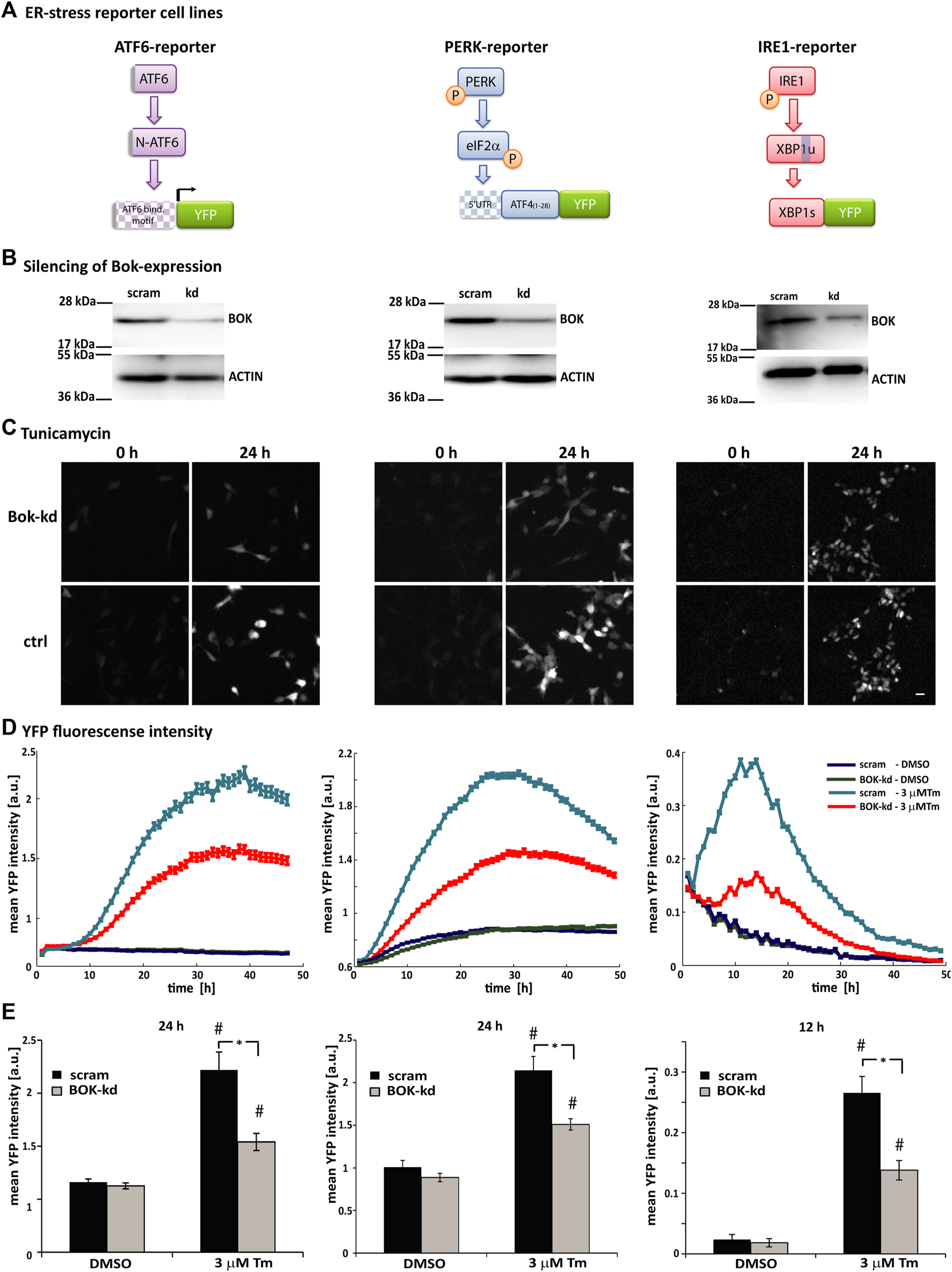
The Bcl-2 family proteins BAK and BAX control the crucial step of pore formation in the mitochondrial outer membrane during intrinsic apoptosis. Bcl-2-related ovarian killer (BOK) is a Bcl-2 family protein with high sequence similarity to BAK and BAX. However, intrinsic apoptosis can proceed in the absence of BOK. Unlike BAK and BAX, BOK is primarily located on the Endoplasmic Reticulum (ER) and Golgi membranes, suggesting a role for BOK in regulating ER homeostasis. In this study, we report that BOK is required for a full ER stress response. Employing previously characterized fluorescent protein-based ER stress reporter cell systems, we show that BOK deficient cells have an attenuated response to ER stress in all three signaling branches of the unfolded protein response. Fluo-4-based confocal Ca2+ imaging revealed that disruption of ER proteostasis in BOK-deficient cells was not linked to altered ER Ca2+ levels. Fluorescence recovery after photobleaching (FRAP) experiments using GRP78/BiP-eGFP demonstrated that GRP78 motility was significantly lower in BOK-deficient cells. This implied that less intra-luminal GRP78 was freely available and more of the ER chaperone bound to unfolded proteins. Collectively, these experiments suggest a new role for BOK in the protection of ER proteostasis and cellular responses to ER stress.

12,115 views

11 citations

ORIGINAL RESEARCH
28 February 2022
Autosomal Recessive Cerebellar Atrophy and Spastic Ataxia in Patients With Pathogenic Biallelic Variants in GEMIN5
Deepa S. Rajan, 30 more and Udai Bhan Pandey
Autosomal Recessive Cerebellar Atrophy and Spastic Ataxia in Patients With Pathogenic Biallelic Variants in GEMIN5
The hereditary ataxias are a heterogenous group of disorders with an increasing number of causative genes being described. Due to the clinical and genetic heterogeneity seen in these conditions, the majority of such individuals endure a diagnostic odyssey or remain undiagnosed. Defining the molecular etiology can bring insights into the responsible molecular pathways and eventually the identification of therapeutic targets. Here, we describe the identification of bi-allelic variants in the GEMIN5 gene among seven unrelated families with nine affected individuals presenting with spastic ataxia and cerebellar atrophy. GEMIN5, an RNA-binding protein, has been shown to regulate transcription and translation machinery. GEMIN5 is a component of small nuclear ribonucleoproteins (snRNP) complexes and helps in the assembly of the spliceosome complexes. We found that bi-allelic GEMIN5 variants cause structural abnormalities in the encoded protein and reduce expression of snRNP complex proteins in patient cells as compared to unaffected controls. Finally, knocking out endogenous Gemin5 in mice caused early embryonic lethality, suggesting that Gemin5 expression is crucial for normal development. Our work further expands on the phenotypic spectrum associated with GEMIN5-related disease and implicates the role of GEMIN5 among patients with spastic ataxia, cerebellar atrophy, and motor predominant developmental delay.

7,016 views

24 citations

The Half-Life-Extended IL21 can Be Combined With Multiple Checkpoint Inhibitors for Tumor Immunotherapy
ORIGINAL RESEARCH
15 November 2021
The Half-Life-Extended IL21 can Be Combined With Multiple Checkpoint Inhibitors for Tumor Immunotherapy
Shaoxian Wu, 8 more and Binfeng Lu
In the era of immune checkpoint blockade cancer therapy, cytokines have become an attractive immune therapeutics to increase response rates. Interleukin 21 (IL21) as a single agent has been evaluated for cancer treatment with good clinical efficacy. However, the clinical application of IL21 is limited by a short half-life and concern about potential immune suppressive effect on dendritic cells. Here, we examined the antitumor function of a half-life extended IL21 alone and in combination with PD-1 blockade using preclinical mouse tumor models. We also determined the immune mechanisms of combination therapy. We found that combination therapy synergistically inhibited the growth of mouse tumors by increasing the effector function of type 1 lymphocytes. Combination therapy also increased the fraction of type 1 dendritic cells (DC1s) and M1 macrophages in the tumor microenvironment (TME). However, combination therapy also induced immune regulatory mechanisms, including the checkpoint molecules Tim-3, Lag-3, and CD39, as well as myeloid derived suppressor cells (MDSC). This study reveals the mechanisms of IL21/PD-1 synergism and shed light on rational design of novel combination cancer immunotherapy.

7,616 views

31 citations

Autophagy is a highly conserved catabolic process induced under various stress conditions to protect the cell from harm and allow survival in the face of nutrient- or energy-deficient states. Regulation of autophagy is complex, as cells need to adapt to a continuously changing microenvironment. It is well recognized that the AMPK and mTOR signaling pathways are the main regulators of autophagy. However, various other signaling pathways have also been described to regulate the autophagic process. A better understanding of these complex autophagy regulatory mechanisms will allow the discovery of new potential therapeutic targets. Here, we present a brief overview of autophagy and its regulatory pathways with emphasis on the epigenetic control mechanisms.

8,178 views

33 citations