54kviews
ORIGINAL RESEARCH
19 July 2022
Shifts in Soil Microbial Community Composition, Function, and Co-occurrence Network of Phragmites australis in the Yellow River Delta
Pengcheng Zhu, 5 more and Weihua Guo
Shifts in Soil Microbial Community Composition, Function, and Co-occurrence Network of Phragmites australis in the Yellow River Delta
Soil microorganisms play vital roles in regulating biogeochemical processes. The composition and function of the soil microbial community have been well studied, but little is known about the responses of bacterial and fungal communities to different habitats of the same plant, especially inter-kingdom co-occurrence patterns including bacteria and fungi. We used high-throughput sequencing to investigate the bacterial and fungal communities of five Phragmites australis habitats in the Yellow River Delta and constructed their inter-kingdom interaction network through network analysis. Results showed that richness did not significantly differ among habitats for the bacterial or fungal communities. The distribution of the soil bacterial community was significantly affected by soil physicochemical properties, whereas that of the fungal community was not affected. The main functions of bacteria and fungi were to participate in the degradation of organic matter and element cycling, both of which are significantly affected by the soil physicochemical properties. Network analysis revealed that bacteria and fungi participated in the formation of networks through positive interactions. The role of intra-kingdom interactions were more important than inter-kingdom interactions. Rare species acted as keystone taxa and play a critical role in maintaining the network structure, while NO3−–N likely played an important role in maintaining the network topological properties. Our findings provide insights into the inter-kingdom microbial co-occurrence network and response of the soil microbial community composition and function to different Phragmites australis habitats in coastal wetlands, which will deepen our insights into the microbial community assembly in coastal wetlands.

5,560 views

32 citations

Variation in Bacterial Community Structure Under Long-Term Fertilization, Tillage, and Cover Cropping in Continuous Cotton Production
Agricultural practices alter the structure and functions of soil microbial community. However, few studies have documented the alterations of bacterial communities in soils under long-term conservation management practices for continuous crop production. In this study, we evaluated soil bacterial diversity using 16S rRNA gene sequencing, and soil physical and chemical properties within 12 combinations of inorganic N fertilization, cover cropping, and tillage throughout a cotton production cycle. Soil was collected from field plots of the West Tennessee Agriculture Research and Education Center in Jackson, Tennessee, USA. The site has been under continuous cotton production for 38 years. A total of 38,038 OTUs were detected across 171 soil samples. The dominant bacterial phyla were Proteobacteria, Acidobacteria, Actinobacteria, Verrucomicrobia, and Chloroflexi, accounting for ~70% of the total bacterial community membership. Conventional tillage increased alpha diversity in soil samples collected in different stages of cotton production. The effect of inorganic N fertilization and conventional tillage on the structure of bacterial communities were significant at all four sampling dates (p < 0.01). However, cover cropping (p < 0.05) and soil moisture content (p < 0.05) only showed significant influence on the bacterial community structure after burn-down of the cover crops and before planting of cotton (May). Nitrate-N appeared to have a significant effect on the structure of bacterial communities after inorganic fertilization and at the peak of cotton growth (p < 0.01). Structural equation modeling revealed that the relative abundances of denitrifying and nitrifying bacteria were higher when conventional tillage and vetch cover crop practices were applied, respectively. Our results indicate that long-term tillage and fertilization are key factors increasing the diversity and restructuring the composition of bacterial communities, while cover cropping may have shorter-term effects on soil bacteria community structure. In this study, management practices might positively influence relative abundances of bacterial functional groups associated with N-cycling. The bacteria functional groups may build a network for providing N and meet microbial N needs in the long-term.

5,435 views

31 citations

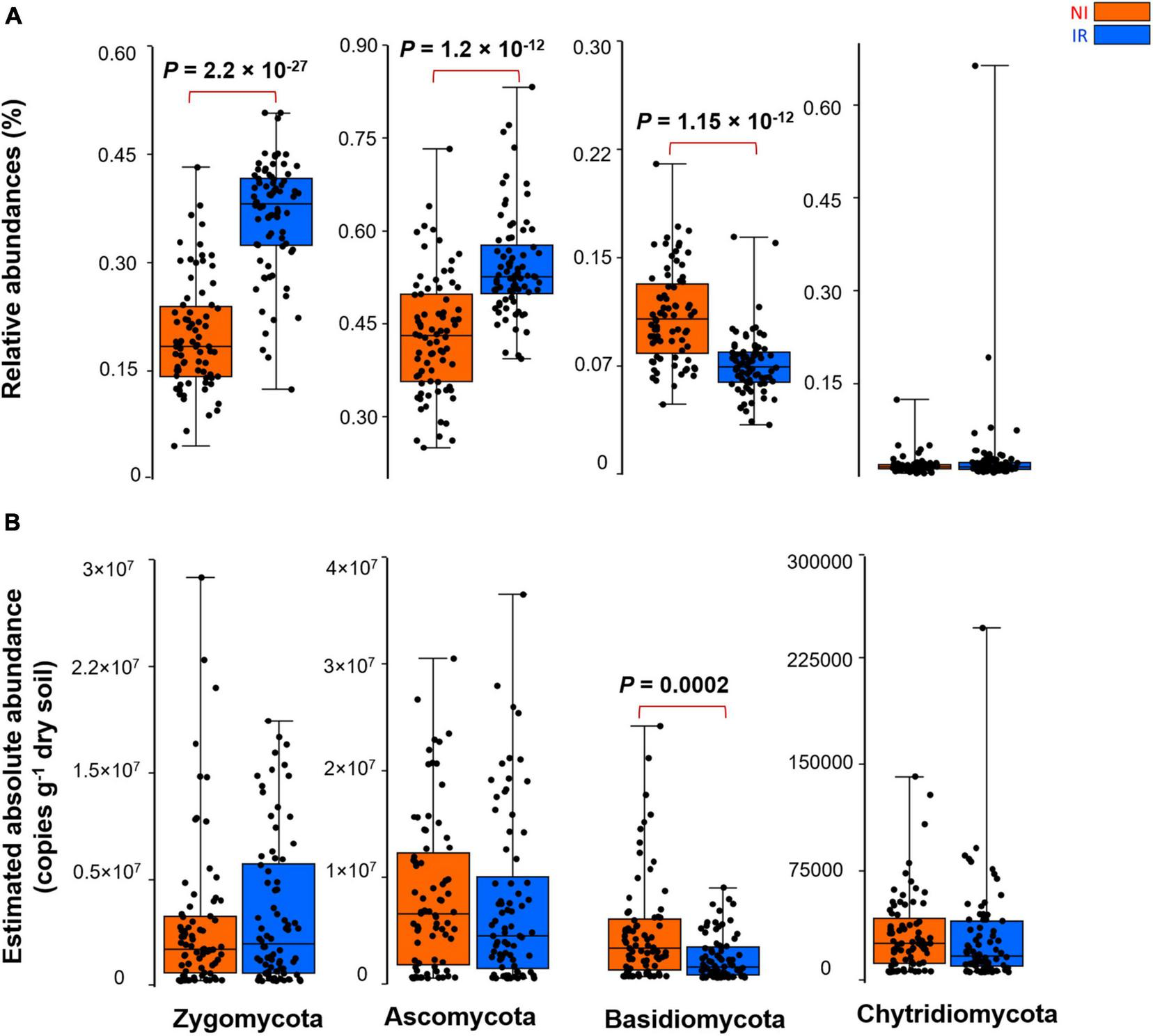
Next-generation sequencing is recognized as one of the most popular and cost-effective ways of characterizing microbiome in multiple samples. However, most of the currently available amplicon sequencing approaches are inherently limited, as they are often presented based on the relative abundance of microbial taxa, which may not fully represent actual microbiome profiles. Here, we combined amplicon sequencing (16S rRNA gene for bacteria and ITS region for fungi) with real-time quantitative PCR (qPCR) to characterize the rhizosphere microbiome of wheat. We show that changes in the relative abundance of major microbial phyla do not necessarily follow the same pattern as the estimated quantitative abundance. Most of the bacterial phyla linked with the rhizosphere of plants grown in soil with no history of water stress showed enrichment patterns in their estimated absolute abundance, which was in contradiction with the trends observed in the relative abundance data. However, in the case of the fungal groups (except for Basidiomycota), such an enrichment pattern was not observed and the abundance of fungi remained relatively unchanged under different soil water stress history when estimated absolute abundance was considered. Comparing relative and estimated absolute abundances of dominant bacterial and fungal phyla, as well as their correlation with the functional processes in the rhizosphere, our results suggest that the estimated absolute abundance approach gives a different and more realistic perspective than the relative abundance approach. Such a quantification approach provides complementary information that helps to better understand the rhizosphere microbiomes and their associated ecological functional processes.

8,484 views

37 citations

ORIGINAL RESEARCH
23 February 2022
Soil Properties Interacting With Microbial Metagenome in Decreasing CH4 Emission From Seasonally Flooded Marshland Following Different Stages of Afforestation
Qian Zhang, 10 more and Qixiang Sun

4,775 views

19 citations

Soil Microbial Community Response to Nitrogen Application on a Swamp Meadow in the Arid Region of Central Asia
ORIGINAL RESEARCH
20 January 2022
Soil Microbial Community Response to Nitrogen Application on a Swamp Meadow in the Arid Region of Central Asia
Yang Hu, 4 more and Hongtao Jia
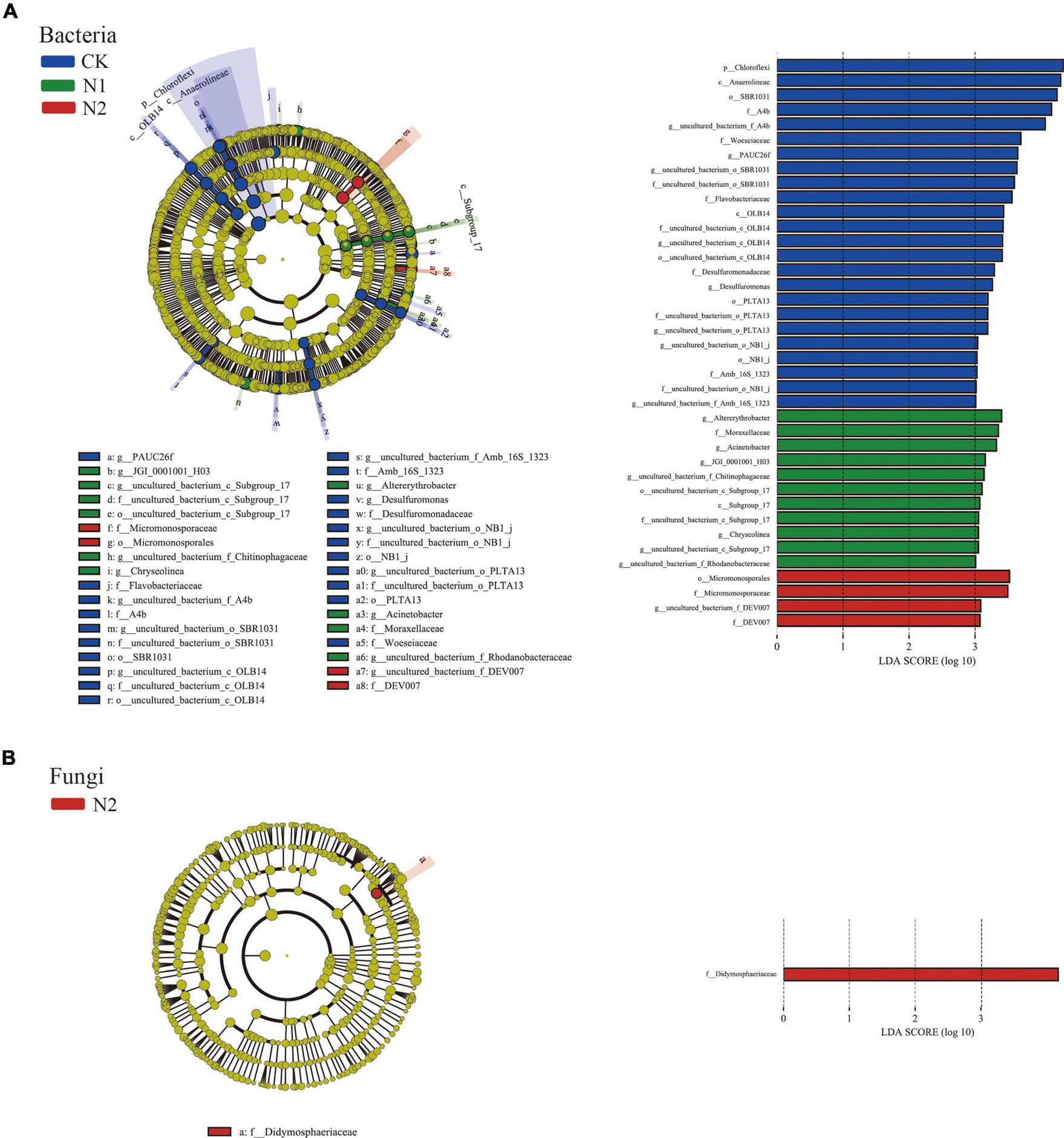
Although a large number of studies have reported the importance of microbial communities in terrestrial ecosystems and their response to nitrogen (N) application, it is not clear in arid alpine wetlands, and the mechanisms involved need to be clarified. Therefore, the response of the soil microbial community in a swamp meadow to short-term (1 year) N application (CK: 0, N1: 8, N2: 16 kg·N·hm−2·a−1) was studied using 16/18S rDNA high-throughput sequencing technology. Results showed that N application had no significant effect on soil microbial community diversity, but significantly changed soil bacterial community structure. N1 and N2 treatments significantly reduced the relative abundance of Chloroflexi (18.11% and 32.99% lower than CK, respectively). N2 treatment significantly reduced the relative abundance of Nitrospirae (24.94% lower than CK). Meanwhile, N application reduced the potential function of partial nitrogen (N) and sulfur (S) cycling in bacterial community. For example, compared with CK, nitrate respiration and nitrogen respiration decreased by 35.78%-69.06%, and dark sulfide oxidation decreased by 76.36%-94.29%. N application had little effect on fungal community structure and function. In general, short-term N application directly affected bacterial community structure and indirectly affected bacterial community structure and function through available potassium (K), while soil organic carbon (SOC) was an important factor affecting fungal community structure and function.

6,335 views

60 citations