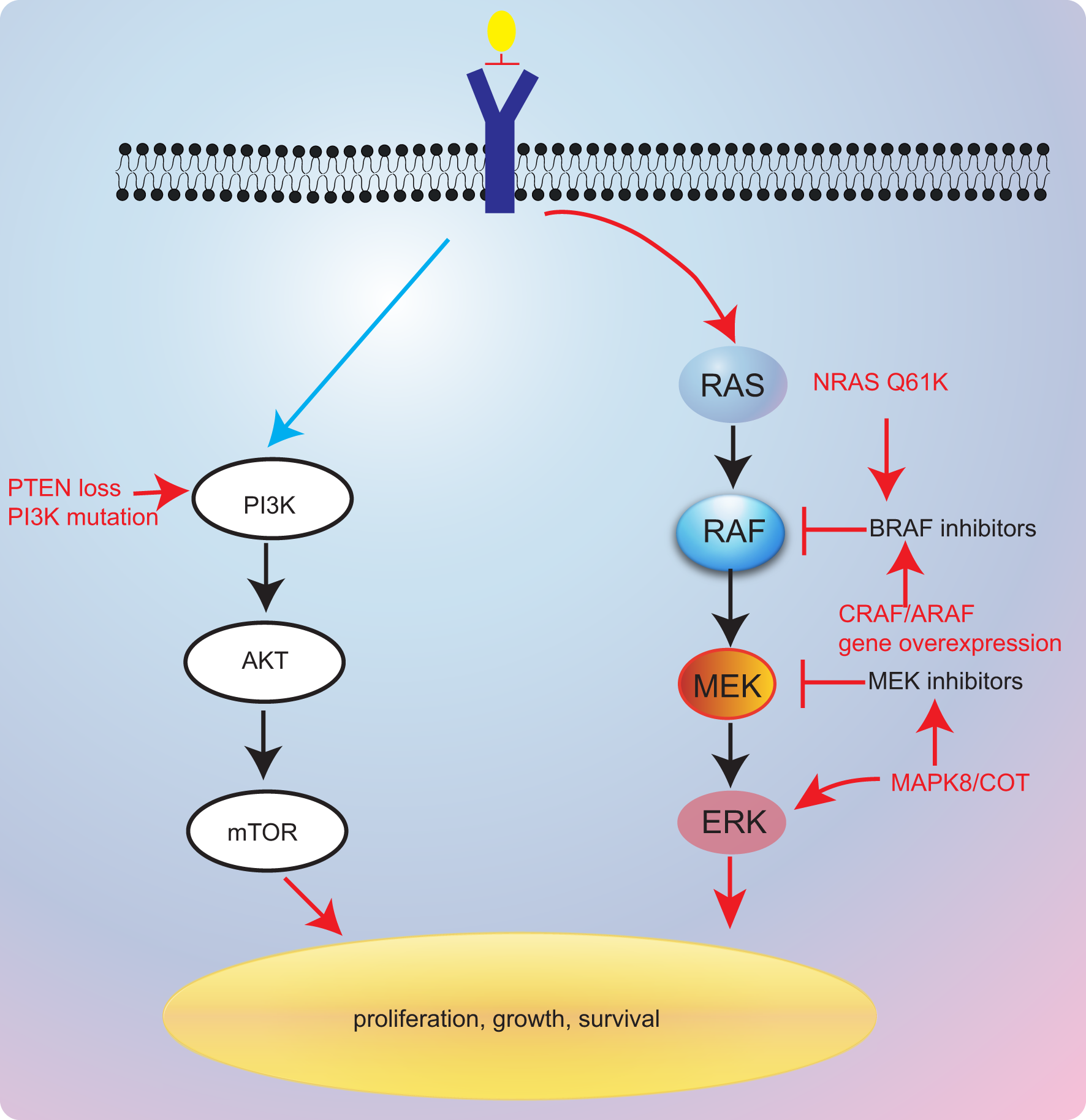
Challenges and Opportunities of TKIs in the Treatment of NSCLC Patients with Uncommon Mutations Substantial advances have been made in our understanding of the molecular biology of cancer, leading to profound progression in the fields of diagnosis and treatment of non-small cell lung cancer (NSCLC). More recently, many uncommon mutations are gaining attention in NSCLC, including epidermal growth factor receptor exon 20 insertion (EGFR 20ins), anaplastic lymphoma kinase (ALK), human epidermal growth factor receptor 2 (HER2), rearranged during transfection (RET), v-Raf murine sarcoma viral oncogene homolog B (BRAF), neurotrophic tropomyosin receptor kinase (NTRK), and others (1). Pharmaceutical agents developed to target classical driver mutations detected in NSCLC patients have provided profound and durable responses compared with conventional chemotherapy. This paradigm shift can also be seen in the realm of uncommon mutations. Ongoing studies and clinical trials of tyrosine kinase inhibitors (TKIs) for uncommon targets are gaining insights into possible treatment options to enable long-term survival of patients. Since immunotherapy serves as the backbone treatment in mutation-negative populations, the efficacy of immunotherapy or immunotherapy-based combinations has also been evaluated in patients harboring uncommon targets. Furthermore, other novel therapies and platforms have been developed and tested to provide more possibilities and options for these patients.In this article, we compiled a series of papers including original research, reviews and case reports that focus on recent advances and challenges in the treatment of lung cancer patients with uncommon driver mutations. For rare EGFR mutations, Xu et al. Finally, we thank all the authors for their inspiring contributions to this topic and hope that these papers will provide our readers with a deep understanding of the current status and future directions in the treatment of NSCLC patients with uncommon mutations.



6 Authors
- FL
Fangfang Liu
Department of Oncology, Tongji Hospital of Tongji Medical College, Huazhong University of Science and Technology, China
- YW
Yuxuan Wei
Department of Oncology, Tongji Hospital of Tongji Medical College, Huazhong University of Science and Technology, China
- HZ
Huan Zhang
The Second Clinical College of Tongji Medical College, Huazhong University of Science and Technology, China
- JJ
Jizong Jiang
Department of Oncology, Tongji Hospital of Tongji Medical College, Huazhong University of Science and Technology, China
- PZ
Peng Zhang
Department of Oncology, Tongji Hospital of Tongji Medical College, Huazhong University of Science and Technology, China
- QC
Qian Chu
Department of Oncology, Tongji Hospital of Tongji Medical College, Huazhong University of Science and Technology, China
14 Authors
- NZ
Ning Zhou
Department of Lung Cancer Surgery, Tianjin Medical University General Hospital, China
- TL
Tong Li
Department of Lung Cancer Surgery, Tianjin Medical University General Hospital, China
- ML
Maoli Liang
Department of Respiratory and Critical Care, Tianjin Medical University General Hospital, China
- FR
Fan Ren
Department of Lung Cancer Surgery, Tianjin Medical University General Hospital, China
- HN
Hong Ni
Department of Lung Cancer Surgery, Tianjin Medical University General Hospital, China
- WL
Wei Liu
Department of Respiratory Medicine, Second Affiliated Hospital of Tianjin University of Traditional Chinese Medicine, China
- TS
Tao Shi
Precision Medicine Center, Tianjin Medical University General Hospital, China
- DX
Dongbo Xu
Department of Pathology, Tianjin Medical University General Hospital, China
- QC
Qiusong Chen
Department of PET/CT Diagnostic, Tianjin Medical University General Hospital, China
- HY
Haonan Yu
Department of PET/CT Diagnostic, Tianjin Medical University General Hospital, China
- ZS
Zuoqing Song
Department of Lung Cancer Surgery, Tianjin Medical University General Hospital, China
- LZ
Lingling Zu
Department of Lung Cancer Surgery, Tianjin Medical University General Hospital, China
- SL
Shuo Li
Department of Respiratory and Critical Care, Tianjin Medical University General Hospital, China
- SX
Song Xu
Department of Lung Cancer Surgery, Tianjin Medical University General Hospital, China
3,697 views
17 citations