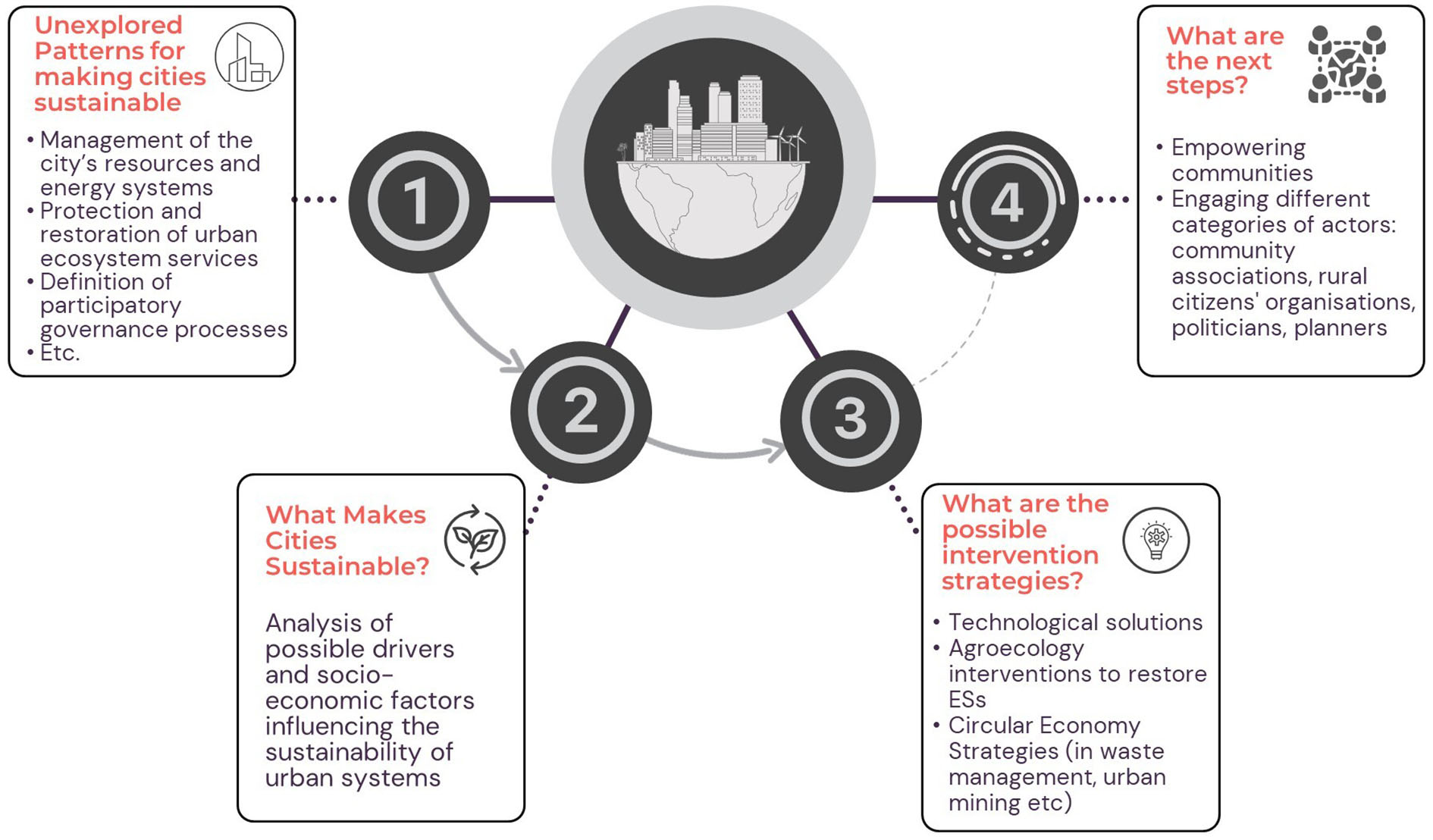
Accelerating climate change and increasing urbanisation processes have led cities to face ever-increasing pressures, especially regarding resource provisioning, land use, preservation of ecosystem services, management and disposal of materials and urban waste (Wolk et al., 2022). Several studies confirm the unsustainable rate of urban growth, with 56% of the world's population now living in urban areas (UN-Habitat, 2022). Although cities occupy less than 5% of the earth's surface, they contribute to 60%-80% of the global energy, 75% of the global emissions, and 26% of the fresh water (Meng et al., 2022). In recent decades, the exponential exploitation of urban resources has led cities to exceed their biocapacity by 15-150 times (Doughty e Hammond, 2004;Dijst et al., 2018).Forecasts for the future are even more dramatic. According to the United Nations (UN, 2022), by 2050, 70% of the world's population will be concentrated in urban areas, releasing 75% of the planet's carbon emissions and consuming about 80 per cent of the electricity generated. Thus, the massive consumption of resources and the production of waste beyond the natural limits of supply and recycling becomes the root of the current urban unsustainability (Ulgiati and Zucaro, 2019).A radical change of development and lifestyles is therefore imperative. The scientific community, professional and business associations, and policy makers urgently need to make a tangible contribution to promoting the sustainability of urban systems. This Research Topic (RT) aims to help re-think how cities, around the world, should address the challenge of a more equitable management of urban resources for increased human and ecosystems wellbeing. At present, cities are heavily dependent on other urban systems and surrounding territories for material and energy supply as well as waste disposal. If urban systems are to move in the direction of sustainability, they must self-organize to increasingly benefit from internal resources and ecosystem services.The seven articles submitted to this RT effectively contribute to fill this gap, demonstrating that there are still many steps to be taken towards sustainable cities, and many strategies to be pursued to manage urban resources. These contributions build upon each other and provide an analytical-strategic picture based on three main steps. The first step, summarised in Zucaro et al. (this issue), aims to put forward which issues are still unexplored in the field of urban resource management, so as to lead academics and practitioners towards innovative solutions and strategies in the journey of cities towards sustainability. The second step, according to the Agostinho et al. (this issue), is to understand 'What Makes Cities Sustainable?', analysing the possible drivers that affect the sustainability of urban systems. The last step is to define viable strategies and models that can accelerate the transition of cities towards sustainable and circular models (Rizzaghi-Asl, this issue; Ghisellini et al., this issue; Padoan et al., this issue; Pengue, this issue; Preka et al., this issue). In this threestep perspective, the remaining contributions deeply explore the roots of urban problems, under different and complementary frameworks (re-powering nature-based systems, implementing urban mining, understanding urban metabolism, benefiting from urban agroecology and, finally, decreasing plastic waste impacts).
The starting point is a shared awareness that the challenge is not so much finding new resources, but instead improving the way urban resources are used, so that more value can be generated with less input. Creativity, community empowerment, stakeholder engagement, sharing ability, and a new way of looking at qualitative instead of quantitative growth are actually needed in a short time frame and cannot be delayed. In this regard, Zucaro et al. (this issue) provide a perspective on possible actions to address this challenge, mainly (but not only) concerning: (i) appropriate management of a city's resources and energy systems, within a framework of sustainable Urban Metabolism (UM) ; (ii) the characterisation of strategies that guarantee a decreasing use of non-renewable resources; (iii) the protection and restoration of urban ecosystem services as well as urban agroecology strategies; (iv) the implementation of participatory governance processes, toward resource allocation for shared prosperity and wellbeing. Agostinho et al. (this issue) examine which biophysical, socioeconomic and cultural variables influence the sustainability of cities, by means of the 'Mandala ODS' (Mandala Objectivos de Desenvolvimento Sustentável, in Portuguese), an innovative Brazilian tool to support city's monitoring and management for the Agenda 2030 objectives (CMN, 2021). The correlation analysis between variables and clusters conducted on a panel of 130 Brazilian cities showed that the sustainability level of cities is associated with regional location, Human Development Index (HDI), poverty incidence, city size and GDP per capita. These results highlight the need for governance that privileges local characteristics, instead of standardised public policies based on a larger scale, which would fail to provide the same benefits to cities with different socioeconomic and cultural characteristics.
Technological solutions. Razzaghi-Asl (this issue) focuses on the need to repower Nature-Intensive Systems to help neighbourhoods and cities in order to reduce both CO2 emissions and their dependence on fossil fuels. In particular, the Author analyses the common boundary concepts and theoretical foundations for characterising Nature-based Solutions (NbS) and Energy Transition (ET) systems, highlighting their potential. Although the study reveals the need for further investigation of potential synergies and trade-offs between the coupled use of NbS and ET, the development and testing of such nature-based climate solutions can provide scientific support to the transition towards increased urban sustainability.
According to Pengue (this issue), it is crucial that cities return to being generators of ecosystem services (ESs), in order to improve their livability, health and resilience. In this sense, urban agroecology not only provides a significant contribution to the restoration of ESs, but also promises to be a real possibility to build local food systems and new food production and consumption ways and networks. Encouraging urban and peri-urban agroecology would first and foremost expand the local economy, contributing to food security, human health, carbon reduction and local employment. In addition, it would establish reconnection with nature and increase awareness of sustainability in cities.
Preka et al. (this issue) focus on plastic waste produced and used in Italian cities (and likely worldwide). This study, starting from the technical-regulatory criticalities of the sector, aims to identify strategic actions to be implemented along the whole plastics value chain in a short, medium and long term perspective. From the analysis it emerges that the promotion of new conversion and recycling processes of traditional plastics and biodegradable bioplastics (especially in some sectors) could be an integral part of a national circular economy strategy and, more generally, lead to a life-cycle systemic approach and effective transition of urban areas towards a sustainable development model. Ghisellini et al. (this issue) investigate circular and socially just solutions to improve urban extraction and use of Construction and Demolition Waste (C&DW) as well as Waste from Electrical and Electronic Equipment (WEEE). The most promising solutions appear to be those based on the application of prevention measures considering the eco-design (for disassembly and for durable products), waste reduction and products repair. These solutions require changes especially in cultural mindsets and the development of appropriate environmental and technical knowledge. Reuse, regeneration and recycling themselves, on the other hand, require technological investments that make their realisation difficult and costly. Although some good practices are spreading (think of the Repair Cafés or examples of buildings designed to be dismantled at the end of their life), the opportunities for urban mining within the circular economy framework are still rather unexplored and should not be disregarded.Padoan et al. (this issue) focus on some crucial aspects within the EU framework and planning: (i) the need to characterise a renewed and holistic approach to the study of UM; (ii) the importance of coupling urban resource use and the social practices of different urban agents, for appropriate reconstruction of UM, starting from the consumption practices of households and organisations; and (iii) the definition of a new set of sociological tools to investigate past and present UM strategies, in order to understand pathways of interdependence, strengths and weaknesses of current regulatory schemes and the potential for change in current practices.
The papers in this RT advocate for a deeper understanding of the criticalities that affect the sustainability of cities and an adequate foresight for the definition of suitable strategies of circular urban resources management. This can only be achieved by means of converging efforts from different sectors and transdisciplinary expertise (Figure 1). The analyses and perspective solutions presented in the articles of this RT show how academics and experts are working to provide an innovative contribution to research and policy. What are the next steps to be taken so that the proposed strategies can be actually implemented? According to Ulgiati et al. (2022), top-down solutions have not always demonstrated the ability to fully address the needs of communities, nor have they promoted stakeholders and citizens engagement in solutions tailored to specific socio-economic contexts. Therefore, the only way forward seems to be to experiment and implement solutions also based on community empowerment and engagement of different categories of actors. In other words, the involvement and mutual interaction of economic actors, policymakers, planners, rural organisations, community associations and citizens must be the next step to make the insights provided by the scientific community actually feasible. If countries and cities are capable to integrate top-down and bottom-up efforts, not only by listening to communities needs but also by empowering them, then to concretely start the transition towards fairer, more inclusive, equitable, and thus truly sustainable cities becomes possible.