
produce energy. On Earth, plants are principal autotrophs that can produce food by photosynthesis to supply energy for organisms. Ultimately, the elements plants take up and accumulate from the environment become part of our bodies' composition. Therefore, an understanding of elemental transport in plants is essential for both solving agricultural problems and improving human health.Plants have to acquire 17 different essential elements (nitrogen, phosphorus, potassium, oxygen, hydrogen, carbon, calcium, magnesium, sulfur, iron, manganese, boron, zinc, molybdenum, copper, chlorine, and nickel) mainly from the rhizosphere by their roots to complete their life cycle. Both shortage and excess of these elements lead to impaired growth, which often translates into yield loss in agriculture. Plants have developed sophisticated and tightly regulated mechanisms for the uptake and translocation of essential elements. On the other hand, plants also take up harmful elements such as cadmium and arsenic non-specifically which may interfere with essential nutrients' uptake. In this Research Topic, we have aimed to cover essential nutrient homeostasis in plants; including, but not limited to their transport, translocation, and interaction with each other. In the research topic volume I, we succeeded in collecting six original research papers, one review, one perspective, and one minireview, which discuss not only the essential but also the toxic metals under various physiological conditions. Following the publication of the issue on Metal Transport in Plants vol. I, we decided to edit a second volume of our research topic, which indicates the importance and significant progress in this research field.The Research Topic Vol. II includes five original research papers, one review, and one mini-review.Bakirbas and Walker found CAN OF SPINACH (COS), a novel long non-coding RNA (lncRNA) involved in iron (Fe) homeostasis. They performed a comparative RNAseq analysis of Fe sufficient, deficient, and resupplied (24 hours Fe resupply after Fe deficiency treatment) Arabidopsis shoots, and focused on a particular Fe-regulated transcript, named COS. Bakirbas and Walker found that reads matching this locus originated from previously unannotated transcripts on the reverse strand which did not contain cDNA and were not produced from the strand predicted to encode proteins. The cos mutant has low Fe levels in the leaves, although it has higher chlorophyll levels compared to wild type (WT). In addition, the cos mutant accumulated singlet oxygen during Fe deficiency, which caused negative effects on photosynthesis. It was suggested that COS lncRNA negatively regulates several Fe homeostasis genes.
Editorial03 April 2024
Editorial: Metal transport in plants, volume II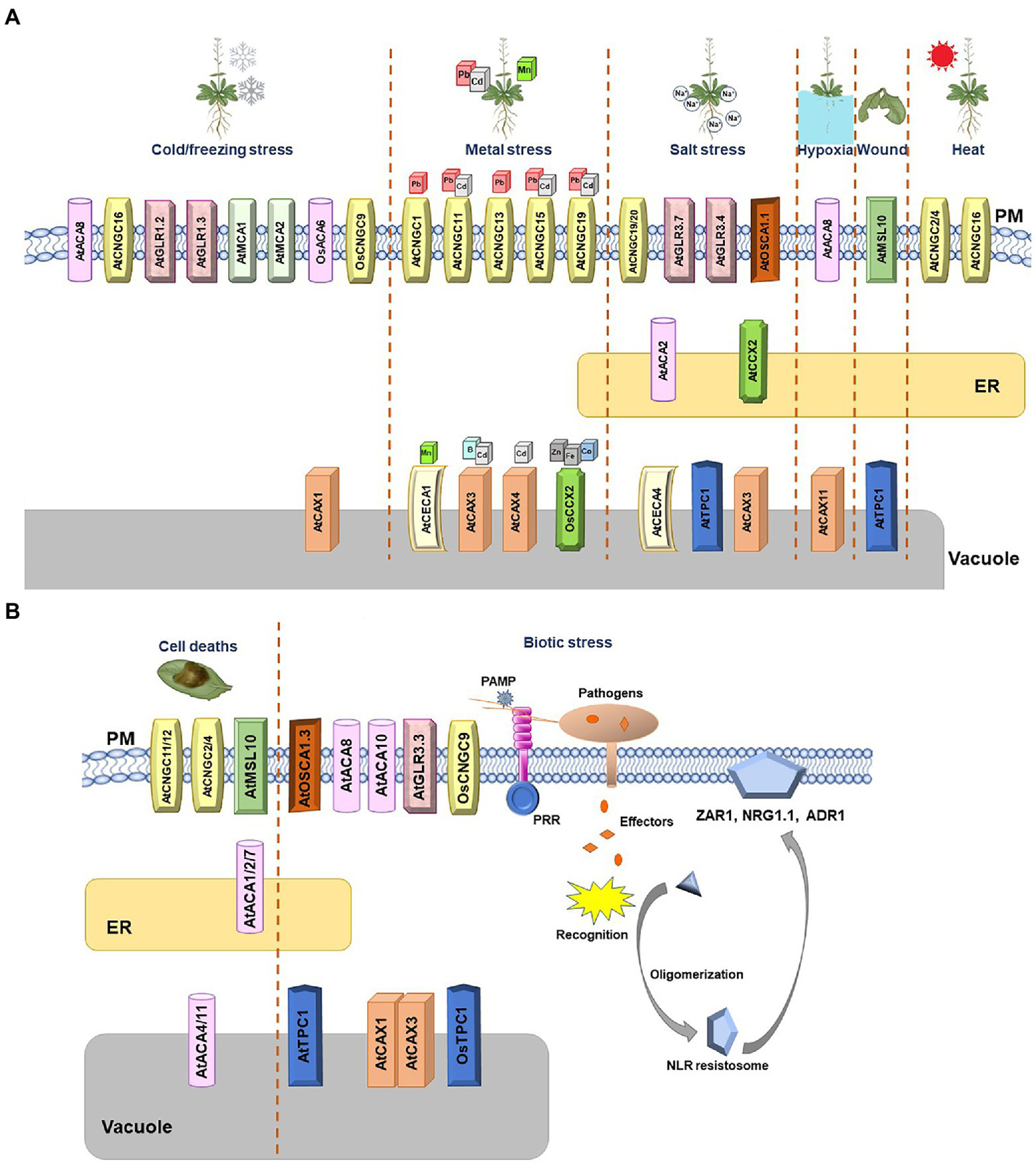
Calcium (Ca2+) serves as a ubiquitous second messenger by mediating various signaling pathways and responding to numerous environmental conditions in eukaryotes. Therefore, plant cells have developed complex mechanisms of Ca2+ communication across the membrane, receiving the message from their surroundings and transducing the information into cells and organelles. A wide range of biotic and abiotic stresses cause the increase of [Ca2+]cyt as a result of the Ca2+ influx permitted by membrane-localized Ca2+ permeable cation channels such as CYCLIC NUCLEOTIDE-GATE CHANNELs (CNGCs), and voltage-dependent HYPERPOLARIZATION-ACTIVATED CALCIUM2+ PERMEABLE CHANNELs (HACCs), as well as GLUTAMATE RECEPTOR-LIKE RECEPTORs (GLRs) and TWO-PORE CHANNELs (TPCs). Recently, resistosomes formed by some NUCLEOTIDE-BINDING LEUCINE-RICH REPEAT RECEPTORs (NLRs), are also proposed as a new type of Ca2+ permeable cation channels. On the contrary, some Ca2+ transporting membrane proteins, mainly Ca2+-ATPase and Ca2+/H+ exchangers, are involved in Ca2+ efflux for removal of the excessive [Ca2+]cyt in order to maintain the Ca2+ homeostasis in cells. The Ca2+ efflux mechanisms mediate the wide ranges of cellular activities responding to external and internal stimuli. In this review, we will summarize and discuss the recent discoveries of various membrane proteins involved in Ca2+ influx and efflux which play an essential role in fine-tuning the processing of information for plant responses to abiotic and biotic stresses.