Editorial: Using Artificial Intelligence Technology for Language Learning Bin Zou, Hayo Reinders, Michael Thomas, David Barr Although research on Artificial Intelligence (AI) stretches back several decades, it has become increasingly prominent over the last several years due to the emergence of Large Language Models (LLMs) and chatbots such as ChatGPT that aim to mimic human conversation and dialogue. This has led to renewed interest in the potential of AI to aid education, particularly through its potential to improve personalized learning, as well as the challenges it presents to academic integrity, and general concerns over security and privacy. In second language acquisition, recent developments in AI build on previous work in Intelligent Computer-Assisted Language Learning (iCALL) (Schulze, 2008), and aims to investigate how learning can be enhanced through personalized learning materials, instruction and feedback (Dai & Wu, 2023;Hellmich & Vinall, 2021;Xiao & Park, 2021). In the area of feedback, for example, language learners can use AI technology to record their voice on their computers or mobile devices and then receive a score and feedback through a speech evaluation system (Dizon, 2020;Zou, et.al., 2023a). In addition, learning outcomes can be enhanced through collaborative activities in social networking contexts when they use AI for speaking practice (Zou, et al., 2023b). Beyond direct instruction, AI has made significant strides in making administrative, curriculum development and testing processes more efficient (Xu et al., 2021).Although AI has considerable potential in language education, there is a dearth of research on the subject and the research that does exist has started to identify important areas for further investigation. One emerging concern is how to provide students with a range of course-and assessment-aligned input. Research has identified gaps in the programming of AI for language learning, consisting of adapting features such as various types of instant feedback of language skills to sustain independent study. Therefore, the potential of AI programs needs be investigated further to explore how AI can be applied to foster language skills that are required in real-life contexts. It is also important to consider how instant feedback in the AI programs can meet learners' language learning goals and the ways to design a variety of feedback to enhance learners' independent study on their computers or mobile devices. This special issue examines the opportunities and challenges of using AI to develop language skills in language learning contexts. It explores how AI can engage learners' development of language skills and the potential benefits of AI for engaging students' language practice. The five papers published in this special issue were subject to a rigorous process involving multiple revisions prior to acceptance for publication. The first research paper (Huang, et al., 2023) looks at using AI for reading practice with deep-learning technologies. The authors provide effective examples for teachers and designers to consider when integrating or designing such AI systems to help learners practice reading skills. The second article (Liu, et al., 2023) investigates students' perceptions of using AI apps for EFL speaking practice. Through an experimental study, the authors show the effectiveness of using AI for overall speaking skills. The third research paper (Yang, et al., 2023) focuses on using an automated writing evaluation system via Natural Language Understanding tasks to develop students' EFL writing skills in argumentative essays. Their findings demonstrate that their combined model is effective for improving learners' writing skills. The following article (Qin, et al., 2023) explores an automatic error type annotation platform for dictation practice for French as a foreign language (FFL) learning. Their study displays a positive result in using this AI system for FFL learning. The final paper (Sun, 2023) uses an experimental approach to investigate the effectiveness of utilizing peer correction when using AI for EFL speaking practice. The findings reveal that peer correction can reinforce students' learning outcomes during their practice on AI speaking tools. Thus, the author suggests considering peer correction tasks during the use of AI for EFL speaking practice.Overall, the articles that are part of this special issue demonstrate that AI offers tremendous real-world potential for enhancing many aspects of language learning and teaching. We hope together the articles will inspire others to continue to investigate this important and rapidly developing field.
Editorial20 September 2023
Editorial: Using artificial intelligence technology for language learning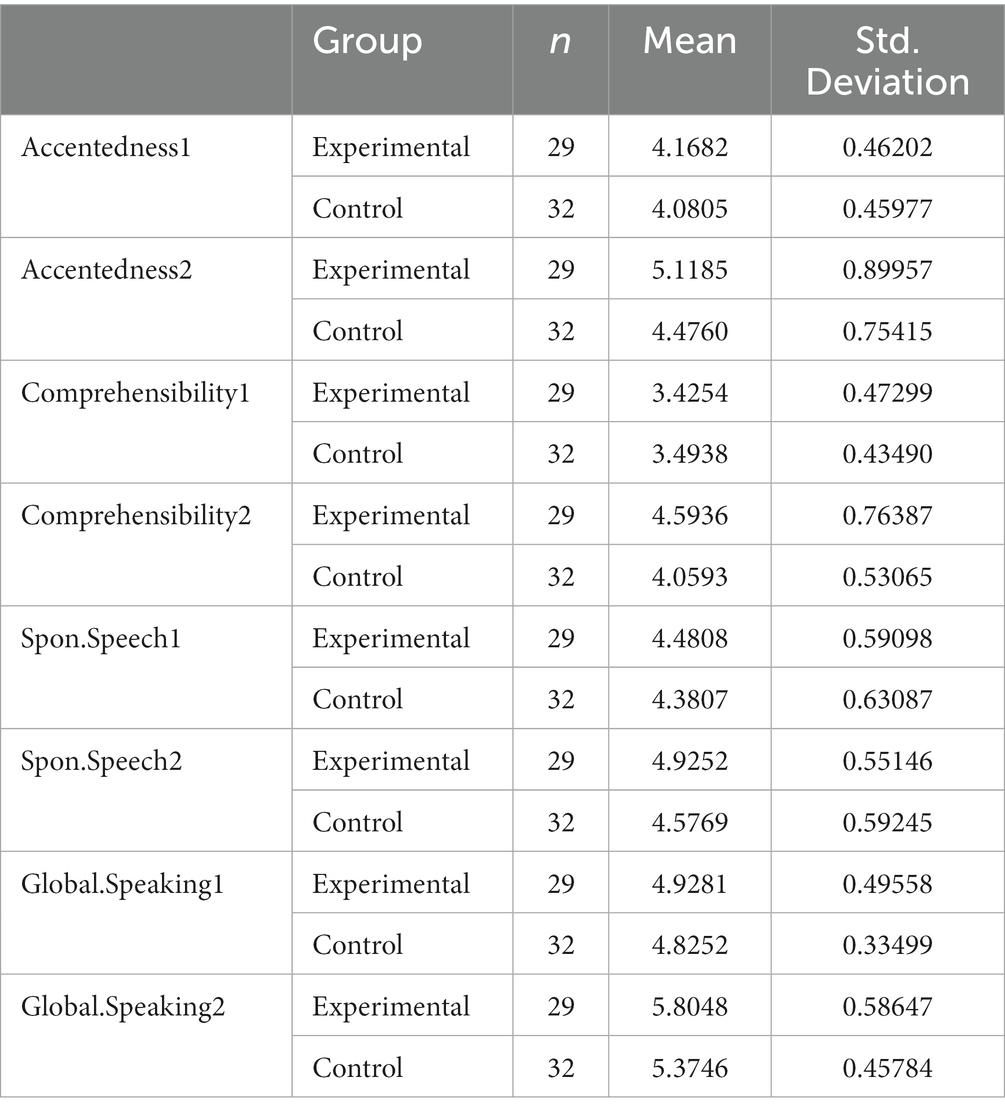
This study used an explanatory sequential design to investigate the effectiveness of automatic speech recognition technology (ASR) with peer correction in enhancing second language (L2) pronunciation and speaking performance of English as a Foreign Language (EFL) learners. A total of 61 intermediate-level Chinese EFL learners were randomly assigned to either a control group (CG) receiving traditional teacher-led feedback and instruction or an experimental group (EG) using ASR technology with peer correction. Read-aloud tasks, spontaneous conversations, and IELTS speaking tests were used to collect data for L2 pronunciation and speaking skill. Also, semistructured interviews were carried out with a number of the participants to explore their perceptions of the ASR technology. The quantitative results showed that the EG outperformed the CG in all measures of L2 pronunciation, including accentedness and comprehensibility. Additionally, the EG demonstrated significant greater improvements in global speaking skill. The qualitative analysis of the interviews revealed that the majority of the participants found the ASR technology helpful in improving their L2 pronunciation and speaking skills. Overall, the findings suggest that ASR technology with peer correction can be an effective tool in enhancing L2 pronunciation and speaking skills in EFL learners.
ORIGINAL RESEARCH
12 January 2023
Ying Qin, 1 more and Yuming Zhai
3 Authors
- YQ
Ying Qin
School of Information Science and Technology, Beijing Foreign Studies University, China
- YL
Yumeng Luo
School of Information Science and Technology, Beijing Foreign Studies University, China
- YZ
Yuming Zhai
Beijing Foreign Studies University (BFSU) Artificial Intelligence and Human Languages Lab, Beijing Foreign Studies University, China
3,755 views
7 citations
BRIEF RESEARCH REPORT
25 January 2023
3,656 views
7 citations