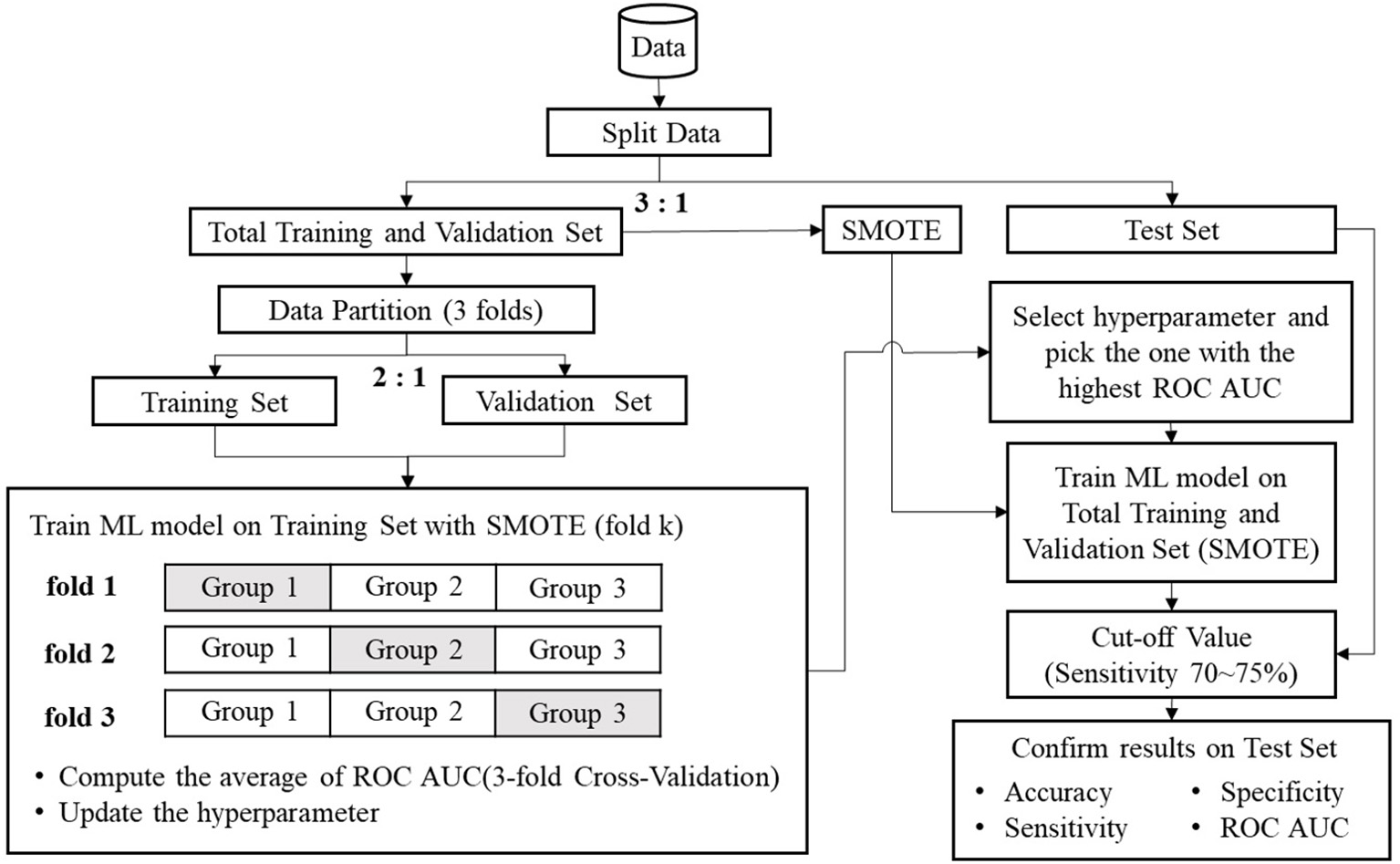
This Research Topic is focused on new insights, novel developments, current challenges, latest discoveries, recent advances, and future perspectives in the field of cardiovascular epidemiology and prevention. Four high-quality studies were included in the Research Topic. Two studies utilized electrocardiographic (ECG) variables and some biologic variables in specific models to correlate to left atrial enlargement and left ventricular diastolic dysfunction, separately, in a military sample of physically active young adults in Taiwan. [1][2][3][4][5][6][7] Hsu et al. used three machine learning classifiers, i.e., support vector machine (SVM), logistic regression (LR) and multilayer perceptron (MLP) for 26 ECG features with or without 6 biological features (age, anthropometric and hemodynamic variables) to predict echocardiographic left atrial enlargement which was defined as the dimension ≥4 cm. The comparison model used the P wave duration of lead II, the traditional ECG criterion for left atrial enlargement. The results found that if the sensitivity is fixed to 70-75%, the specificity of the SVM classifier for ECG only is 72.4%, and that of the MLP classifier for all biological and ECG features is up to 81.1%, both of which are higher than 48.8% by the P wave duration. In another study, Liu et al. used multiple logistic regression model to identify the independent ECG and cardio-metabolic risk factors of left ventricular diastolic dysfunction, which was diagnosed as either one of the three echocardiographic criteria met: (1) mitral inflow E/A ratio <0.8 with a peak E velocity of >50 cm/s, (2) tissue Doppler lateral mitral annulus e′ <10 cm/s, and (3) E/e′ ratio >14. The results showed that of the cardio-metabolic markers, central obesity, defined as waist circumference ≥90 cm for men, was the only independent marker of left ventricular diastolic dysfunction [odds ratio (OR) and 95% confidence interval: A propensity score model using inverse probability weighting with regression adjustment was used to estimate the effect of smoking on the MACE occurrence.The results revealed that MACE rates were 1.9, 1.2, and 1.6 per 100 patients per month in the current smokers, former smokers and never smokers, respectively.After applying a propensity score model, current and former smokers had the onset of recurrent MACEs sooner than non-smokers, with a median time of 4.4 vs. 4.9 vs. 13.5 months (p < 0.001), respectively. This study concluded that the "smoker's paradox" phenomenon 6 was not found in their population. Taken together, the present Research Topic represents an important source of up-to-date information, covering many aspects of risk factors for heart diseases.More comprehensive knowledge based on these discoveries may bring about new perspectives.
3 Authors
- XL
Xiaopeng Liang
Division of Clinical Pharmacology and Therapeutics, Department of Medicine, School of Clinical Medicine, The University of Hong Kong, Hong Kong SAR, China
- OH
Oscar Hou In Chou
Division of Clinical Pharmacology and Therapeutics, Department of Medicine, School of Clinical Medicine, The University of Hong Kong, Hong Kong SAR, China
- BM
Bernard M. Y. Cheung
Division of Clinical Pharmacology and Therapeutics, Department of Medicine, School of Clinical Medicine, The University of Hong Kong, Hong Kong SAR, China
11 Authors
- XY
Xiao Yu
, Sun Yat-Sen University, China
- YT
Yu Ting Li
Sun Yat-Sen University, China
- HC
Hui Cheng
, Sun Yat-Sen University, China
- SZ
Sufen Zhu
University of Oxford, United Kingdom
- XH
Xiu-Jing Hu
Zhejiang Provincial Center for Disease Control and Prevention, China
- JJ
Jia Ji Wang
Centre for General Practice, The Seventh Affiliated Hospital, China
- BH
Bedru H. Mohammed
The University of Hong Kong, Hong Kong SAR
- YJ
Yao Jie Xie
The Hong Kong Polytechnic University, Hong Kong SAR
- JH
Jose Hernandez
EDU, Digital Education Holdings Ltd., Malta
- HW
Hua-Feng Wu
Shishan Community Health Centre of Nanhai, China
- HH
Harry H. X. Wang
, Sun Yat-Sen University, China
3,486 views
3 citations