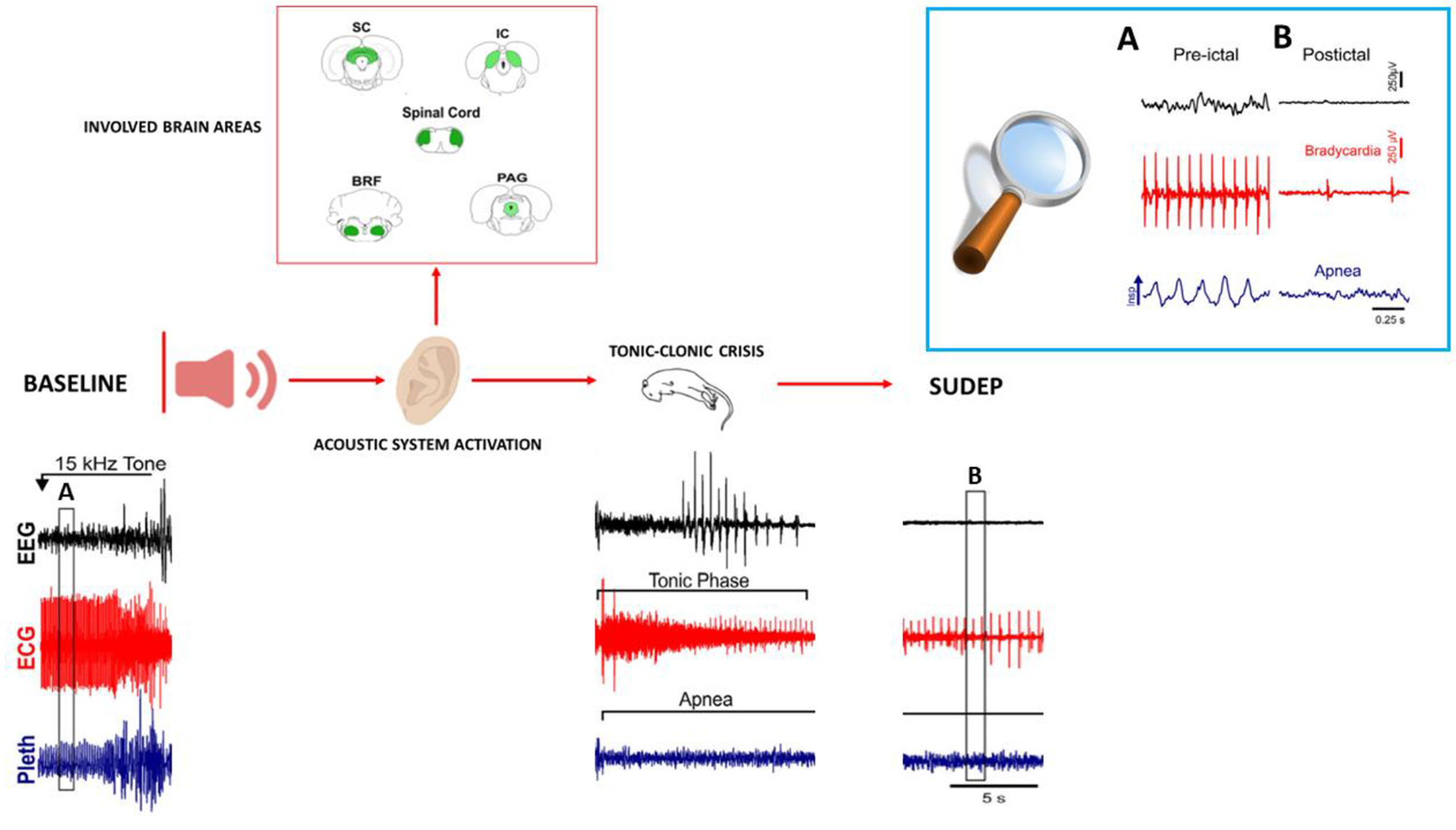
Epilepsy is the fourth most common neurological disorder in the world. Many etiologically relevant animal models of epilepsy have been developed in small rodents (mice and rats) that may help to overcome these challenges. Our research topic aims to gain basic knowledge from animal epilepsy models to improve our understanding of the neurobiological etiology of seizures, genetic correlates, and related comorbidities of the different types of epilepsy. This is a collection of studies that aim to bridge the translational gap between animal data and clinical trials (Figure 1). brain pathologies and in premature death, most prevalent in young adult drug-resistant epilepsy patients. The authors consider the translational value of animal models and brought together shreds of evidence indicating that dilute brown agouti coat color (DBA/2) mice, which are genetically susceptible to audiogenic generalized seizures, could be regarded as a relevant animal model of SUDEP with a sufficient amount of face validity and perhaps also predictive validity.Zhang et al (https://doi.org/10.3389/fneur.2023.1255097) conducted an experimental study in a rat model of focal cortical dysplasia generated by in utero X-ray-radiation and compared expression profiles with that obtained in surgical specimens from patients. The study proposes that epileptogenesis of focal cortical dysplasia type IIb and tuberous sclerosis complex is caused by changes in the expression of α-synuclein, a member of synucleins family that plays a crucial role in modulating synaptic transmission in the central nervous system, which are associated with an impairment of N-methyl-D-aspartate (NMDA)-ergic mechanisms. More studies concerning the modulating effects of α-synuclein on seizure activity are indicated.The review paper of Sibarov et al (https://doi.org/10.3389/fneur.2023.1201104) considers the product of the immediate early gene encoding the activity-regulated cytoskeletonassociated (Arc) protein in the pathogenesis of epilepsy. Arc protein modulates excitatoryinhibitory balance in neuronal networks of mammals. In active neurons, Arc protein forms retrovirus-like capsids within synapses. After seizures, released Arc particles may accumulate in astrocytes. In their translational approach, the authors focused on rodent models for convulsive and non-convulsive seizures as well on genetic epilepsy models to elucidate the intricate role of Arc in epilepsy. It is proposed that changes in Arc-protein-mediated activity can potentially affect the excitatory-inhibitory balance of the involved neuronal network, either by reducing seizure threshold and promoting stability or inducing lability.• The knowledge gained from rats/mice strains with genetic predispositions to epilepsy.Yavuz et al (https://doi.org/10.3389/fneur.2023.1231736) conducted an experimental study in the genetic absence epilepsy rat from Strasbourg (GAERS). They examined the pro-absence effect of the alpha 2A adrenoreceptor (AR) agonist dexmedetomidine, which was administered systemically in GAERS during the first postnatal month.Their study indicates that alpha 2A-AR mechanism is involved in aunilateral onset of absence-like seizures in the left cortex in close to 50% of the animals. The unilateral onset does fit in recent theories about the focal onset of an archetypical type of generalized epilepsy.Toplu et al (https://doi.org/10.3389/fneur.2023.1282494) used GAERS to investigate the orexin-type 2 receptor (OX2R) signaling pathway in absence epilepsy. The authors discovered that the OX2R agonist had a suppressive effect on spike-wave discharges, as demonstrated by the significantly reduced expression of OX2R in cortex and thalamus. This effect can be attributed to the agonist's regulation of wake/sleep states. The therapeutic potential of targeting OX2R in the treatment of various types of epilepsies, and especially absenceepilepsy awaits further research. .• The knowledge gained from knockout and genetically modified rats/mice.Liu et al (https://doi.org/10.3389/fneur.2023.1243301) investigated the gammaaminobutyric acid (GABA)-ergic mechanisms of epileptic activity. They targeted Glutamate decarboxylase 1 (GAD1)-an enzyme involved in the synthesis of GABA and obtained Gad1 knockout rats from the Long-Evans background. The authors propose a functional model in which GABA produced by GAD1 in the reticular thalamic neurons is released outside the synapses and causes inhibition within the reticular thalamic nucleus. Of note, these thalamic neurons are a major source of inhibition of the thalamic-cortical relay cells • Novel treatment options for patients with therapy-resistant epilepsy.Xue et al (https://doi.org/10.3389/fnins.2023.1157060) used a penicillin-induced motor epileptic model in adult male C57BL/6 J mice and employed optogenetic and chemogenetic approaches to study the involvement of the subthalamic nucleus (STN) and the substantia nigra pars reticulata (SNr) in motor seizures. Inhibition of excitatory neurons in the STN and the projections from the STN to the SNr reduced seizure activity, but activation of these neurons and pathways amplified seizure activity.The authors also concluded that deep brain stimulation of the STN could be a potential treatment for motor epilepsy and could enhance the SNr's antiepileptic effects through orexin pathways.The review of Righes Marafiga and Baraban (https://doi.org/10.3389/fnins.2023.1177678) discusses interneuron-based transplantation therapy in acquired epilepsy models, such as the well-knownpilocarpine model for Temporal Lobe epilepsy. These authors consider a novel strategy that used embryonic medial ganglionic (MGE) progenitor cells targeting parvalbumin-expressing and somatostatin-expressing cells in epileptic networks. Extremely relevant is, that regards a true disease-modifying therapyin the form of a selective addition of new inhibitory interneurons into these circuits.