In their perspective, "One step beyond the lab and clinic: "walking the dementia conversation," Zegarra-Valdivia, Aguzzoli-Peres, Kornhuber, Arshad, and Paredes-Manrique take a bold step beyond the lab and clinic bringing together researchers, caregivers, and patients to "walk the talk" for dementia. This article not only shifts the focus from pathology to conversation but also emphasizes the importance of community engagement and real-world discussions in shaping our understanding of brain health and values.Fitri, Lage, Mollayeva, Santamaria-Garcia, Chan, Cominetti, and Ayhan highlight the profound impact of empathy as a crucial skill in disrupting disparities in global brain health. This research advocates for a collective approach to address global mental health challenges, transcending geographical and cultural boundaries.Ibanez, Matallana, and Miller pose a compelling question in "Can prosocial values improve brain health?" Here, the focus shifts to the symbiotic relationship between prosocial values and the well-being of the brain, holding promises for advancing preventative and intervention strategies.Berendzen's exploration of social attachment as a window into the neural basis of prosocial values offers valuable insights into the emotional underpinnings of our social behaviors. This research contributes to the growing body of knowledge surrounding empathy, cooperation, and the neural substrates that facilitate prosocial behavior.
Stirland, Ayele, Correa-Lopera, Arshad, Zegarra-Valdivia, Prioleau, and others invite us to consider the cultural basis of authenticity and leadership in brain health, prompting reflections on how cultural nuances influence cognitive well-being. The article further examines how societal values, when aligned with principles of respect and equity, contribute to overall cognitive health.Hill-Jarrett invites us to explore "The Black radical imagination: a space of hope and possible futures," encouraging a departure from conventional perspectives. The cultural and social dimensions explored in this article inspire a reevaluation of the intersections between culture, identity, and brain health, challenging us to recognize the rich diversity of experiences that shape our values
Merrilees, Mayotte, Vong, Matice, and Prioleau shift attitudes toward aging, dementia, and caregiving by using personal narrative to promote person-centered values. Through the integration of personal stories, this research transcends traditional academic boundaries, providing a humanistic perspective on brain health and values.Kaczmarska adds a unique rhythm to the collection. Through the lens of dance, this research perspective not only offers insights into potential therapeutic avenues for those with dementia but also underscores the profound connection between embodiment and the brain. It highlights the significance of physical experiences in shaping our cognitive landscapes and the potential therapeutic benefits of embodied practices in promoting brain health and well-being.
Antoniou, Haeusermann, Bernstein Sideman, Fong, Callahan, Miller, and Rankin explore the intricate moral landscapes of individuals grappling with frontotemporal dementia (FTD). This research delves into the ethical dimensions of cognitive challenges, urging us to reconsider societal structures and support systems for those navigating the complex terrain of moral decision-making amid neurodegenerative conditions.A unique dimension is added to the collection through the investigation of neuroanatomical and cellular degeneration in patients with social disorders characterized by new ritualistic belief systems. This comparative study between a TDP-C patient and a Pick patient sheds light on the intricate relationship between neural degeneration and social disorders. Understanding these connections may pave the way for innovative interventions and treatments in the realm of mental health.
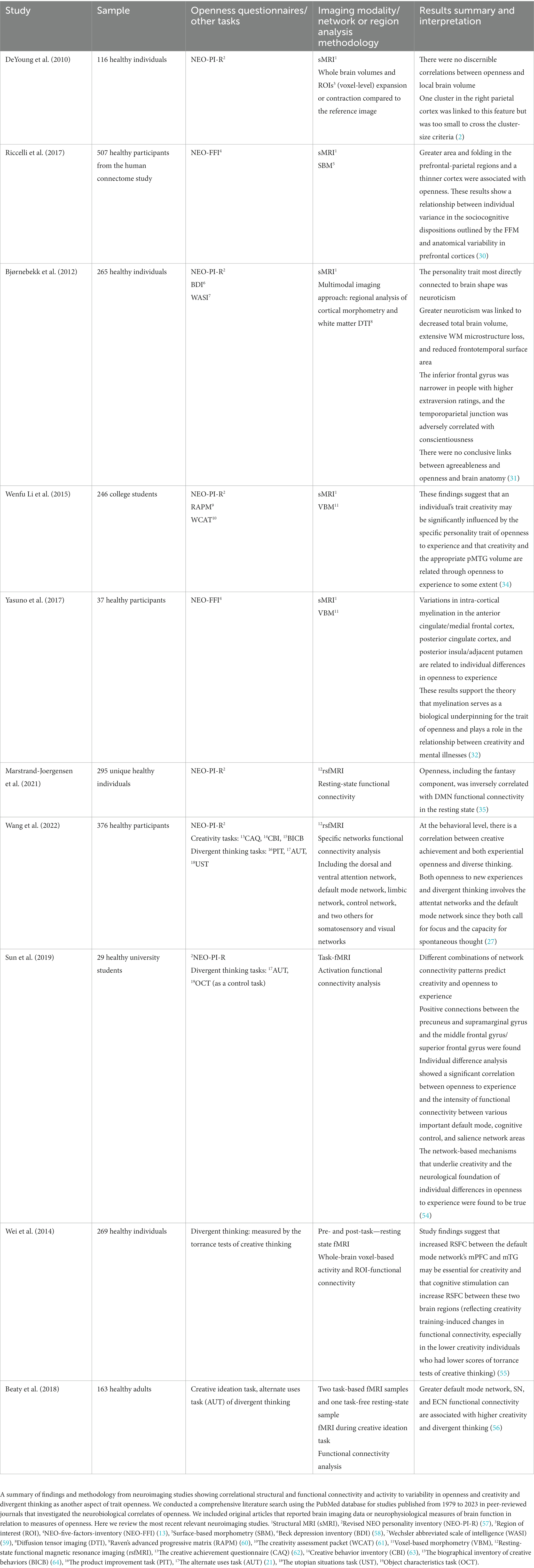
In their exploration, Raya, Ogunyemi, Broder, Carstensen, Illanes-Manrique, and Rankin shed light on individual differences in personality traits with underlying neurobiological foundations. This piece expands our comprehension of how traits such as openness contribute to the diversity of values and cognitive processes, shaping our unique interactions with the world.The reciprocal relationship between openness and creativity is a subject explored by Abu Raya, Ogunyemi, Rojas-Carstensen, Broder, Illanes-Manrique, and Rankin. From neurobiological perspectives to the influence of multicultural environments, the authors traverse the complex interplay between personality traits and neural processes. This research not only broadens our understanding of individual differences but also highlights the interconnectedness of neural processes with psychological traits, offering insights that extend beyond the laboratory into real-world scenarios.
Khalaila, Dasgupta, and Sturm explore the neural underpinnings of respect across different cultures. Using a neuroscientific lens, the authors provide valuable insights into the mechanisms through which respect is processed in the brain, offering a nuanced understanding of this complex socio-cultural phenomenon.Arshad, Zegarra-Valdivia, Prioleau, Valcour, and Miller explore the impact of respect, equity, and leadership in brain health. This research extends beyond individual cognitive processes, examining the societal and organizational factors that contribute to overall brain health.
Messimeris, Levy, and Le Bouc present an intriguing exploration of economic and social values by investigating the impact of lesions to the human ventromedial prefrontal cortex. By examining the neurological consequences of such lesions, the authors shed light on the neural substrates that govern our decision-making processes in social and economic contexts. This research not only informs our understanding of the brain's role in value-based choices but also holds implications for fields like economics, where the exploration of decision-making mechanisms is key.
The article by Avelino-Silva, Trujillo, and Udeh-Momoh delves into the intricate relationship between fairness and the brain. From the depths of our guts to the complexities of neural processes, the authors critically examine the neurological mechanisms that establish our sense of fairness. Their insights contribute to a deeper understanding of the cognitive processes involved in shaping our ethical values, with potential implications for fields ranging from psychology to ethics.
Dasgupta, Furlano, Bandler, and collaborators inject a note of optimism with "Hope for brain health: impacting the life course and society." By examining interventions across the life course, the research suggests that positive impacts on individuals can resonate on a societal level. This article challenges us to consider brain health as a collective responsibility, urging society to invest in strategies that promote cognitive well-being throughout the lifespan.The articles in "The Neurobiology of Values" research topic create a fascinating picture of how our brains and values are closely connected. Each article, like a unique thread, adds something special to our understanding, whether it's about the brain's role in fairness or how our brains shape our social behavior. This collection helps us see that our values aren't just abstract ideas; they're deeply woven into our brains, impacting how we think, decide, and act. It's an exciting journey through the neural pathways of human values, offering a complete view that goes beyond labs and clinics into the diverse landscapes of culture, society, and our everyday experiences.