
Multitasking: Executive Functioning in Dual-Task and Task Switching Situations

222kviews
Editorial15 February 2018
Editorial: Multitasking: Executive Functioning in Dual-Task and Task Switching Situations

Persons are often engaged in activities that combine multiple tasks (so called multitasking), even though this combination is typically accompanied by performance costs in the individual tasks in comparison to their performance as single tasks. Such performance costs suggest that performing multiple tasks brings the cognitive processing system to its limits. However, the observed limitations can inform theories of how cognitive processing is generally organized. In detail, investigations on the limitations of multitasking performance can reveal fundamental aspects of the cognitive processing architecture and mechanisms of human information processing.

These aspects have been investigated with a variety of experimental paradigms typically comprising two different component tasks that vary in the degree of temporal overlap. While it is difficult to define with precision what constitutes a ‘task’ (Kiesel et al., 2010; Monsell, 2003; Rogers & Monsell, 1995), one can define ‘task’ broadly, so that (i) simple stimulus-response (S-R) translations (e.g., press a response key when hearing a low tone in so-called choice reaction time [RT] tasks), (ii) continuous tasks like motor tracking, (iii) complex movements (e.g., type writing), or (iv) tasks without necessarily yielding overt behavior (e.g., counting) can constitute a task if a person aims to achieve a discriminable goal state. Irrespective of the specific type of task, multitasking research includes research on dual-task performance and task switching performance (Pashler, 2000). While dual-task performance requires concurrent and simultaneous task processing and motor responses, task switching focusses on multitasking with different sequentially processed component tasks.
23,655 views

57 citations

Cognitive flexibility, the ability to flexibly switch between tasks, is a core dimension of executive functions (EFs) allowing to control actions and to adapt flexibly to changing environments. It supports the management of multiple tasks, the development of novel, adaptive behavior and is associated with various life outcomes. Cognitive flexibility develops rapidly in preschool and continuously increases well into adolescence, mirroring the growth of neural networks involving the prefrontal cortex. Over the past decade, there has been increasing interest in interventions designed to improve cognitive flexibility in children in order to support the many developmental outcomes associated with cognitive flexibility. This article provides a brief review of the development and plasticity of cognitive flexibility across early and middle childhood (i.e., from preschool to elementary school age). Focusing on interventions designed to improve cognitive flexibility in typically developing children, we report evidence for significant training and transfer effects while acknowledging that current findings on transfer are heterogeneous. Finally, we introduce metacognitive training as a promising new approach to promote cognitive flexibility and to support transfer of training.

65,552 views

245 citations

ORIGINAL RESEARCH
31 July 2017
Walking-Related Dual-Task Interference in Early-to-Middle-Stage Huntington's Disease: An Auditory Event Related Potential Study
Marina de Tommaso, 3 more and Sara Invitto

4,184 views

13 citations

High-Frequency Binaural Beats Increase Cognitive Flexibility: Evidence from Dual-Task Crosstalk
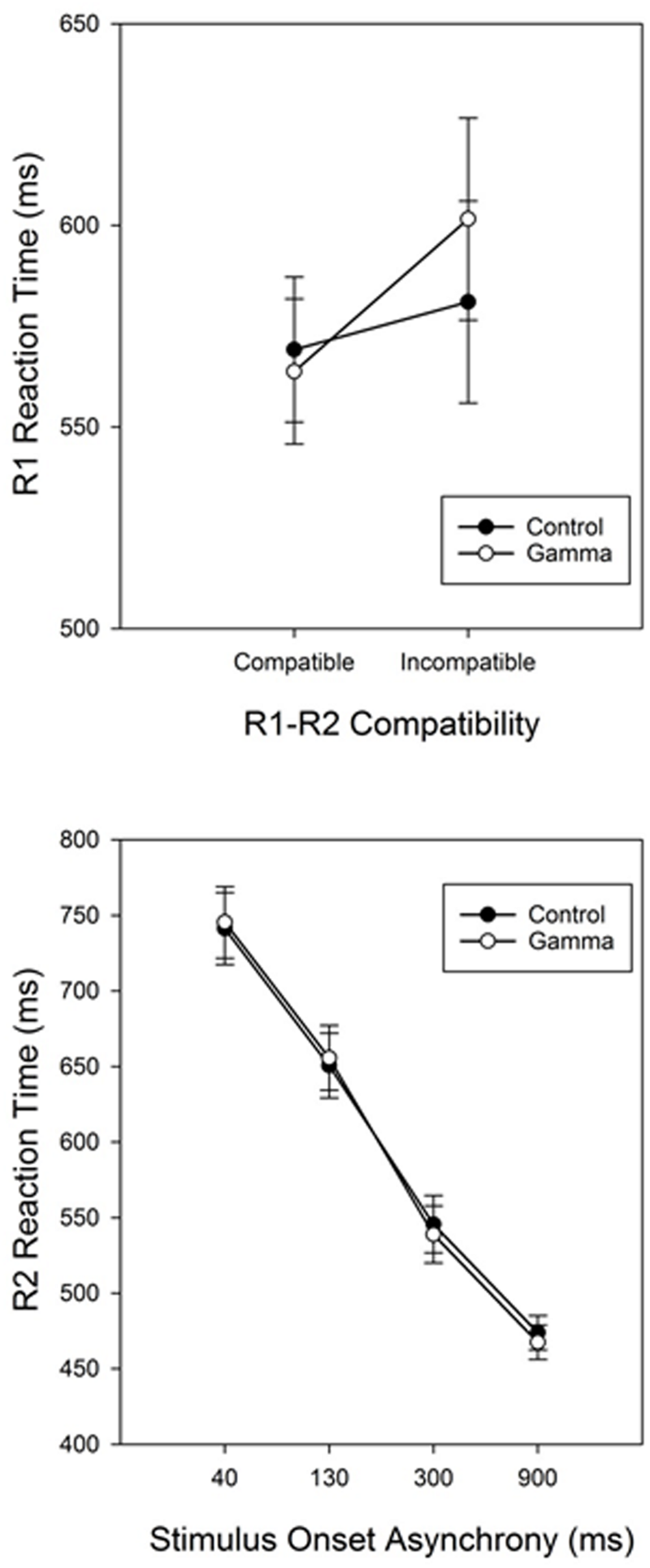
Increasing evidence suggests that cognitive-control processes can be configured to optimize either persistence of information processing (by amplifying competition between decision-making alternatives and top-down biasing of this competition) or flexibility (by dampening competition and biasing). We investigated whether high-frequency binaural beats, an auditory illusion suspected to act as a cognitive enhancer, have an impact on cognitive-control configuration. We hypothesized that binaural beats in the gamma range bias the cognitive-control style towards flexibility, which in turn should increase the crosstalk between tasks in a dual-task paradigm. We replicated earlier findings that the reaction time in the first-performed task is sensitive to the compatibility between the responses in the first and the second task—an indication of crosstalk. As predicted, exposing participants to binaural beats in the gamma range increased this effect as compared to a control condition in which participants were exposed to a continuous tone of 340 Hz. These findings provide converging evidence that the cognitive-control style can be systematically biased by inducing particular internal states; that high-frequency binaural beats bias the control style towards more flexibility; and that different styles are implemented by changing the strength of local competition and top-down bias.

39,896 views

52 citations