Current Concepts in Epidemiology, Diagnosis, Associated Co-Morbidities, and Therapeutics of Non-Melanoma Skin Cancers: Beyond Basal Cell and Squamous Cell Carcinomas

61kviews
CASE REPORT
8 January 2025
Angiomatoid fibrous histiocytoma with EWSR1-CREB1 gene fusion occurs in lungs and ribs with systemic multiple metastases: a case report and review of the literature
Dongmei Feng, 5 more and Chunmei Zhang

3,160 views

6 citations

ORIGINAL RESEARCH
11 October 2024
Advanced lung cancer inflammation index is associated with prognosis in skin cancer patients: a retrospective cohort study
Weifeng Lan, 6 more and Yuqing Wen

3,029 views

5 citations

An overview of cutaneous squamous cell carcinoma imaging diagnosis methods
Cutaneous squamous cell carcinoma, a type of non-melanoma skin cancer, is a form of keratinocyte carcinoma that stands as one of the most prevalent cancers, exhibiting a rising frequency. This review provides an overview of the latest literature on imaging methods for diagnosing squamous cell carcinoma (SCC) and actinic keratosis (AK). It discusses the diagnostic criteria, advantages, and disadvantages of various techniques such as dermatoscopy, skin ultrasound (US), in vivo and ex-vivo reflectance confocal microscopy (RCM), and line-field confocal optical coherence tomography (LC-OCT). These methods offer benefits including non-invasiveness, rapidity, comprehensive lesion imaging, and enhanced sensitivity, but face challenges like high costs and the need for specialized expertise. Despite obstacles, the use of these innovative techniques is expected to increase with ongoing technological advancements, improving diagnosis and treatment planning for keratinocyte carcinomas. Standardizing LC-OCT imaging algorithms for AK, Bowen's disease, and SCC remains an area for further research.

7,138 views

10 citations

CASE REPORT
17 July 2024
Case report: Variability in clinical manifestations within a family with incontinentia pigmenti
Tatiana Belysheva, 11 more and Darya Ponomareva

3,287 views

1 citations

Basal cell carcinoma—a clinical indicator of immunosuppression
ORIGINAL RESEARCH
14 March 2024
Basal cell carcinoma—a clinical indicator of immunosuppression
Lucian G. Scurtu, 4 more and Olga Simionescu

4,504 views

5 citations

CLINICAL TRIAL
1 March 2024
A randomized trial of a wearable UV dosimeter for skin cancer prevention
Emmanuel L. P. Dumont, 6 more and George I. Varghese
A randomized trial of a wearable UV dosimeter for skin cancer prevention
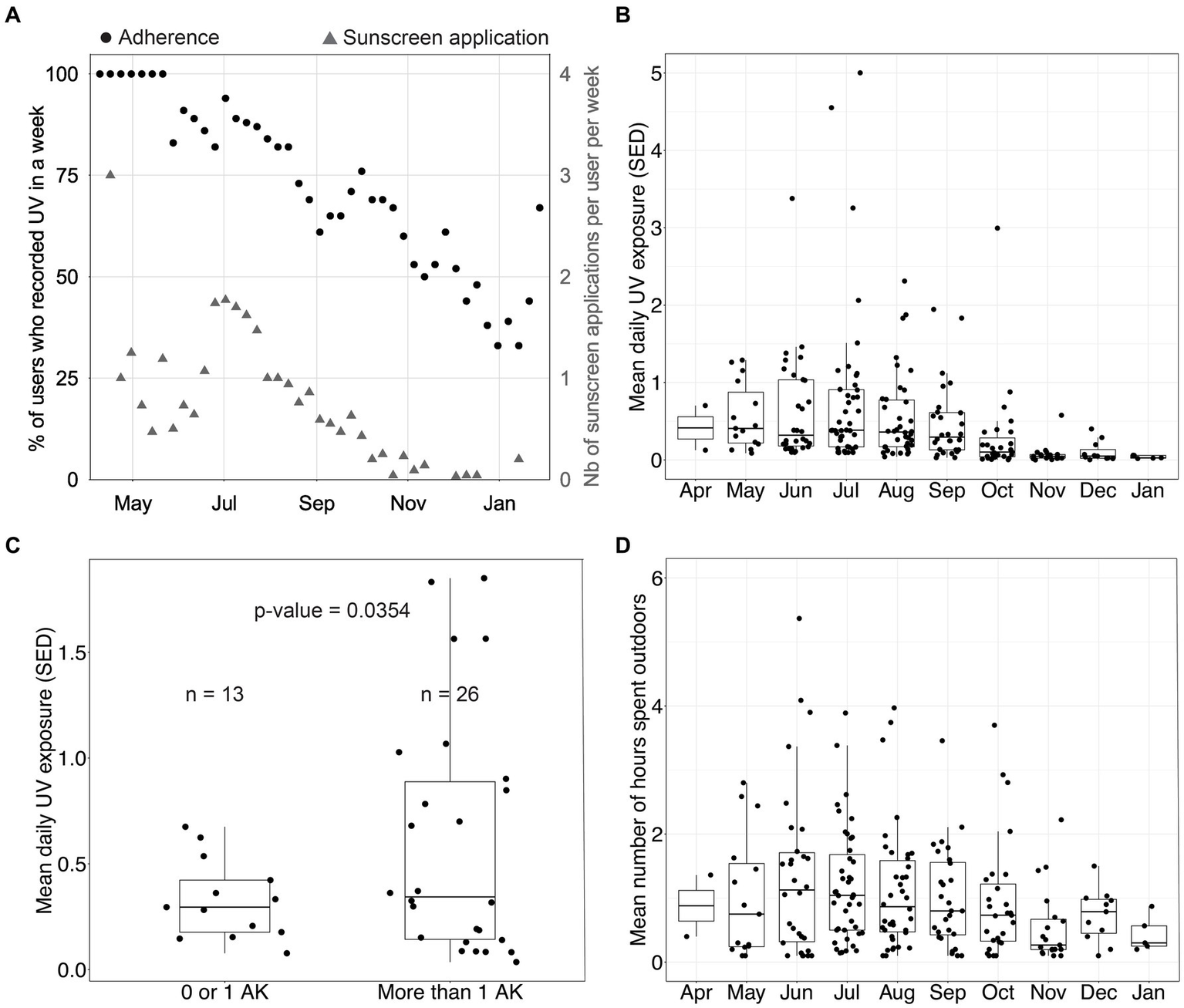
Non-melanoma skin cancer (NMSC) is the most prevalent cancer in the United States. Despite guidelines on ultraviolet (UV) avoidance, it remains difficult for people to assess their exposure, as UV is invisible and the onset of UV-induced symptoms is delayed.In a prospective randomized trial, 97 elderly patients with a history of actinic keratoses (AK) were followed over six months. Fifty patients received UV counseling from a dermatologist and a wearable UV dosimeter that provided real-time and cumulative UV exposure. Forty-seven patients received only UV counseling from a dermatologist.Over 75% of participants recorded UV exposure at least once a week during the summer. After 6 months of intervention, when comparing the device group to the control group, we observed a nonsignificant 20% lower ratio of incidence rates of AKs (95% CI = [-41%, 55%], p-value = 0.44) and a significant 95% lower ratio of incidence rates of NMSCs (95% CI = [33%, 99.6%], p-value = 0.024). Surveys demonstrated that the control group's score in self-perceived ability to participate in social activities significantly increased by 1.2 (p-value = 0.04), while in the device group, this score non-significantly decreased by 0.9 (p-value = 0.1). We did not observe changes, or between-group differences, in anxiety and depression surveys.This pilot clinical trial has a short duration and a small sample size. However, device adherence and quality of life questionnaires suggest a smartphone-connected wearable UV dosimeter is well accepted by an elderly population. This trial also indicates that a wearable UV dosimeter may be an effective behavioral change tool to reduce NMSC incidence in an elderly population with a prior history of AKs.The trial was registered on clinicaltrials.gov under the identification NCT03315286 on October 20, 2017.

5,572 views

9 citations

Clinical and histopathological characteristics, diagnosis and treatment, and comorbidities of Bowen’s disease: a retrospective study
ORIGINAL RESEARCH
15 November 2023
Clinical and histopathological characteristics, diagnosis and treatment, and comorbidities of Bowen’s disease: a retrospective study
Cheng Zhou, 9 more and Changbing Shen

6,854 views

9 citations

Introduction: Embolia cutis medicamentosa or Nicolau syndrome is a rare drug reaction associated with the administration of various injectable medications. The pathogenesis of the disease is unknown, though intra and periarterial injection of the drug is a possible cause. The aim of this study was to describe and analyze the clinical characteristics of Nicolau syndrome in patients examined in daily dermatological practice.We performed a retrospective chart review, between January 2011 and December 2020, in patients diagnosed with Nicolau syndrome, from the cases of a private dermatology medical office in Târgu Mureș, Romania.Results: During the 10-year period, 7 patients were diagnosed with Nicolau syndrome. Of these, 4 (57%) patients were males and 3 (43%) were females, The male to female ratio was 1.33. The median age was 64 (interquartile range, IQR, 62-71), with the youngest patient being diagnosed at age 61 and the oldest at age 74. Regarding the drugs classes that caused Nicolau syndrome, these were intravenous antibiotics in 57 %, and non-steroidal anti-inflammatory drugs in 43% of cases.Conclusions: All patients healed in a period of 6 to 8 weeks. No complications occurred. In conclusion, Nicolau syndrome is a rare side effect of injectable drug administration.

6,739 views

6 citations

Case report: Abrikossoff's tumor of the facial skin
CASE REPORT
31 May 2023
Case report: Abrikossoff's tumor of the facial skin
Valeriu Ardeleanu, 7 more and Alin Laurentiu Tatu
Abrikossoff tumors are also known as granular cell tumors (GCT), originating from Schwann cells. The most common location is in the oral cavity, followed by the skin, but they can also be found in the breast, digestive tract, tracheobronchial tree or central nervous system. They can affect both sexes at any age, with a higher incidence between 30-50 years and a slight predisposition for females. They are usually solitary tumors but may also be multifocal. Most of the time they are benign, the malignancy being exceptional in less than 2% of cases. Clinically, they appear as solid, well-defined, painless tumors, located subcutaneously with dimensions that can reach up to 10 cm. The definitive diagnosis is based on the immunohistochemical examination and the treatment for benign tumors consists of surgical excision. Chemotherapy or radiotherapy may be required for malignant lesions, but the treatment regimens and their benefits remain unclear. This paper presents the case of a 12-year-old girl with a benign GCT, located in the skin on the mandibular line.

3,266 views

6 citations

CASE REPORT
13 September 2023
Treatment of metastatic squamous cell carcinoma arising in sacrococcygeal pilonidal sinus: a case report series
Ainara Soria Rivas, 10 more and Juan Jose Serrano Domingo

3,933 views

4 citations