Conservation Agriculture for Sustainable Food Production Systems

Cover image for Research Topic "Conservation Agriculture for Sustainable Food Production Systems"
130kviews
An assessment of vegetable production constraints, trait preferences and willingness to adopt sustainable intensification options in Kenya and Uganda
Global food production systems are under pressure due to population increase, limited farmland, biotic and abiotic constrains, and ongoing climate change. Sustainable intensification is needed to increase agricultural productivity with minimal adverse environmental and social impacts. Vegetable-integrated push pull (VIPP) technology coupled with black soldier fly (BSF) frass offer such opportunities to smallholder farmers. However, farmers’ vegetable preferences and willingness to adopt these innovations remain unknown and are variable across various geographic scales. Focus group discussions (FGDs) and in-person interviews with smallholder farmers were conducted to assess vegetable production constraints and select vegetables to be integrated into VIPP coupled with BSF frass biofertilizer in Kenya and Uganda. Twenty-six FGDs followed by in-person interviews were conducted from July to November 2023 with 227 and 106 farmers from Kenya and Uganda, respectively. A total of 23 vegetable types were identified. The most considered discerning parameters and traits included household consumption, income generation, nutritional value, extended harvesting, drought tolerance and resistance to diseases and insect pests. The major constraints were the high cost of agrochemicals and fertilizers and poor seed quality in Kenya while diseases, pests, drought and poor rainfall, low soil fertility, too much rainfall and floods, high cost of agrochemicals and fertilizers, lack of seeds and poor seed quality were pressing constraints among farmers in Uganda. More than 83% of farmers showed readiness to adopt a combination of VIPP+BSF. Kales, spinach, cabbage, Amaranthus, African nightshade and tomatoes were preferred in central Kenya whereas cowpeas, kales, African nightshade, Amaranthus, pumpkin leaves and spider plants in western Kenya were preferred as vegetables to be included in VIPP and BSF frass innovations. Ugandan farmers considered eggplants, Amaranthus, garden eggs, cabbage, kales and tomatoes the most popular vegetables to be incorporated in VIPP and BSF frass innovations. Our results provide a baseline for vegetables to be integrated into VIPP with BSF frass biofertilizer for validation with farmers. The study also underlies how farmer crop preferences vary according to site and the need for participatory selection to increase the chances of adoption of agricultural interventions.

5,331 views

16 citations

ORIGINAL RESEARCH
22 April 2025
Impact of nine years of conservation tillage and precise nutrient management on equivalent yields, soil microbial dynamics, and water-energy footprints of the maize–mustard rotation
K. K. Lakhena, 16 more and Rajkumar Jat

3,811 views

7 citations

Digital technologies commercially available in Germany in the context of nature conservation and ecosystem service provisioning in agriculture
REVIEW
24 March 2025
Digital technologies commercially available in Germany in the context of nature conservation and ecosystem service provisioning in agriculture
Tsvetelina Krachunova, 2 more and Sonoko D. Bellingrath-Kimura

5,782 views

8 citations

ORIGINAL RESEARCH
5 February 2025
Physiological and productivity responses of Tahiti acid lime grafted onto dwarfing rootstocks under different planting and mulching practices
Ana Júlia Borim de Souza, 6 more and Fernando Alves de Azevedo

2,696 views

5 citations

ORIGINAL RESEARCH
11 November 2024
Rice residue management alternatives and nitrogen optimization: impact on wheat productivity, microbial dynamics, and enzymatic activities
Charul Chaudhary, 6 more and Ashok Yadav

3,487 views

6 citations

Residue retention and precision nitrogen management effects on soil physicochemical properties and productivity of maize-wheat-mungbean system in Indo-Gangetic Plains
ORIGINAL RESEARCH
2 September 2024
Residue retention and precision nitrogen management effects on soil physicochemical properties and productivity of maize-wheat-mungbean system in Indo-Gangetic Plains
Govindaraj Kamalam Dinesh, 21 more and D. M. Mahala

5,108 views

10 citations

The influence of soil types and agricultural management practices on soil chemical properties and microbial dynamics
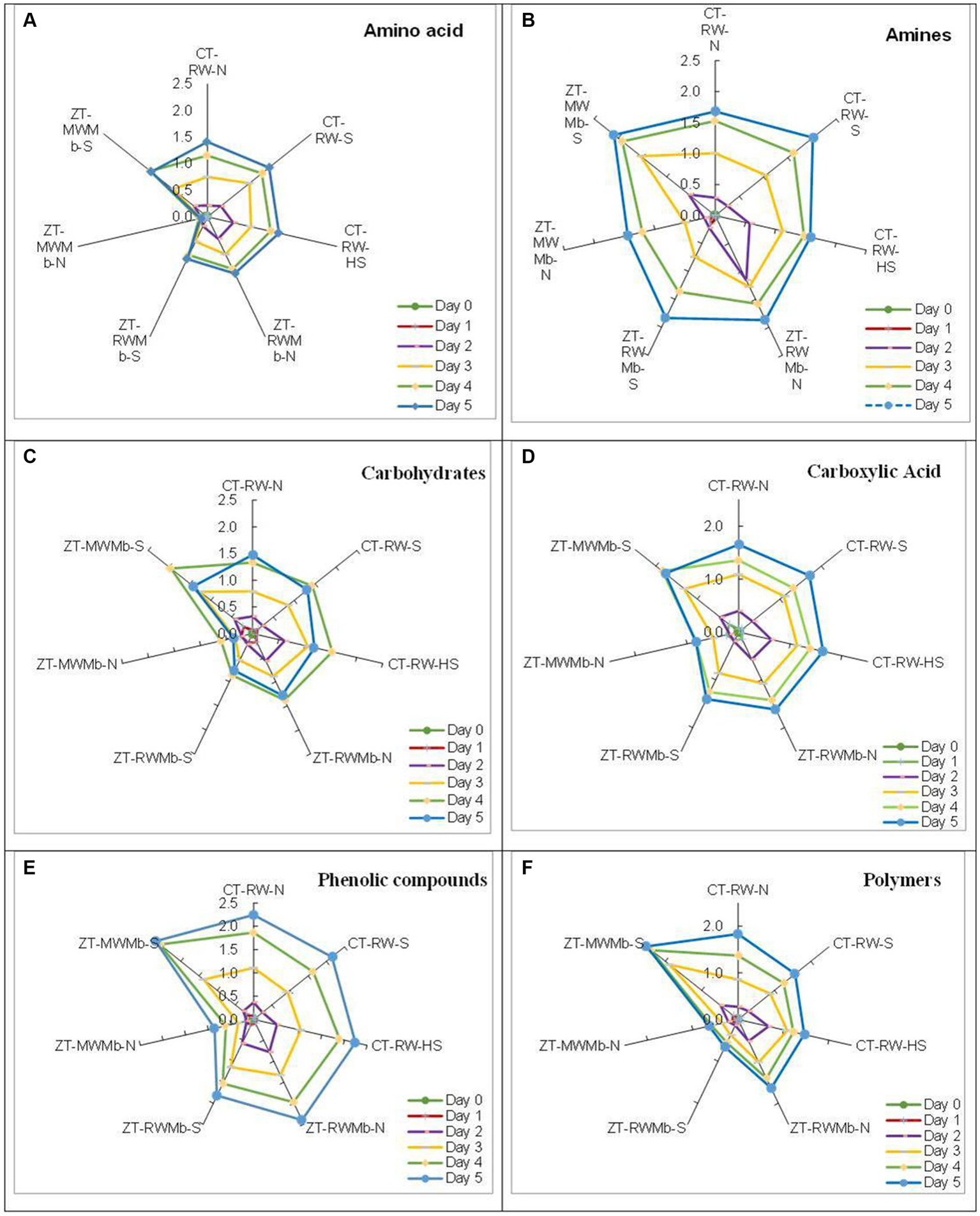
Soil provides essential nutrients for plant growth, but excess salts hinder development, making crops more vulnerable under climate change conditions. Soil microorganisms play a significant role in nutrient cycling. However, limited information is available on microbial behavior/community changes and functional diversity in different soil types (normal, sodic and highly sodic) and cropping systems [rice-wheat (RW); rice-wheat-mungbean (RWMb); maize-wheat-mungbean (MWMb)] and management practices in the north-western Indo-Gangetic plains of India. We investigated the influence of different soil types on physical and chemical properties at the surface level (0-15 cm) in relation to soil microbial population, activities, and functional diversity, focusing on community-level physiological profiling (CLPP) under different agriculture systems. Seven treatment combinations of soil types, cropping systems and management practices were evaluated. Soil pHs was found to be lower in zero-till (ZT) based sodic soil compared to conventional-till (CT) sodic soil. Soil organic carbon (SOC) (0.91 and 0.90%) content and available N (154.46 and 132.74 kg ha -1 ) were higher with ZT-based system under normal (N) soils (ZT-RWMb-N and ZT-MWMb-N) than in CT-based normal soil (0.67 and 121.04 kg ha -1 ). Similarly, higher SOC and N (0.85 and 76.11 kg ha -1 ) were found under ZT management in sodic soils (S) compared to CT management (0.73% and 121.05 kg ha -1 ). Substrate utilization (amino acids, amines, carbohydrates, carboxylic acids, phenolic compounds, and polymers) increased with the incubation period. During 0-120 h of incubation, the highest utilization of amino acids, amines, carboxylic acids, phenolic compounds, and polymers was observed for ZT-MWMb-S soils, while the lowest was recorded for ZT-MWMb-N soils.Under high salt conditions, soil enzymatic activities (dehydrogenase, acid phosphatase, alkaline phosphatase etc.) declined significantly compared to normal soils, affecting soil chemical and physical conditions. Microbial population and enzyme activities decreased with increasing salt stress across all cropping systems. These findings suggest that adopting efficient crop management practices can help mitigate the adverse effects of soil salinity on microbial diversity and soil health, thereby enhancing sustainable agricultural productivity in salt-affected regions.

6,076 views

15 citations

ORIGINAL RESEARCH
15 August 2024
Microbial mechanism of soil carbon emission reduction in maize-pea intercropping system with no tillage in arid land areas of northwestern China
Qi-ming Wang, 8 more and Xiao-hui Xu

2,822 views

6 citations

Optimizing planting geometries in eucalyptus-based food production systems for enhanced yield and carbon sequestration
ORIGINAL RESEARCH
7 June 2024
Optimizing planting geometries in eucalyptus-based food production systems for enhanced yield and carbon sequestration
The integration of trees into diverse land use systems holds potential for India to meet nationally determined contribution (NDC) targets under the Paris Climate Agreement. With a target of sequestering 2.5 to 3 billion tons of CO2 equivalent by 2030, the study focused on the widespread and economically viable eucalyptus-based agroforestry, practiced widely in various planting geometries tailored to meet industrial end-use requirements. In this context, a detailed study was conducted to quantify the influence of five planting geometries of eucalyptus on intercrops (Dhaincha - barley rotation) biomass, soil properties, and carbon stock of the system during 2009-2016. Results revealed that biomass accumulation of different tree components was 62.50–74.09% in stem; 6.59–9.14 % in branch; 3.18–5.73% in leaves; 12.20–20.44% and 1.71–3.48% in fine roots across the planting geometries. The mean carbon content of stem, branch, leaves and roots was 49.00, 47.00, 43.00 and 49.00 %, respectively. Over the 8–years period, geometry of 3×3 m performed better in terms of total biomass production (344.60 Mg ha− 1 by tree biomass and 62.53 Mg ha−1 by intercrops). The tree diameter at breast height and height (DBH2H) was found as a very good predictor of dry weight followed by DBH alone. Among various functions (linear, allometric, logistic, Gompertz, Chapman and exponential), the best-fit equation was allometric i.e. B=300.96*DBH2H0.93 (Adj R2- 0.96) for eucalyptus based on universal model adequacy and validation criteria. The carbon sequestration rate was maximum (20.79 Mg C ha–1 yr–1) in 3×3 m followed by 17×1×1 m. The total carbon stock of eucalypts–based system (tree+crop+soil) varied significantly under different planting geometries and sole crop rotation (dhaincha–barley). The higher carbon storage (237.27 Mg ha–1) obtained from 3×3 m spacing and further partitioning carbon stock in tree—166.29 Mg ha–1, crop—25.01 Mg ha–1 and soil—45.97 Mg ha–1. Tree-based systems were valuable components of agriculture, advocating for their widespread adoption to reduce CO2 emissions and generate income through carbon credits. These findings will provide crucial insights of sustainable land use practices and advance India’s commitment towards adaptation of climate change mitigation strategies.

5,991 views

19 citations

ORIGINAL RESEARCH
8 April 2024
Typology analysis and adaptive capacity of commercial gardening farmers to climate change in peri-urban areas along the coastal area of Benin (West Africa)
Bidossessi Syntiche Chiméi Mérimée Ahouangan, 5 more and Marcel Romuald Benjamin Houinato

4,979 views

9 citations

ORIGINAL RESEARCH
13 May 2024
Short-term residual effects of occasional tillage on crop performance, soil water, and water-use efficiency in a 10-year no-till system under a dry Mediterranean climate
Massamba Diop, 8 more and Khalil El Mejahed

3,584 views

7 citations

ORIGINAL RESEARCH
20 February 2024
Soil properties and quinoa yield as affected by irrigation and vermicompost application under a drip-tape irrigation system
Diba Sheykhi Sanandaji, 3 more and Zahed Sharifi

3,323 views

4 citations

ORIGINAL RESEARCH
14 February 2024
Natural Farming represents an agro-ecological methodology for farming that emphasizes regenerative practices with an aim to promote holistic ecological balance and reduce the dependence on external inputs as well as financial resources. Substantial concern has recently arisen over the need to promote agroecosystems that are more sustainable in order to improve the deteriorating soil health as well as reversing the yield plateau of crop. So, the current on farm field experiment was executed comprising of 8 treatments with different combination of natural farming inputs (Ghanjeevamrit, Jeevamrit, Beejamrit), organic fertilizer (such as FYM), integrated nutrient management (NPK, FYM, Azotobacter and Azolla) and in-organic(NPK) to examine and compare the consequence of natural farming inputs, organic fertilizer and in-organic dosage of fertilizer on soil nitrogen uptake, soil physicochemical properties, soil biological properties, soil microbial population and crop yields in a rice-wheat cropping system over two crop seasons 2021-23 [rice (Pusa-1509) and wheat ]. The study results demonstrated that there was significant (p<0.05) increase in the soil's nitrogen availability and nitrogen uptake with the use of natural farming inputs as compared to control treatment, whereas, natural farming treatments (TNF1, TNF2, TNF3, TMNF) were inferior than integrated nutrient management (TINM) and recommended doses of fertilizer (TRDF) treatment in case of nitrogen uptake by both rice and wheat crop.The outcomes demonstrated that there was significant (p<0.05) increase in the soil's nitrogen availability and nitrogen uptake with the use of natural farming inputs. Whereas non-significant changes were observed in case soil pH and electrical conductivity. The soil enzymatic activity (Dehydrogenase, β-
Empirical observation of natural farming inputs on nitrogen uptake, soil health, and crop yield of rice-wheat cropping system in the organically managed Inceptisol of Trans Gangetic plain

6,732 views

30 citations

Sequestration of carbon in arable cropping systems is considered as one of the potential climate change mitigation strategies. In this context assessing the potential of sugarcane cropping systems should be a priority, as it leaves substantial amounts of recyclable residues essential for maintaining soil organic carbon (SOC), improving soil health and overall resource enhancement. We evaluated impacts of residue retention and nutrient management practices on the SOC, its pools, storage, soil biology, and yield in a multi-ratooning sugarcane system. A field experiment was conducted in split plot design with residue burning (RB) and residue retention (RR) as main plot treatments and three nutrient management practices i.e. 25% of recommended dose of fertilizers (RDF i.e. 300: 150: 150 kg N, P2O5 and K2O kg ha-1 ) as basal + 75% through fertigation (N1); 50% of RDF as basal + 50% through fertigation (N2) and 75% of RDF as basal + 25% through fertigation (N3) as sub plot treatments in ratoon sugarcane. Soil samples were collected initially and after six years of multi-ratooning (one plant and four ratoon crops) from 0-30 cm soil layer. Results indicated that plots with RR had 21% higher total SOC with 42, 47, 17 and 13% higher very labile, labile, less labile and non-labile C pools, respectively than RB plots (P < 0.05). RR also had higher lability and recalcitrant index than RB. Of the total SOC stock, contribution of passive pools were higher (72-75%) than active pools. Significantly higher dehydrogenase activity (DHA) (86%), alkaline phosphatase activity (APA) (16%) and ß-glucosidase activity (BGA) (22%) were observed in RR as compared to RB plots; whereas for nutrient management practices, it followed the order: N2>N3>N1, respectively. Microbial counts also followed the same trend as that of enzyme activities. Residue retention practices reported higher C sequestration (0.68 Mg C ha-1 yr-1 ), carbon retention efficiency (37%) and yield (38%) with a potential to reduce GHG emission by 2.72 Mg CO2 ha-1 yr-1 as compared to traditional practice. Residue retention and 50-75% RDF as basal is recommended for higher soil C retention and soil biology for sustained sugarcane productivity.

4,715 views

31 citations

ORIGINAL RESEARCH
8 January 2024
Realizing the value of grassland ecosystem services: global practice and its inspiration for the karst desertification control area
Yongyao Li, 2 more and Wenfang Zhang

3,240 views

8 citations

Effects of agricultural subsidies on farm household decisions: a separable household model approach
ORIGINAL RESEARCH
5 December 2023
Effects of agricultural subsidies on farm household decisions: a separable household model approach
Priyanka Lal, 7 more and Ravinder Kumar

8,119 views

3 citations