
Biological invasions are one of the most significant causes of biodiversity loss and a key component of global change (IPBES, 2019). Although non-native species (NNS) are often used for commercial purposes, they can have several negative impacts, which may depend on the geographical and socio-economic context (Robinson et al., 2005; Gallardo et al., 2016; Carranza et al., 2023). The assessment and management of biological invasions in marine environments is more challenging than in terrestrial ones, since it is difficult to detect NNS early enough for successful eradication. Prevention at the pathway level is considered the best approach to reduce NNS introduction rates (Hewitt & Campbell, 2007), including early detection, border surveillance and rapid response actions (Carvalho et al., 2023; Sankaran et al., 2023). Most efforts are currently focused on monitoring high-risk areas for NNS, such as ports or aquaculture facilities, with additional focus on the management of introduction vectors (Ojaveer et al., 2014). In recent years, an important global milestone for the management of NNS was achieved through the Ballast Water Management Convention (IMO, 2004), aiming to control the introduction of NNS via ballast waters of large commercial vessels. However, other vectors are still not regulated in most countries. Of considerable concern is biofouling, which is currently the most high-risk non-regulated global vector. Despite some countries being strongly active in the monitoring and management of NNS (e.g., Australia and New Zealand), the majority do not have an action plan, baseline data on marine biodiversity, or an assessment of the main pathways and vectors. In the current research topic, a study on fouling communities conducted by Sempere-Valverde et al. provides a crucial baseline for future monitoring for NNS in the Red Sea, Saudi Arabia, a region that is expecting extensive coastal urbanization. Moreover, understanding how the risk of introduction in areas prone to invasion, such as ports and marinas, changes with other variables is key to enhancing prevention plans. The study conducted by Bonfim et al. explores relationships among abiotic variables, biotic resistance and propagule pressure, and associated changes to introduction risk. Coastal artificial structures are proliferating worldwide and are associated with the establishment of NNS. This phenomenon is expected to increase in the coming decades, preempting the need for new management strategies, including the creation of less-suitable substrates for NNS. A complementary strategy to managing NNS introduction vectors is the enhancement of biodiversity in anthropogenic sites through eco-engineering interventions. This is a relatively new approach (Dafforn et al., 2017; Bishop et al., 2022) based on stimulating communities rich in native species in areas susceptible to bioinvasions, to promote resistance to NNS settlement (i.e., biotic resistance hypothesis; Elton, 1958). An experiment to test the performance of different materials was conducted by Matikinca & Zondi in a South African port, observing how fibreglass supported a higher species richness compared to other commonly used materials in ports. While a significant effect of substrate type on native and non-native species was not detected, the study emphasises the need for region-specific assessments, particularly in understudied areas. It also highlights the importance of similar studies that examine other substrate factors and consider long-term assessments. Moreover, the sprawl of coastal artificial structures is altering the distribution of species and the structure of marine communities, facilitating the introduction of NNS (Firth et al., 2016). Stressful conditions in urban areas are not usually detrimental to NNS, which may be due to a lower presence of native competitors or selection of more resistant life strategies (Piola & Johnston, 2008; Gauff et al., 2022). This phenomenon was also observed by Gauff et al. through an Italian case study on the non-native bivalve Xenostrobus securis (Lamarck, 1819). A significant challenge in the management of marine biological invasions is the lack of investment in building future taxonomic expertise, despite its crucial importance in biodiversity assessments (Costello, 2020). Taxonomic misidentification can lead to erroneous evaluation of NNS distribution and bioinvasion patterns (Golo et al., 2023). Taxonomic studies should be prioritised for correct species identification, but the loss of this expertise, together with the difficulties in discriminating cryptic species, is generating interest and development of integrative approaches, such as molecular analyses and, more recently, the use of AI-based solutions (Cahill et al., 2018; Azevedo et al., 2020; Ditria et al., 2022; Katsanevakis et al., 2024). In this context, the opinion paper of Zhou et al. highlighted the importance of developing AI-based solutions for automated image classification of marine species, to help scientists and citizens in identifying species and the early detection of NNS. However, most of the projects or applications already available to assist users with marine species identification can be found for larger, more charismatic taxa, such as fishes, echinoderms or corals (see references in Zhou et al.), while smaller and less attractive species are largely unknown, unreported and easily misidentified. Once species are correctly identified, it is important to increase the ecological and biological knowledge of such species in the invaded regions, since their biological traits or impacts are likely poorly known outside of their native range (Anton et al., 2019; Cardeccia et al., 2018; Karachle et al., 2022). In this sense, three contributions in this topic focused on compiling, reviewing, recording and assessing NNS distribution, considering different abiotic factors. Bisset et al. reviewed the effects of Carcinus maenas (Linnaeus, 1758), a well-known worldwide crab invader, on coastal ecosystem engineers. Similarly, Evangelopoulos et al. present an overview of the distribution and impacts on fisheries of NNS in the North Aegean Sea. Finally, Machado et al. registered for the first time the bivalve Theora lubrica A. Gould, 1861 in the South-western Atlantic, providing new insights on its morphology and ecological aspects. Species introduction is included as a key target in the achievement of global objectives for biodiversity conservation [i.e. the reduction rates of introduction and establishment of NNS by at least 50 percent by 2030 (Target 6; UN/CBD, 2022)], thus stimulating the implementation of management actions and the development of new tools to effectively mitigate NNS impacts and limit new introductions. This research topic embraces different aspects of marine bioinvasions by addressing knowledge gaps on specific regions, novel tools, or concepts to be further assessed, acting as a platform to further address marine bioinvasion research gaps and challenges.
Editorial16 September 2025
Editorial: Bridging knowledge gaps in marine biological invasions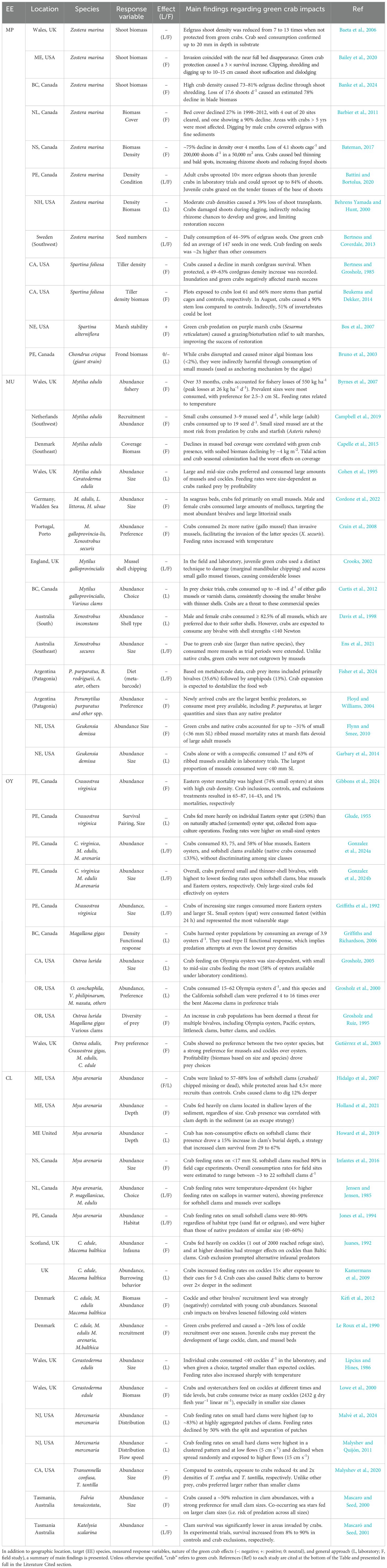
MINI REVIEW
3 June 2025
William G. Bissett, 1 more and Pedro A. Quijón
3 Authors
- WG
William G. Bissett
Coastal Ecology Laboratory, Department of Biology, University of Prince Edward Island, Canada
- PA
Patricia A. Ramey-Balci
Department of Biological Sciences, University of Manitoba, Canada
- PA
Pedro A. Quijón
Coastal Ecology Laboratory, Department of Biology, University of Prince Edward Island, Canada
By creating habitats or influencing the immediate physical environment, ecosystem engineers shape the diversity, function and services provided by ecosystems. Thus, the disruption of these species is relevant given their broad influence on native communities and ecosystems. As such, we review the effects (positive, negative, or neutral) of a widespread invasive species, the European green crab (Carcinus maenas) on key coastal ecosystem engineers. We examined the literature and focused on 53 published studies to assess reported impacts on well-known macrophytes, mussels, oysters and clams. Despite the wide range of response variables measured and reported, green crab effects were overwhelmingly negative. These effects were mediated by direct (through consumption and sediment burrowing) or indirect mechanisms (through seed consumption, alteration of habitat quality or effects on related species), and were often context dependent. These conclusions are limited by ongoing green crab expansions where possible impacts have not been yet documented, and by cases of neutral or minor impacts that remain unpublished. Green crab effects often result in disruption rather than the loss of local ecosystem engineers, but they clearly add to the ongoing effects of other global stressors.

IntroductionMaritime traffic and coastal urbanisation significantly contribute to the introduction and proliferation of non-indigenous species (NIS). However, the lack of information might prevent effective monitoring in data-limited regions, particularly in areas experiencing demographic growth, where monitoring biofouling communities could offer crucial insights into the dynamics of NIS invasions. This study represents a baseline characterization of the biofouling communities in the northern Saudi Arabian Red Sea (NEOM region) prior to extensive urban, industrial, and commercial development.MethodsSamples were collected in November 2023 and February 2024 from seven sites within the region. At each site and time, three settlement structures, each with a PVC panel attached to a brick and rope, were sampled after 3-months deployment. Panels were analysed with photo quadrat analysis (PhQd), examined to manually collect sessile macroinvertebrate specimens for taxonomic identification using morphological and DNA barcoding analysis, and scraped for bulk DNA analyses using DNA metabarcoding. Five water samples were also collected for environmental DNA (eDNA) analysis. The environmental characteristics of each site were obtained by deploying temperature data loggers and through an environmental risk assessment.ResultsCommunity patterns observed from the PhQd and bulk DNA datasets revealed a clear separation of two sites within Sharma lagoon from the remaining sites. The eDNA analysis of seawater confirmed these spatial differences, also detecting a variation between sampling times that was not observed with the other approaches. A total of 20 NIS and 18 cryptogenic species were recorded, from which 12 were identified morphologically and the remaining detected with molecular methods only. The generally low NIS coverage confirms that the NEOM region is less affected by marine biological invasions compared to other anthropized habitats within the Red Sea. However, sites in the Sharma lagoon showed high human pressure levels and comparatively higher coverage of cryptogenic bryozoans on panels.DiscussionThis study provides the first detailed assessment of biofouling communities in NEOM, establishing a baseline and contributing to a regional species reference library for non-indigenous and cryptogenic species. As coastal development spreads, it presents both challenges and opportunities, highlighting the need for sustainable, ecosystem-based approaches to protect valuable natural areas. This baseline is essential for future monitoring of biofouling dynamics as the region develops.
