Stress, Immunity, and Inflammation in Metabolic Disorders

35kviews
Leptin, CRP, and adiponectin correlate with body fat percentage in adolescents: systematic review and meta-analysis
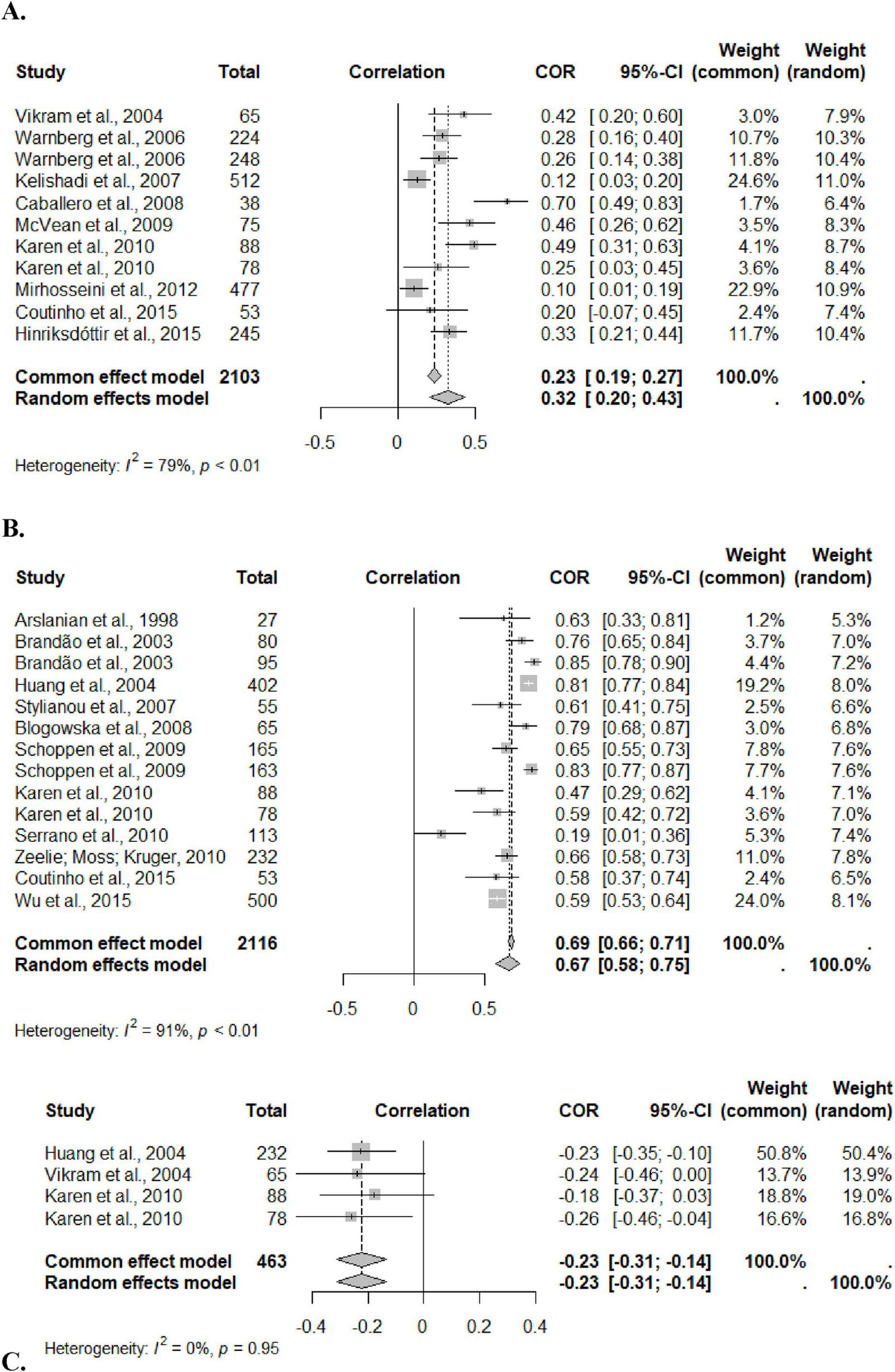
IntroductionAdipose tissue is important in the secretion of inflammatory substances, and may be directly or indirectly associated to the development of cardiovascular and metabolic diseases in adolescence.ObjectiveTo evaluate whether inflammatory markers are associated to body fat percentage in adolescents.MethodologySystematic review conducted following the items of the PRISMA, and registered in PROSPERO. The descriptors adolescent, body fat distribution and cytokines were combined together in the electronic databases: Scopus, PubMed, Embase, Cochrane, Scholar Google and ProQuest, independently by two researchers, in January 2022 and atualized in November 2024. Meta-analysis of the correlation of inflammatory markers with body fat percentage was conducted using the metabin function of the meta package of the RStudio software (4.0.4).ResultsResulted in 7,592 records, of which 31 articles met the inclusion criteria and were selected for this study. Cross-sectional and prospective cohort observational studies were included. The meta-analysis included 4,682 adolescents, aged 10 to 19 years, of both sexes. The inflammatory markers leptin and C-reactive protein were positively correlated (r = 0.67; r = 0.32) and adiponectin was negatively correlated (r = −0.23) with body fat percentage in adolescents of both sexes.ConclusionIn adolescents, the body fat percentage is related to the inflammatory markers leptin, C-reactive protein and adiponectin. It is important to evaluate the body fat composition of adolescents in clinical practice to identify those with a higher percentage of fat, that may reflect an inflammatory profile, as well as increased cardiometabolic risk that accompanies adolescents into adulthood.Systematic review registrationhttps://www.crd.york.ac.uk/PROSPERO/view/CRD42020208305, identifier PROSPERO: CRD42020208305.

4,206 views

14 citations

ORIGINAL RESEARCH
12 September 2025
A unique polygenic mouse model of obesity exhibits a distinct immunological profile that may offer protection against systemic inflammation, diabetes, and behavioral impairments
Ulrike Gimsa, 3 more and Alexander Rebl

4,103 views

Fecal microbiota transplantation improves hepatic steatosis induced by HFD in a mouse model associated with liver ILC1 regulation and indole-3-carbinol level
ORIGINAL RESEARCH
19 February 2025
Fecal microbiota transplantation improves hepatic steatosis induced by HFD in a mouse model associated with liver ILC1 regulation and indole-3-carbinol level
Peng-fei Hou, 5 more and Man-tian Mi
BackgroundThe prevalence of metabolic dysfunction-associated steatotic liver disease (MASLD) has increased worldwide. In recent years, fecal microbiota transplantation (FMT) has become an important promising method for the treatment of MASLD. However, the mechanism remains unclear.MethodsThe animal model with C57BL/6 male mice induced by high-fat diet (HFD) for 12 weeks has been introduced. Fecal microbiota and indole-3-carbinol (I3C) was given by oral gavage.ResultsOur study demonstrated that a 6-week healthy gut microbiota transplantation tended to ameliorate hepatic steatosis and reverse the decreased liver ILC1 induced by HFD. Interestingly, there was also a negative correlation between liver ILC1 and liver TG, TC level. Furthermore, the protective effect was associated with the elevated levels of serum indole-3-carbinol (I3C). Also, a I3C administration for 6 weeks improved liver steatosis and increased the frequency of liver ILC1 induced by HFD through aryl hydrocarbon receptor (AhR) activation. Moreover, I3C binds to the residues of ALA349, PHE348, LEU309, TYR316, PHE318 on AhR through hydrogen bonds, Π bonds, hydrophobic bonds which was proved by molecular docking.ConclusionTo conclude, our data demonstrated that FMT improved liver steatosis induced by HFD associated with liver ILC1 regulation and indole-3-carbinol level. The study highlighted the potential treatment value of FMT and microbiota-derived I3C in the MASLD treatment and regulation of liver ILC1 function.

3,393 views

12 citations

Transcriptomics and microbiome insights reveal the protective mechanism of mulberry-derived postbiotics against inflammation in LPS-induced mice
ORIGINAL RESEARCH
18 February 2025
Transcriptomics and microbiome insights reveal the protective mechanism of mulberry-derived postbiotics against inflammation in LPS-induced mice
BackgroundNatural food-derived bioactive compounds have garnered increasing attention for their potential to modulate immune responses and promote gut health. In particular, compounds like mulberry-derived postbiotics (MDP) may offer novel therapeutic strategies to address inflammation, a key driver of many metabolic disorders.MethodologyThis study examines the protective effects of MDP against inflammation in LPS-induced mice, using transcriptomic and microbiome analyses to explore underlying mechanisms.ResultsMDP pretreatment alleviates LPSinduced villous atrophy and intestinal barrier damage, promoting recovery of intestinal morphology. Transcriptomic profiling revealed significant changes in gene expression, with 983 upregulated and 1220 downregulated genes in the NC vs LPS comparison, and 380 upregulated and 204 downregulated genes in the LPS vs LPS+MDP comparison. Enrichment analysis using GO and KEGG pathways revealed significant associations with transcriptional regulatory activity, and the NOD-like receptor signaling pathway among the differentially expressed genes. Protein-protein interaction analysis identified key genes involved in inflammation and immune regulation, with hub genes like IL6, CXCL10, and MYD88 in the LPS group and CD74, CIITA, and H2-AB1 in the MDP-treated group.ConclusionMicrobiome analysis suggested MDP may also influence gut microbiota composition, supporting systemic immune regulation. These findings highlight MDP’s potential as a food additive for immune modulation and gut health.

4,033 views

4 citations

ORIGINAL RESEARCH
4 February 2025
Siglec-E augments adipose tissue inflammation by modulating TRAF3 signaling and monocytic myeloid-derived suppressor cells during obesity

4,434 views

3 citations