Wave Propagation in Complex Environments, volume II

45kviews
ORIGINAL RESEARCH
5 June 2025
Accurate earthquake and mining tremor identification via a CEEMDAN-LSTM framework
Chao Wang, 4 more and Zhaoyang Yan
Accurate earthquake and mining tremor identification via a CEEMDAN-LSTM framework
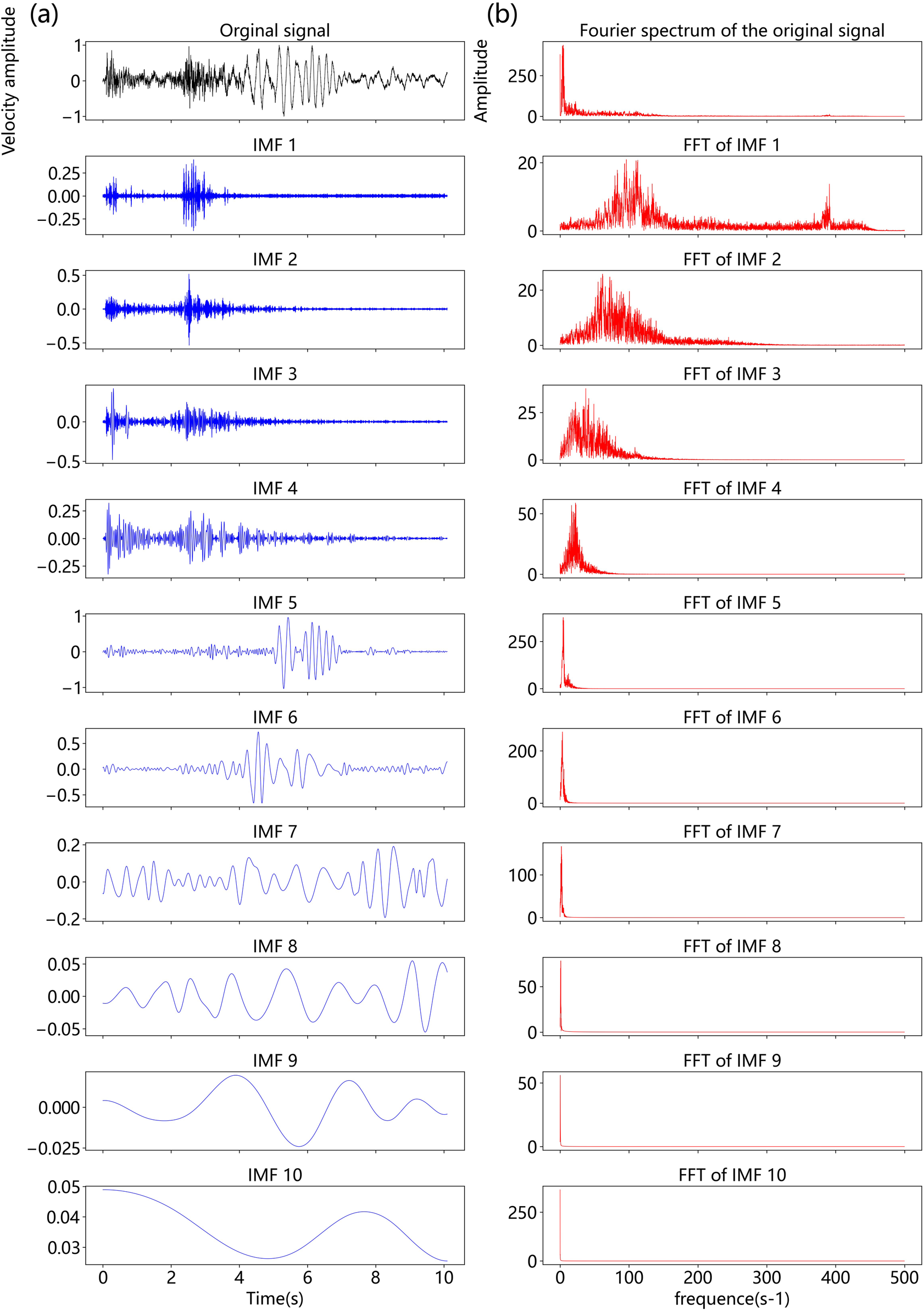
The accurate identification of mining tremors and earthquakes is important for establishing a comprehensive mining tremor catalog that can aid in providing regulatory oversight for mining activities. Moreover, using a catalog purely consisting of earthquakes allows for more advanced seismological studies, such as active fault delineation, strong earthquake prediction, and stress field calculations, to be conducted. We focus on the spectral characteristics of mining tremors and earthquakes. By identifying short-period surface waves in the given data and utilizing an improved complete ensemble empirical mode decomposition method with adaptive noise (CEEMDAN) in combination with long short-term memory (LSTM) networks, we conduct a discriminative analysis of seismic events in Liaoning, China, and Japan. After completing basic preprocessing steps for both mining tremors and earthquakes, CEEMDAN is used to decompose the data into different intrinsic mode functions (IMFs). The variance contribution rates of the IMFs are extracted as features, which distinctly identify the short-period surface wave components of mining tremors. These features are subsequently input into an LSTM model for classification training, resulting in an accurate classification model. The results demonstrate that CEEMDAN-LSTM effectively addresses the noise and short-period surface wave aliasing issues encountered within the modes, yielding significantly enhanced classification accuracy. The classification success rate has been significantly improved to 96.5%. Additionally, this study explores the advantages and limitations of various classification features and models, providing effective technical support and new perspectives for the automatic identification of seismic events in the future. This research provides not only an understanding of the characteristics of mining tremors and earthquakes but also a scientific basis for earthquake early warning and disaster prevention. This study suggests that future research can further optimize the model in terms of speed and apply the model to classify more nonnatural seismic events.

2,656 views

5 citations

IntroductionElastic wave propagation in fluid-saturated porous media is of great significance in various fields. Based on the soil mechanics model of a two-phase medium, the reflection problem of an obliquely incident plane P1-wave at the free surface is systematically explored, which aims to reveal the physical mechanism of wave propagation in saturated semi-infinite space.MethodsThe dispersion characteristic equations of body waves are obtained by using the Helmholtz decomposition method. The theoretical formulas of reflection coefficients and surface displacements are derived and verified for correctness by simplifying. Finally, numerical investigations are carried out on the variations of the displacement reflection coefficients and surface displacements with the incident angle for different boundary conditions, wave frequencies f, porosities n, Poisson’s ratios ν, and modulus ratios Ew/μ.ResultsIt is shown that the surface response of half-space is somewhat affected by the boundary conditions while little influenced by the wave frequency. It is also found that the effects of material properties on the surface response cannot be ignored.DiscussionThese conclusions provide a theoretical basis for wave survey technology of seismic engineering and site seismic response analysis.

2,371 views

3 citations

Acoustic interaction of submerged thin-shell structures considering seabed reflection effects
ORIGINAL RESEARCH
29 January 2025
Acoustic interaction of submerged thin-shell structures considering seabed reflection effects
Xin Zhang, 3 more and Guang Lei
This paper presents a novel approach for simulating acoustic-shell interaction, specifically focusing on seabed reflection effects. The interaction between acoustic waves and shell vibration is crucial in various engineering applications, particularly in underwater acoustics and ocean engineering. The study employs the finite element method (FEM) with Kirchhoff-Love shell elements to numerically analyze thin-shell vibrations. The boundary element method (BEM) is applied to simulate exterior acoustic fields and seabed reflections, using half-space fundamental solutions. The FEM and BEM are coupled to model the interaction between acoustic waves and shell vibration. Furthermore, the FEM-BEM approach is implemented within an isogeometric analysis (IGA) framework, where the basis functions used for geometric modeling also discretize the physical fields. This ensures geometric exactness, eliminates meshing, and enables the use of Kirchhoff-Love shell theory with high-order continuous fields. The coupled FEM-BEM system is accelerated using the fast multipole method (FMM), which reduces computational time and memory storage. Numerical examples demonstrate the effectiveness and efficiency of the proposed algorithm in simulating acoustic-shell interaction with seabed reflection.

2,371 views

2 citations

Study on the performance of pervious concrete under freeze–thaw cycle based on PFC3D
ORIGINAL RESEARCH
10 January 2025
Study on the performance of pervious concrete under freeze–thaw cycle based on PFC3D
Qidan Xiao, 2 more and Jun Zhao
Pervious concrete exhibits different freeze–thaw performance compared to conventional concrete owing to its unique porous structure. Therefore, studying its mechanical and durability properties under freeze–thaw conditions has become a pressing issue. A numerical model of pervious concrete was created using the discrete element method based on actual aggregates to evaluate the impact of freeze–thaw cycles (FTCs) on the mechanical properties of pervious concrete. Pore water in the microstructure of pervious concrete was defined using PFC3D software through simulation of the freezing and expansion processes of the pore water, while applying freeze–thaw loading. This study employs the parallel bond model in PFC3D software to account for adhesion between the material particles. The linear ontological relationship of the parallel bond model was modified to a linear curvilinear relationship. The FTCs resulted in strength loss reductions of 0.62%, 2.17%, 4.06%, and 5.87% for corresponding mass losses of 0.66%, 0.89%, 1.21%, and 6.66% compared to the control. The models were monitored for fracture location and uniaxial compressive damage using PFC3D software, and the attenuation constant of the freeze–thaw resistance of pervious concrete was examined with respect to varying porosity and initial uniaxial compressive strength (UCS). The results indicate that the decay constant increases with increasing porosity and modulus of elasticity while decreasing with increasing values of the initial UCS.

2,951 views

7 citations

Design and thermal performance analysis of self-insulation concrete compound blocks
ORIGINAL RESEARCH
4 December 2024
Design and thermal performance analysis of self-insulation concrete compound blocks
Qidan Xiao, 2 more and Jun Zhao
More than 60% of energy losses occur through the building envelope. Exterior wall insulation technology is widely used for wall insulation, but it is prone to cracking, falling off, and causing fires. Self-insulation concrete compound blocks (SIB) have attracted considerable attention in recent years for meeting building energy efficiency standards without the need for external insulation treatment. In this study, the shale ceramsite concrete (SCC) was prepared as the base material for the blocks through the orthogonal test and range analysis. In accordance with the insulation requirements of residential building walls, 12 types of self-insulation concrete compound blocks (SIB) were designed. The heat transfer process of these blocks was simulated and analyzed using Ansys Workbench, enabling a comparison of the thermal conductivity effects resulting from different hole distribution schemes in the insulation blocks. The simulated values were compared with the theoretical calculations, and the simulated results were in good agreement with the theoretical calculations. The results showed that TZ-12 exhibited the optimal hole configuration with a heat transfer coefficient of 0.5 W/(m2·K), which was 38.3% lower than that of the external insulation block TZ-9. Additionally, TZ-12 demonstrated the average compressive strength of 8.28 MPa and the minimum compressive strength of 7.45 MPa, meeting the requirements for MU7.5 strength grade and also satisfying the requirement of not less than MU5.0 when self-insulation blocks were used for external walls. The simulated heat flux rate of the self-insulation concrete compound block wall (SIBW) was 15.4 W, and its heat transfer coefficient was 0.56 W/(m2·K), which was 29.1% lower than that of the external thermal insulation wall (ETIW), meeting the design standard for achieving the 65% energy saving in residential buildings situated in regions with hot summers and cold winters.

3,652 views

5 citations

Research on the prediction method of wing structure noise based on the combination of conditional generative adversarial neural network and numerical methods
ORIGINAL RESEARCH
8 October 2024
Research on the prediction method of wing structure noise based on the combination of conditional generative adversarial neural network and numerical methods
Shujie Jiang, 2 more and Lingyu Gao
This paper presents a technique for predicting noise generated by airfoil structures that combines deep learning techniques with traditional numerical methods. In traditional numerical methods, accurately predicting the noise of airfoil structures requires significant computational resources, making it challenging to perform low-noise optimization design for these structures. To expedite the prediction process, this study introduces Conditional Generative Adversarial Networks (CGAN).By replacing the generator and discriminator of CGAN with traditional regression neural network models, the suitability of CGAN for regression prediction is ensured. In this study, the data computation was accelerated by expanding the kernel function in the traditional boundary element method using a Taylor series. Based on the resulting data, an alternative predictive model for wing structure noise was developed by integrating Conditional Generative Adversarial Networks (CGAN).Finally, the effectiveness and feasibility of the proposed method are demonstrated through three case studies.

1,891 views

4 citations

ORIGINAL RESEARCH
12 November 2024
Acoustic analysis of a three-dimensional cylindrical shell model under electromagnetic vibration
Yanming Xu, 3 more and Kuanyao Zhao

2,037 views

2 citations